Sales Funnels: How to Build Predictable Revenue Systems for B2B Service Businesses
Funnel Builders Expert builds complete sales funnels, marketing funnels, and automation systems for service-based businesses that want more qualified leads, more booked calls, and more paying customers without getting buried in technical setup.

Why Sales Funnels Matter More Than Ever in 2026
A sales funnel is the step-by-step path a stranger follows to become a paying customer and, eventually, a repeat buyer and referral source. For coaches, consultants, and local service businesses, that path is the difference between unpredictable cash flow and a revenue system you can forecast, test, and scale.
Modern B2B sales funnels model the entire customer journey, from the first click in the awareness stage through lead capture, sales conversations, onboarding, and long-term customer loyalty. A sales funnel is a strategic marketing model visualizing the customer journey from first contact to repeat purchase. When each stage is measured and optimized, your business stops guessing where revenue comes from and starts engineering it.
At Funnel Builders Expert, we design done-for-you funnels and automation systems for 6- and 7-figure experts and local service providers across the US, Canada, UK, Australia, and New Zealand. This guide walks through how a sales funnel works, which models fit which businesses, and how to build one that runs with minimal daily oversight.

What Is a Sales Funnel? (And How It Differs From Pipelines and Marketing Funnels)
A sales funnel is the structured sequence of stages prospects move through, from first contact to becoming paying customers and beyond. It maps every funnel stage of the customer lifecycle: awareness, interest, consideration, decision, purchase, and retention. Common tools in sales funnels include landing pages, email sequences, and analytics platforms that track behavior at each step.
Marketing Funnel vs. Sales Funnel
A marketing funnel focuses on generating awareness and capturing leads. A sales funnel picks up where marketing hands off and drives conversion, onboarding, and customer retention. Here is a quick comparison:
Aspect
Marketing Funnel
Sales Funnel
Primary goal
Awareness, lead generation
Conversion, onboarding, revenue
Core metrics
Impressions, clicks, opt-ins
Close rate, revenue, retention
Typical owner
Marketing team
Sales team or combined revenue teams
Sales Funnel vs. Sales Pipeline
The sales pipeline represents your internal deal stages: "Discovery call booked," "Proposal sent," "Negotiation," "Closed-won." It is your company's sales model viewed from inside. The funnel, by contrast, maps the buying process from the prospective customer's perspective. A well-defined sales funnel streamlines the sales pipeline process by giving both sides a shared map.
Modern funnels are non-linear. Prospects can binge your content, skip the interest stage entirely after seeing a strong case study, or re-enter after going cold for months. Build for flexibility, not rigid step-by-step enforcement.

The Core Stages of a Sales Funnel (Awareness to Action)
Online marketing funnels utilize the AIDA framework to guide prospects, and we adapt it for B2B services into six sales funnel stages: Awareness, Interest, Consideration, Decision, Action, and Post-Purchase. The sales funnel has six stages that map the full customer lifecycle from stranger to loyal advocate.
Awareness Stage
Awareness is the stage where potential customers first discover a brand. In the awareness stage, potential customers learn about a product or service through channels like Local SEO, Google Ads, Meta Ads, referrals, or strategic partnerships. A webinar titled "How to Add €30k/Month With Group Coaching Offers" is a practical example of how B2B businesses generate awareness with a value-first approach.
Interest Stage
Interest is when prospects evaluate solutions and research before deciding. During the interest stage, prospects engage with educational content: blog posts, case studies, and lead magnets. Lead magnets are valuable resources offered to convert visitors into leads. A "Free Funnel Blueprint Audit" or a downloadable ROI calculator gives an interested prospect a reason to hand over contact details and move deeper into the customer journey.
Consideration and Decision Stage
The decision stage involves comparing products based on pricing and features. Prospects at this point attend strategy calls, review comparison guides, and use ROI calculators. For coaches and local service providers, this is where you handle objections around price, time investment, and tech complexity using testimonials, guarantees, and transparent pricing.
Action Stage
In the action stage, customers finalize their purchase and become paying customers. This means accepted proposals, completed checkout flows, or signed consulting agreements. Clear CTAs, mobile-friendly forms, and payment plan options reduce friction and prevent prospects drop-off at the final purchase moment.
Post-Purchase and Retention
Post-purchase involves nurturing customers for repeat business and loyalty. Structured onboarding in the first 7 to 10 days, success milestones at 30, 60, and 90 days, and cross-sell opportunities (group programs, advanced implementation) turn one-time buyers into loyal customers. This stage drives the bulk of customer lifecycle value for service businesses.
Beyond AIDA: Funnel Models for Different B2B Sales Scenarios
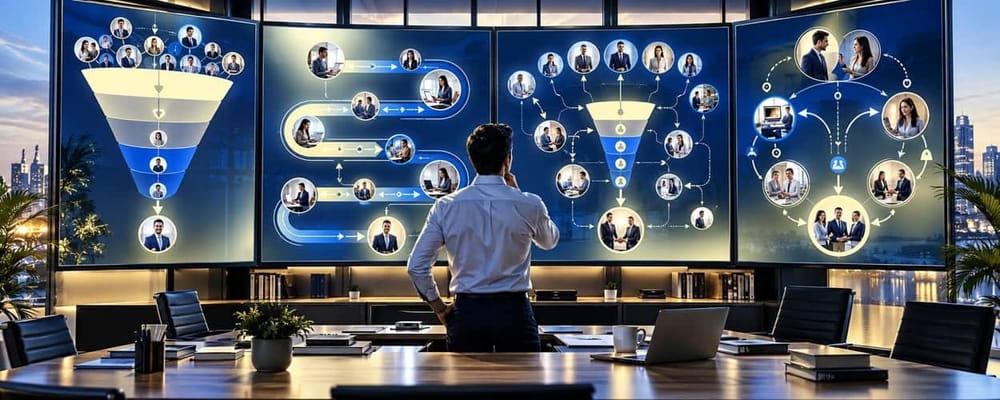
A single sales funnel model does not fit every offer. High-ticket consulting, recurring retainers, and low-ticket courses each require different emphasis across stages. Your sales funnel depends on deal size, buyer complexity, and how much selling motion each offer requires.
3-stage funnel (Awareness, Consideration, Decision). Best for short sales cycles and low-ticket offers like a €997 mini-course. A coach running Meta Ads to a checkout page with a short email nurture in between is using this model. Fewer touchpoints, faster revenue, lower per-deal value.
7-stage customer lifecycle funnel (Awareness, Interest, Evaluation, Decision, Onboarding, Retention, Expansion). Built for subscription or retainer services. An agency selling a €5,000/month retainer needs onboarding systems, quarterly reviews, and expansion pathways. Customer relationship management tools track each stage and flag churn risks. This model maps the full sales funnel process from first ad click to multi-year retention.
4-stage model (Attract, Convert, Close, Delight). Focused on post-sale advocacy. A consultant offering bespoke strategy work uses content and SEO for lead generation to attract, lead magnets and calls to convert, personalized proposals to close, and VIP communities plus referral programs to delight. Satisfied customers become future prospects through word-of-mouth.
Why a Sales Funnel Is Critical for B2B Sales and Service Businesses
Visibility Into Where Prospects Leak Out
Sales funnels help identify drop-off points in customer journeys. Without a mapped funnel, you cannot tell whether 60% of webinar attendees fail to book a call because of weak follow-up emails or because the offer does not match their pain points. Tracking conversion rates reveals sales funnel effectiveness at each stage.
Benchmark data from 2026 show typical B2B visitor-to-lead conversion at 1.5 to 3%, lead-to-MQL at 25 to 35%, MQL-to-SQL at 13 to 40%, and opportunity-to-close at 20 to 30%. If any single stage underperforms, the compound effect on revenue is severe.
Marketing and Sales Alignment
A shared funnel map coordinates marketing campaigns, ad spend, sales scripts, and follow-up cadences. When both your marketing efforts and sales efforts operate from the same model, marketing and sales efforts stop duplicating work or blaming each other for pipeline gaps.
Financial Compound Effect
A coaching business closing 20% of strategy calls generating €10k per client earns €200k from 100 calls. Raising close rate to 28% from the same 100 calls yields €280k, an extra €80k with zero additional ad spend. Optimizing each funnel stage increases conversion rates across the board. Key performance indicators at every stage make these gains visible and repeatable.
Sales funnels provide data-driven insights into customer behavior, and businesses with effective sales funnels see improved customer retention because the system catches churn signals early.

How to Build a Sales Funnel: A 6-Step Blueprint
This is the framework we use in done-for-you builds at Funnel Builders Expert. It works whether you are a solo consultant or a local service company with sales reps across multiple regions.
Step 1: Clarify Your Offer and Price Points
Define your flagship product or service, a downsell (lower commitment path), and an upsell (premium tier). A consultant might offer 1:1 coaching as the core, a group program as the downsell, and done-for-you implementation as the upsell. Your sales funnel strategies start here because price and offer complexity determine how many touchpoints you need.
Step 2: Research Your Target Audience and Create Buyer Personas
Effective sales funnels require clear buyer personas for targeted marketing. Use customer interviews, CRM customer data, and surveys to build profiles. Example personas: "7-figure agency owner who hates tech and wants a done-for-you system" or "busy local tradie in Sydney running 1 to 2 crews, needs more leads through Google Maps." When you create buyer personas grounded in real customer interactions, your targeting sharpens.
Step 3: Map Your Current Customer Journey
List every touchpoint: ads, website pages, DMs, emails, calls, proposals. Assign each to a funnel stage. Most businesses find a gap between lead magnet download and sales call; there is no nurture, no education, no trust-building. That gap is where more prospects go cold.
Step 4: Design Your Funnel Architecture
Choose your funnel type: webinar funnel, VSL funnel, challenge funnel, application funnel, or local lead-gen funnel. Sketch the page sequence: ad to landing page to thank-you page to email nurture to strategy call booking to proposal to purchase.
Step 5: Build Conversion Assets
Create the pieces: an application page collecting qualification info, a thank-you page with a next-step video, a 5-email nurture sequence moving from welcome to case study to teaching to CTA, and a proposal template tailored by persona. Sales funnels enhance targeting of marketing campaigns to buyer personas when every asset speaks to a specific segment.
Step 6: Launch in Phases and Iterate
Start with a minimum viable funnel. Run it for 2 to 4 weeks. Collect data on cost per lead, booking rate, close rate. Find the weakest stage. Fix one variable at a time. Re-measure. The sales funnel steps that matter most are the ones backed by data, not assumptions.

Traffic and Awareness: Filling the Top of Your Funnel with Quality Leads
The awareness stage determines how many qualified leads enter your funnel. With B2B visitor-to-lead rates averaging 1.5 to 3%, improving traffic quality matters more than raw volume. Sales funnels increase qualified traffic and lead conversion rates when you match channels to buyer intent.
Proven channels for coaches and local service businesses:
- Local SEO: Google Business Profile optimization and local landing pages targeting "service + city" keywords pull in high-intent potential buyers who are actively searching.
- Google Ads: Keywords like "business coach for consultants" or "kitchen remodeler in Austin" cost more per click but convert at higher rates because the buyer already has intent.
- Meta Ads: Strong for cold awareness and retargeting. Best paired with a lead magnet and email nurture, not a direct sales pitch.
- LinkedIn: Ideal for high-ticket B2B offers and expert services where target customers are active professionals.
- Social media platforms and social media posts build authority over time; social media marketing works best as a support channel, not a primary lead source for most B2B service businesses.
Track every source into your CRM. Referral sources convert at 30 to 40%, inbound content at 15 to 25%, outbound at 5 to 15%. If you cannot map source to closed deal, you cannot judge channel ROI.
A simple starter campaign: run a Meta Ad promoting a lead magnet PDF, retarget downloaders with a case study ad, and nurture by email toward a strategy call booking. That is lead generation feeding a complete funnel.

Middle of the Funnel: Nurturing, Education, and Trust-Building
Mid-funnel is the space between lead capture and sales conversation. Prospects are problem-aware but not yet ready to buy. This is where most sales funnels either build enough trust to convert or lose the lead to silence.
Educational content types that work here: case studies with specific numbers ("How we added 73 booked calls in 90 days for a local service business"), comparison guides ("Done-for-you vs. DIY funnel building"), and FAQ videos addressing cost and time objections. Personalized content increases engagement and conversion rates because prospects see their own situation reflected.
Email Nurturing Sequences
Email marketing nurtures leads through the sales funnel stages. Targeted email campaigns guide prospects through the interest stage with a sequence like this:
- Day 0: Welcome email confirming opt-in, setting expectations
- Day 2: Case study showing results for a similar business
- Day 4: Educational piece teaching one concept they can apply immediately
- Day 7: Objection-handling email (cost, time, "too techy")
- Day 10: CTA to book a strategy call or attend a live session
Combine email with retargeting ads and SMS reminders for time-sensitive events. Integrating sales funnels with CRM systems enhances customer insights by scoring leads based on email opens, link clicks, and page visits. When a lead hits a threshold, your sales team gets a notification at just the right time.

Bottom of the Funnel: Converting Interested Leads into Clients
Bottom-of-funnel prospects are in the decision stage. They have consumed your content, read your case studies, and compared you against alternatives. They need clarity, not pressure.
Conversion mechanisms: application funnels (pre-qualify before the call), strategy or diagnostic calls, conversion-focused webinars with limited seats, and live demos. Use calendar tools with integrated email and SMS reminders to reduce no-shows.
Structuring a high-converting sales call: open with discovery (current situation, goals, challenges), diagnose the core problem, present a roadmap, frame ROI with numbers from customer feedback and past results, address objections, and close with clear next steps. This sales process builds trust because it mirrors consulting, not hard selling.
Offers aligned with value: implementation bonuses, payment plans, fast-start onboarding sessions. Avoid random discounts that cheapen your brand. Remove friction with short application forms, mobile-friendly checkouts, and clear pricing pages.
Mini example: Ad → Lead magnet PDF → 5-email nurture → Application form → Strategy call → Signed €5k/month consulting agreement. From 500 visitors: 15 downloads (3%), 5 applications, 3 calls, 1 closed client. That single client funds the next month's ad spend and then some.

Retention, Upsells, and Customer Loyalty: The Hidden Half of Your Funnel
For most expert and local service businesses, the highest ROI comes after the first sale. Acquiring a new client costs 5 to 7 times more than retaining an existing one. Most sales funnels stop at the sale; a successful sales funnel keeps going.
Retention system: onboarding sequence in the first 7 days, success milestones at 30, 60, and 90 days, quarterly business reviews to reinforce value and surface new needs. Regular communication improves customer retention rates and prevents silent churn.
Upsell and cross-sell opportunities: move 1:1 coaching clients into group programs, sell advanced implementation projects, or add recurring maintenance packages. Upselling and cross-selling enhance customer lifetime value and improve customer retention without increasing acquisition costs. Existing customers who see results become your best sales resources through referrals.
Customer loyalty tactics: referral programs with clear incentives, VIP client communities, and invite-only Q&A sessions. Customer engagement stays high when clients feel they belong to something beyond a transaction. Excellent customer service at every touchpoint turns satisfied customers into advocates.
Build retention and expansion as explicit stages in your funnel diagrams. They are not afterthoughts; they are where sales success compounds.

Sales Funnel Metrics, KPIs, and Optimization Cycles
Sales funnels optimize marketing strategies based on customer behavior data. But only if you measure the right things. Regularly refining sales funnels based on data improves performance; guessing does not.
KPIs by Funnel Stage
Funnel Stage
Key Metric
Target Benchmark
Awareness
Cost per lead (CPL)
Varies by channel
Interest
Lead-to-appointment rate
10–20%
Consideration
Call show-up rate
60–80%
Decision
Proposal-to-close rate
20–30% (top quartile: 35–45%)
Post-purchase
90-day retention rate
85%+
Tracking conversion rates at each stage reveals exactly where your funnel leaks. Sales velocity, the speed at which qualified prospects move through the funnel, is another metric that tells you whether your sales cycle length is competitive.
Monthly Optimization Rhythm
- Pull stage-by-stage data from your CRM and ad dashboards
- Identify the single biggest bottleneck (e.g., low booked-call rate)
- Brainstorm 2 to 3 fixes (new headline, different CTA, revised email)
- A/B test one variable for 2 weeks
- Measure results. Keep the winner. Move to the next bottleneck.
Use A/B testing on landing page headlines, email subject lines, and CTAs. CRM reports visualize where qualified prospects stall. This rhythm turns your funnel from a static artifact into a living system.

Tools and Automation to Scale Your Sales Funnel
Manual funnel management breaks at scale. Sales reps miss follow-ups, messaging drifts, and response times slow down. Marketing automation solves these problems by handling repetitive tasks with consistent execution.
Must-Have Tools
- CRM system (HubSpot, Pipedrive, or similar) for tracking customer behaviors, customer preferences, and deal stages
- Funnel builder or website CMS for landing pages and checkout flows
- Email marketing automation workflow platform for nurture sequences and behavioral triggers
- Calendar scheduling tool with automated reminders
Practical Automation Examples
- Instant lead response email within 2 minutes of form fill
- SMS reminders 24 hours and 1 hour before booked appointments
- Reactivation sequences for leads who went cold after 30 days
- Review request automation 7 days after service delivery
Sales funnels provide the logic; automation provides the scale. Integrating your funnel with a CRM lets you score leads, flag at-risk clients, and trigger personalized follow-ups based on customer data and engagement patterns.
At Funnel Builders Expert, we architect and implement this full stack so busy coaches, consultants, and local service businesses can focus on delivery instead of managing tech.

Common Sales Funnel Mistakes (and How to Fix Them)
Here are the errors we see most often across B2B service businesses:
- Running ads before offer clarity. A coach spends €3,000 on Meta Ads pointing to a homepage with no lead magnet or clear CTA. Fix: define your core offer first, build a dedicated landing page that matches the ad's promise.
- No mid-funnel nurturing. Leads download a PDF and hear nothing until a sales call invite 10 days later. Fix: deploy a 5-email nurture sequence with case studies and educational content addressing pain points.
- Overcomplicated funnels for simple offers. Building a full webinar plus tripwire plus upsell architecture for a €97 product. Fix: use a direct checkout with a simple thank-you page. Match funnel complexity to deal size.
- Ignoring existing customers. No retention system, no referral ask, no upsell pathway. Fix: add onboarding, check-ins, and expansion stages. The hidden half of your funnel is often the most profitable.
- No tracking of basic metrics. Flying blind on visitor-to-lead rate, close rate, or which marketing activities drive actual revenue. Fix: set up a dashboard with stage-by-stage conversion rates and review it monthly.
- Technical friction. Slow load times, forms with 12 fields, proposals that take a week to send. Fix: simplify forms, optimize mobile UX, use proposal templates, and speed up follow-up.
Start with a linear path (ad to opt-in to nurture to call) and prove it works before adding branches, segmentations, or advanced automation. A sales funnel template that is simple and functional beats a complex one that never launches.

Putting It All Together: Building a Sales Funnel That Runs (Almost) on Autopilot
An effective sales funnel combines awareness, nurture, conversion, and retention into one system that attracts, qualifies, converts, and retains clients. Sales funnels visualize the customer journey from awareness to purchase and beyond, turning scattered marketing campaigns into a coordinated engine.
A funnel is a living system, not a one-time project. Quarterly reviews of funnel metrics, updated case studies, and revised automation triggers keep your sales funnel understanding current as customer behaviors and market conditions shift.
First 30 Days Roadmap
- Week 1: Map your current customer journey. Clarify your offer. Choose a funnel model (3-stage, 4-stage, or 7-stage) based on your deal size and business to business sales cycle.
- Week 2: Build or revise your landing page, lead magnet, email nurture sequence, and proposal template. Write copy that speaks to your buyer personas.
- Week 3: Set up traffic sources (Google Ads, Meta, Local SEO, LinkedIn). Install tracking. Connect your CRM.
- Week 4: Launch. Collect data. Identify the weakest stage. Run your first optimization.
The sales process does not need to be perfect on day one. It needs to be live, measured, and improved one stage at a time.
If you want a done-for-you, high-converting client acquisition system tailored to your market and your target customers, book a strategy session or funnel audit with the Funnel Builders Expert team. We handle the architecture, automation, and optimization so you can focus on delivering your product or service and serving your clients.
Website
Ecommerce Website
Blog Website
Website Design
Web Management
WordPress Website
SEO - AIO
AI Optimization
Local SEO
On-Off Page
SEO Audits
Technical SEO
Paid Advertising
Display Ads
Meta Ads
Google Ads
Linkedin Ads
TikTok Ads
CRM Automation
CRM Setup
Email Marketing
Lead Management
Pipeline Automation
SMS Marketing
Disclaimer: This site is not affiliated with or endorsed by Google or Meta™. All content is for educational purposes only and does not guarantee results or earnings. Your success depends on your own efforts, experience, and circumstances. Financial examples are illustrative, not promises. Always seek professional advice before making business or financial decisions. By using this site, you agree we are not liable for outcomes based on this information.
2026 © Funnels Builders Expert, a Sydney Website Design Agency product - Privacy Policy - Terms & Conditions