
Marketing Funnels: A Practical Guide to Full-Funnel Growth for Coaches and Service Businesses
Most coaches and service businesses have traffic. What they lack is a system that turns that traffic into booked calls, paying clients, and long-term revenue. That system is a marketing funnel. This guide breaks down what marketing funnels are, how they work stage by stage, the metrics that matter, and how to build one that actually scales your business.

What Is a Marketing Funnel?
A marketing funnel is a visual model of the customer journey from first discovering your brand to becoming a loyal, repeat buyer. The marketing funnel concept describes how a broad audience of strangers gets filtered down through stages of engagement until a smaller group takes action and becomes paying customers.
Here is what you need to know at a high level:
- A marketing funnel visually represents the customer journey, mapping every touchpoint between "who are you?" and "take my money."
- The basic marketing funnel stages include the awareness stage, the consideration stage, conversion, and retention. Marketing funnels typically include awareness, consideration, and conversion stages at minimum.
- The funnel often simplifies a messy and non-linear customer journey. In reality, prospects loop back, skip stages, and re-enter at different points. But the model still gives you a framework to diagnose problems and optimize.
- Funnels align marketing messages with the buyer's psychological state at each stage, so you deliver the right message at the right time.Marketing funnels help optimize marketing strategies and improve ROI by showing you exactly where potential customers drop off.
Example for coaches: A prospective customer sees your short video on social media (awareness stage), downloads your free guide (interest stage), watches your webinar (consideration stage), books a discovery call (intent), and enrolls in your program (conversion). That entire customer journey is your funnel.
Simple TOFU–MOFU–BOFU map:
TOFU (Top of Funnel) → Awareness & Interest MOFU (Middle of Funnel) → Consideration & Intent BOFU (Bottom of Funnel) → Decision & Conversion → Retention & Advocacy

Marketing Funnel vs Sales Funnel vs Content Marketing Funnel
The best funnel builder isn't the one with the prettiest templates or the longest feature list. It's the one that supports a complete, measurable client acquisition system-connecting traffic, landing pages, lead capture, automation, and CRM into a machine that reliably generates more leads and turns them into customers.
- Marketing funnel: The end-to-end system covering demand generation, lead nurture, conversion, customer retention, and advocacy. It spans all digital channels, all marketing efforts, and all teams.
- Sales funnel: A narrower view focused on the middle of the funnel through the bottom of the funnel. It tracks sales qualified leads through discovery calls, proposals, objection handling, and closing. Owned by your sales process or, for many coaches, by you personally.
- Content marketing funnel: A subset that maps specific content formats to each funnel stage. Social media posts and blog articles at the top, case studies and webinars in the middle, VSLs and sales pages at the bottom.
How a coaching business uses all three together:
- Content marketing funnel produces educational content (blog posts, free challenges) that attracts a broad audience at the top.
- These feed into the sales funnel: qualified leads enter sales consultations, review your offer, and close.
- The overarching marketing funnel connects everything, including retention workflows and referral programs that feed new awareness.
At Funnel Builders Expert, we integrate all three into one full funnel strategy rather than treating awareness, sales, and content as separate silos.

The Evolution of the Marketing Funnel (From AIDA to Full Funnel)
The marketing funnel concept is over a century old, but it has evolved dramatically.
- 1898 – AIDA is born. The original model, often attributed to E. St. Elmo Lewis, proposed four stages: Attention, Interest, Desire, Action. It was designed for print advertising and face-to-face selling.
- 1924 – The funnel shape appears. William W. Townsend applied a funnel metaphor to the sales process in his book Bond Salesmanship, visualizing how many prospects enter and few exit as buyers.
- 1960s–2000s – Hierarchy of effects. Models added stages like knowledge, liking, and conviction. Digital marketing made each stage measurable with web analytics and tracking pixels.
- 2010s–present – Full funnel marketing. Modern funnels may add advocacy to the traditional stages to encourage customer referrals. Retention and loyalty became recognized as revenue drivers, not afterthoughts. The "messy middle" was acknowledged: prospects consume content non-linearly across digital channels, making full funnel thinking essential.
For online coaches and local service businesses today, advocacy through customer testimonials, reviews, and referrals often drives a significant share of new leads back into the awareness stage.

Core Types of Marketing Funnels
Not every business needs the same funnel model. Here are the three most common:
- Basic marketing funnel (3-stage): Awareness → Consideration → Conversion. Best for coaches just starting at around €10k/month who need clarity on their core client journey: one lead magnet, one discovery call, one offer.
- AIDA funnel (4–5 stages): Attention → Interest → Desire → Action (+ Satisfaction). Adds emotional triggers and post-purchase follow-up. Useful when you want to layer in more targeted advertising and nurture sequences.
- Granular / multi-stage funnel (6–7+ stages): Includes intent, evaluation, retention, and advocacy as distinct phases. Necessary when ad spend grows, you run multiple offers (low-ticket, mid-ticket, high-ticket), and you need to diagnose leaks at specific points.
Which model fits your business?
Business Type
Recommended Funnel
Why
B2C (fitness coach, low-ticket)
Basic or AIDA
Shorter buying cycle, emotional decisions
B2C (fitness coach, low-ticket)
Granular / multi-stage
Long evaluation, multiple decision-makers
Hybrid (online coach, high-ticket)
AIDA or granular
B2B-level consideration with B2C-level emotion

Digital, Full-Funnel & Content Marketing Funnels
A digital marketing funnel tracks prospect activity across every online touchpoint: search engines, paid ads, social media, email, and your website. Digital marketing funnels provide measurable data at every stage, which is what makes them so powerful compared to traditional models.
A full funnel marketing strategy means aligning brand awareness, demand generation, conversion, and retention into one coordinated system instead of running isolated campaigns.
Here is how content marketing maps to each stage:
- TOFU content: Blog posts optimized for SEO for lead generation, online video (YouTube tips, Reels), how-to guides, social media posts. Goal: increase brand awareness and attract valuable audiences.
- MOFU content: Webinars, case studies, product comparison guides, email sequences with valuable content. Goal: nurture the interest and consideration stages.
- BOFU content: Sales pages, VSLs, pricing breakdowns, success stories, limited-time offers. Goal: maximize conversions.
Funnel Builders Expert builds full funnel marketing systems that stitch together Local SEO, Google Ads, Meta Ads, email automation, and CRM workflows into a single client acquisition engine.

B2B vs B2C Funnels (and Where Coaches & Local Services Fit)
Understanding where your business sits on the B2B–B2C spectrum directly affects how you design your funnel.
- B2B funnels: Longer sales cycles (weeks to months), multiple decision-makers, heavy emphasis on ROI data and case studies. Converting leads requires more touchpoints and relevant content in the middle of the funnel.
- B2C funnels: Shorter cycles (hours to days), single buyer, emotional triggers, lower price points. Social media engagement and digital advertising drive volume at the top.
- Hybrid (coaches, consultants, local services): This is where most of our clients sit. You sell to individuals, but your price points (€3,000–€15,000+) demand B2B-level trust-building. Prospective customers need social proof, case studies, and often multiple touchpoints before committing.
Two concrete examples:
- A consultant selling a €6,000 group program: the buyer attends a webinar, reviews customer testimonials, compares alternatives, then books a call. This mirrors B2B evaluation with B2C speed.
- A home-improvement contractor quoting a $15,000 project: the buyer finds them through Local SEO, checks reviews, views a portfolio funnel similar to what pool builders use, requests a quote, and decides based on trust and reputation.

The 6–7 Key Stages of a Modern Marketing Funnel
The marketing funnel includes six stages: awareness, interest, consideration, intent, action, and purchase. Many modern frameworks add a seventh: advocacy.
Here is what each marketing funnel stage covers:
- Awareness: Awareness is the top stage where potential customers first discover a brand. The primary goal of the awareness stage is to build brand recognition. In the awareness stage, prospects first learn about a brand or product.
- Interest: Prospects actively seek information. They follow you, read your content, engage with social media posts. This is the interest stage where further engagement begins.
- Consideration: Consideration is the middle stage where prospects evaluate different solutions. They compare your offer against competitors, review case studies, and weigh pricing.
- Intent: The prospect signals readiness: registering for a webinar, requesting a quote, adding to cart. The intent stage significantly increases the likelihood of converting leads.
- Action: The action stage involves finalizing the decision to purchase. This is where sales consultations, proposals, and contracts happen.
- Purchase: Decision is the bottom stage where prospects make their final choice to purchase. A smooth checkout process helps convert leads into paying customers during the decision stage.
- Retention & Advocacy: Existing customers stay engaged, make repeat purchases, and become brand advocates who refer others, feeding the top of the funnel with new awareness.
These stages map neatly to TOFU (awareness, interest), MOFU (consideration, intent), and BOFU (action, purchase, early retention). Customer retention and loyalty sit at the bottom but fuel the top through referrals and social proof.
Example journey: Someone downloads your free e-book on business growth (awareness/interest), joins a live webinar and reviews your case studies (consideration/intent), books a discovery call and enrolls in your 12-month group program (action/purchase), stays engaged, sees results, and refers three colleagues (retention/advocacy).

Stage-by-Stage Strategies: Top, Middle, and Bottom of the Funnel
TOFU, MOFU, and BOFU are the three operational layers marketing teams use daily. Only about 5% of buyers are "in-market" at any given time, which is why your entire funnel needs to work together to capture demand at every stage.
Top of the Funnel (TOFU) - Awareness
- Brands use SEO and social media to increase awareness of their products. Invest in blog content, short-form video, and social media engagement to reach a broad audience.
- Run cold ads on Meta or Google to increase brand awareness among your target audience.
- Create educational content like how-to guides and tips videos that solve real problems without asking for anything in return.
- Goal: attract attention, encourage shoppers to explore, and build a list of potential customers.
Middle of the Funnel (MOFU) - Nurture
- Nurturing strategies include offering valuable resources and building trust during consideration. Use email sequences, webinars, and retargeting ads to keep prospects engaged.
- Product comparison guides are effective during the consideration stage. Create content that helps prospects evaluate your offer versus alternatives.
- Content should match customer intent throughout each stage of the funnel. At this stage, that means addressing objections and demonstrating credibility.
- Provide ongoing engagement through case studies, success stories, and community building efforts.
Bottom of the Funnel (BOFU) - Convert
- Access to reduce risk.
- Use Dynamic Product Ads to streamline the purchase process for e-commerce or digital product offers.
- Deploy limited-time incentives, payment plans, and risk reversal (guarantees) to encourage action.
- A smooth checkout or enrollment process matters: remove friction, simplify forms, confirm next steps immediately.
Mini funnel example for a coach: Free challenge (TOFU) → automated email sequence with case studies (MOFU) → discovery call with marketing automation workflow handling scheduling and reminders (BOFU) → enrollment in high-ticket program.

Funnel Metrics & KPIs to Track at Every Stage
You cannot optimize what you do not measure. Marketing funnel metrics exist to diagnose leaks, improve campaign performance, and forecast revenue. Tracking conversion rates helps identify drop-off points in the funnel, and monitoring drop-off rates between funnel stages is vital for identifying bottlenecks in customer experience.
A well-optimized funnel can achieve 45% higher ROI, yet only 28% of marketers find their funnel strategies very successful. Here are the categories to track:
Metric Category
Funnel Stage
Key KPIs
Traffic metrics
TOFU
Impressions, reach, clicks, bounce rate. Traffic metrics measure the number of prospects at the top of the funnel.
Engagement metrics
TOFU/MOFU
Email open rates, social media engagement, content downloads, webinar attendance. Engagement metrics assess audience interaction with content at any funnel stage.
Lead generation
MOFU
Cost per lead (CPL), lead volume, MQL-to-SQL conversion rate
Conversion metrics
BOFU
SQL-to-close rate, ROAS, ad spend efficiency, average deal size. Conversion rate measures the percentage of leads that become customers.
Retention metrics
Post-purchase
Churn rate, repeat purchase rate, referral rate, NPS. Retention metrics track how well a business retains its customers post-purchase. Customer lifetime value indicates the total revenue from a customer over time.
Benchmarks worth knowing: Visitor-to-lead conversion averages 1.5–2.5% for B2B, with top performers hitting 8–15%. BOFU SQL-to-customer conversion often lands around 20–25%. For local service businesses, customer churn runs at 60–65% after the first or second visit, making retention a critical lever.
A full funnel marketing strategy links these metrics into one dashboard view so you see marketing performance across the entire funnel, not isolated campaigns.

Full-Funnel Marketing Strategy for Coaches & Local Service Businesses
For a coach or service provider at €10,000+/month aiming to scale, a full funnel strategy connects every channel to a single system.
Here is what that looks like in practice:
- TOFU channels: Local SEO and content marketing for organic visibility, Meta Ads for cold traffic, social media posts and online video for reach.
- MOFU systems: Retargeting ads, automated email sequences with lead scoring, webinars and case studies that gather data on prospect behavior.
- BOFU process: Sales calls or automated enrollment, VSLs, payment processing, CRM follow-up for unconverted leads.
- Retention layer: Onboarding sequences, progress check-ins, community access, referral programs.
Using marketing automation can improve lead tracking and engagement across every layer. Marketing automation helps efficiently generate viable leads and track engagement without drowning in manual tasks. 28% of marketers find their automation strategies very successful, and the rest are often underusing the tools available. Automated tools allow data-driven decisions without information overload.
Using automation, businesses can personalize each step of the customer journey, from the first ad click to the renewal reminder. Funnel automation helps to nurture leads efficiently without manual intervention.
Sample 90-day implementation roadmap:
- Weeks 1–2: Define your ideal client profile, audit your current funnel, and clarify your BOFU offer.
- Weeks 3–4: Set up tracking (analytics, CRM, UTMs), install pixels, connect offline and online data.
- Month 2: Deploy TOFU content and ads, build your email list via lead magnets, test MOFU assets (webinars, case studies).
- Month 3: Refine BOFU conversion assets, begin optimization based on funnel metrics, launch retention workflows.

Customer Retention, Loyalty, and Advocacy at the Bottom of the Funnel
The bottom of the funnel does not end at purchase. Retention and advocacy occur post-purchase and aim to keep customers engaged and loyal. Retention strategies are crucial after the purchase stage to maintain customer loyalty.
Retaining existing customers costs far less than acquiring new ones. For local service businesses, where 60–65% of clients do not return after their first or second visit, improving customer retention directly increases customer lifetime value. Marketing automation can increase customer lifetime value through re-engagement campaigns.
Concrete retention marketing tactics:
- Onboarding sequences: Retention strategies include onboarding, customer education, and ongoing support post-purchase. Welcome emails, expectation-setting, and quick-win resources reduce early churn.
- Progress check-ins: Scheduled touchpoints (automated or manual) to ensure customer satisfaction and catch issues before they cause drop-off.
- Loyalty programs: Loyalty programs increase customer lifetime value and encourage referrals. Offer discounts on future purchases, exclusive content, or priority access.
- Community building efforts: Private groups, Slack channels, or membership communities strengthen customer relationships and create long term relationships.
- Referral programs: Turn loyal customers into brand advocates by incentivizing referrals. These feed directly into the awareness stage, creating a self-reinforcing loop.
Human outreach to lapsed clients can bring 25–40% of them back. Automated emails alone recover just 1–3%. Timing matters: once a client lapses past three weeks, return probability drops sharply.
Common Funnel Mistakes (and How to Fix the Leaks)
Here are the most frequent errors we see, along with their symptoms and fixes:
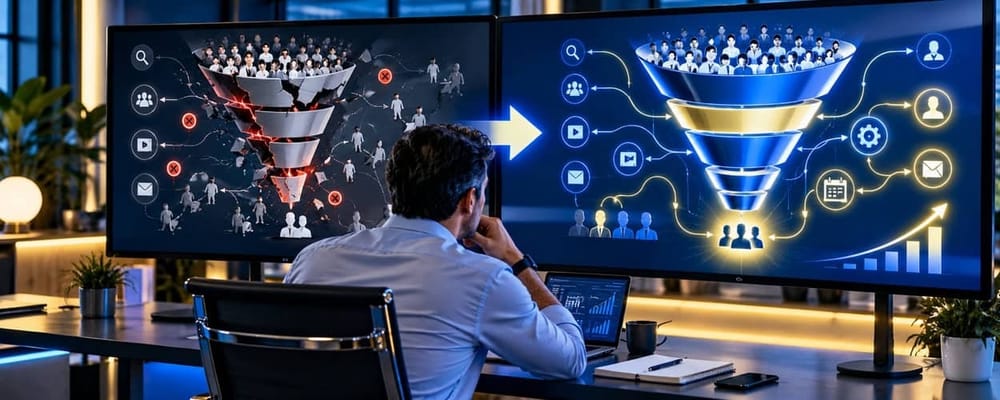
- Mistake: Over-focusing on TOFU without nurturing MOFU/BOFU. Symptom: High traffic, low leads, wasted ad spend. Fix: Shift budget toward retargeting, email sequences, and case studies that move people through the interest and consideration stages.
- Mistake: Weak lead qualification. Symptom: Many leads but few sales qualified leads; sales consultations feel unproductive. Fix: Add qualifying questions to intake forms, implement lead scoring, and use automation workflows to filter before booking calls.
- Mistake: No nurture between opt-in and pitch. Symptom: People download your lead magnet then ghost. BOFU conversion craters. Fix: Build a 5–7 email sequence with valuable content, social proof, and soft CTAs before presenting your offer.
- Mistake: Poor offer–audience fit. Symptom: Qualified leads reject your offer or object on price. Fix: Revisit your ideal client profile, refine marketing messages, adjust packaging or risk reversal.
- Mistake: Ignoring retention. Symptom: High churn, low referrals, constant pressure to find new leads. Fix: Build onboarding, loyalty, and referral programs. Measure customer satisfaction and repeat purchases.
- Mistake: Not tracking funnel metrics. Symptom: No visibility into where prospects drop off; unable to improve campaign performance. Fix: Build a dashboard covering each funnel stage with clear KPIs. Review monthly. Make data driven decisions.

Building and Optimizing Your Own Marketing Funnel
Here is a step-by-step process to build your funnel from scratch:
- Define your ideal client. Be specific about demographics, pain points, budget, and buying behavior of your target audience.
- Map the entire customer journey. Outline every touchpoint from first contact to purchase and beyond.
- Choose your funnel model. Start with a basic marketing funnel if you are early-stage. Layer sophistication as you scale.
- Select channels. Pick 2–3 digital channels where your valuable audiences actually spend time. Do not spread yourself thin.
- Build assets. Landing pages, lead magnets, email sequences, sales pages, onboarding materials. Content should match customer intent throughout each stage of the funnel.
- Connect your tech stack. CRM, email platform, ad accounts, analytics. Ensure everything talks to each other.
- Launch and measure. Track your marketing funnel metrics from day one. Gather data before making big changes.
- Optimize monthly. Review drop-off rates, test new marketing tactics, refine your messaging, and adjust budgets based on what the numbers tell you.
Start lean. A basic three-stage funnel that converts is worth more than a complex system that sits half-built. You can always add targeted advertising, segmentation, and advanced automation later.
Understanding what a funnel builder does can help you decide whether to build in-house or work with a specialist who shortcuts the learning curve on tech, media buying, and marketing strategy.

How Funnel Builders Expert Helps You Implement Full-Funnel Systems
Funnel Builders Expert is a B2B services agency specializing in done-for-you marketing funnels and complete client acquisition systems for coaches, consultants, course creators, and local service businesses.
Here is what our team builds and manages:
- Conversion-focused websites and sales funnels designed to turn traffic into booked calls and paying customers.
- Local SEO and Google Business Profile optimization for local service visibility, similar to what we build for flooring companies and other trades.
- Google Ads and Meta Ads management with full-funnel campaign structures that align ad spend to every stage of the marketing funnel.
- CRM setups and marketing automation that handle lead scoring, follow-up, onboarding, and re-engagement without manual work.
- Retention and referral systems that turn existing customers into loyal customers and brand advocates.
Our global-local model places certified funnel builders across the US, Canada, UK, Australia, and New Zealand so you get someone who understands your local market, your customers, and your competitive landscape.
Our ideal client: Online coaches, consultants, or course creators with validated offers and monthly revenue of €10,000+ who want to automate lead flow and scale without handling all the technical, ad, and marketing operations themselves.
Your next step: Schedule a strategy call or funnel audit to map out a tailored full funnel marketing plan for your business. No fluff. Just a system designed to generate business growth, predictable lead flow, and scalable success.

Website
Ecommerce Website
Blog Website
Website Design
Web Management
WordPress Website
SEO - AIO
AI Optimization
Local SEO
On-Off Page
SEO Audits
Technical SEO
Paid Advertising
Display Ads
Meta Ads
Google Ads
Linkedin Ads
TikTok Ads
CRM Automation
CRM Setup
Email Marketing
Lead Management
Pipeline Automation
SMS Marketing
Disclaimer: This site is not affiliated with or endorsed by Google or Meta™. All content is for educational purposes only and does not guarantee results or earnings. Your success depends on your own efforts, experience, and circumstances. Financial examples are illustrative, not promises. Always seek professional advice before making business or financial decisions. By using this site, you agree we are not liable for outcomes based on this information.
2026 © Funnels Builders Expert, a Sydney Website Design Agency product - Privacy Policy - Terms & Conditions