Website Sales Funnel: How to Turn Your Website Into a 24/7 Client Acquisition System
Most websites sit there looking pretty and doing nothing. They get traffic, maybe a few "contact us" form fills, and the owner wonders why revenue isn't growing. The problem isn't the design. It's the lack of a structured website sales funnel that takes visitors from stranger to paying client without you being glued to your inbox.
This guide walks you through exactly how to build a website that works as a full client acquisition system-from mapping funnel stages and designing conversion-focused pages to scoring leads, automating follow-up, and optimizing every step based on real data.
Key Takeaways
A website sales funnel is a structured path that turns cold visitors into qualified leads, booked calls, and paying customers. Unlike a static brochure site with scattered links and vague calls to action, a funnel-driven website guides every visitor through a deliberate sequence-awareness, interest, evaluation, decision, and post-purchase retention-with each page serving a single, measurable purpose. Sales funnels with clear stages improve conversion rates by 300%, making the architecture of your site one of the highest-leverage investments you can make.
For coaches, consultants, and course creators already generating $10,000+/month, the shift from a "pretty but passive" site to a conversion-focused funnel unlocks scalable growth. Instead of relying solely on referrals or one-to-one outreach, a well defined sales funnel lets you attract, qualify, and convert prospects at scale. Funnels can also reduce customer acquisition costs by 30%, freeing up budget for growth instead of chasing cold leads manually.
A high-converting landing page, strategically positioned lead magnet, automated email nurture sequence, and integrated booking system work together to increase conversion rates and customer retention across the entire customer lifecycle. When every piece is aligned, the compounding effect on revenue is significant.
Funnel Builders Expert designs done-for-you, automated website funnels that combine paid ads, Local SEO, and marketing automation to generate qualified leads consistently for coaches, consultants, and local service businesses. This article gives you the step-by-step blueprint: mapping funnel stages, designing pages, scoring leads, and optimizing based on customer feedback and analytics.
What Is a Website Sales Funnel?
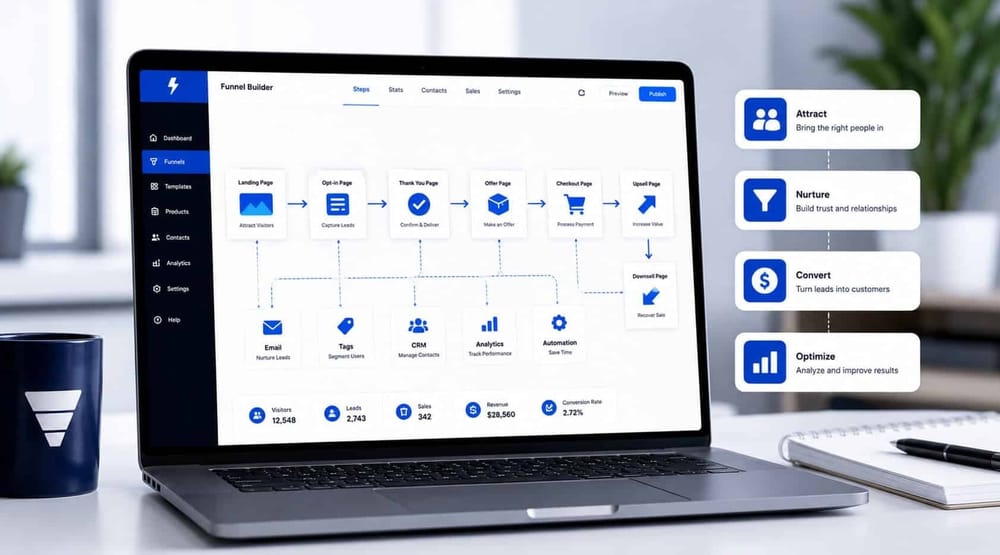
A website sales funnel is the end-to-end path a visitor takes on your site-from the first click at the awareness stage, through the interest stage and evaluation, all the way to the final purchase and post-purchase retention. A sales funnel represents the customer journey from awareness to purchase, and every step in between is intentional.
The four core stages of a sales funnel are Awareness, Interest, Decision, and Action. More detailed models expand this to six stages: awareness, interest, decision, intent, evaluation, and action. Regardless of how granular you get, the principle is the same-each page on your website should correspond to a specific funnel stage with one primary CTA.
This is what separates a funnel-driven site from a traditional sales funnel approach like a brochure website. A brochure site scatters information across pages with vague navigation and generic "Contact Us" buttons. A funnel-driven site captures qualified leads through targeted landing pages, forms, and lead magnets, then nurtures them through email, retargeting, and marketing automation until they book or buy.
Here’s one of the simplest sales funnel examples for a coach:
- Facebook ad drives traffic to a webinar registration landing page
- Thank-you page confirms registration and sets expectations
- Email nurture sequence delivers authority content and case studies
- Strategy call booking page presents the offer with social proof
- Onboarding page welcomes new clients into the program
Every page has one job. Every transition is tracked. That's how a basic sales funnel becomes a revenue engine.
Why Coaches and Consultants Need a Website Sales Funnel in 2026
Buying behavior has changed dramatically. According to 6sense's 2025 Buyer Experience Report, B2B buying cycles have shrunk from approximately 11.3 months to 10.1 months, and buyers are selecting likely vendors earlier in the process-before they ever speak to a sales rep. Meanwhile, Gartner reports that 61% of B2B buyers prefer a rep-free buying experience for much of their journey.
B2B sales funnels involve multiple stakeholders in decision-making, and B2B sales require extensive research and evaluation before purchase. B2B content is often data-driven and focused on business outcomes. By contrast, B2C sales funnels typically have shorter sales cycles than B2B, and B2C funnels prioritize emotional connections and personal benefits. B2C sales often rely on impulse buying and brand loyalty. Whether you're selling coaching, consulting, or local services, your website must meet buyers where they are-doing their own research.
High-ticket online coaches and consultants often waste traffic on homepages with multiple links, dropdown menus, and competing CTAs instead of a focused funnel that qualifies prospective customers and drives booked calls. A website sales funnel supports one-to-many client acquisition, allowing experts to scale beyond 1:1 outreach and referrals. If you're interested in effective marketing for coaches, this shift in strategy is foundational.
Funnel Builders Expert sees the best results when a website is treated as the core "hub" of the sales funnel-not just an online business card. When your site is funnel-based, every visitor enters a structured sales process that works 24/7, whether you're on a call, asleep, or on vacation.
Core Stages of a Website Sales Funnel
Understanding what the prospect is thinking at each stage lets you design pages that meet them where they are.
- Awareness stage: "I have a problem, and I'm starting to look for solutions." Awareness is the first stage where potential customers learn about a product or service. Content here educates and attracts.
- Interest stage: "Which options are available, and which are credible?" In the interest stage, prospects engage with educational content to learn more. They're comparing, consuming, and bookmarking.
- Evaluation/Consideration: "Does this provider actually solve my specific problem?" The decision stage involves comparing products and considering pricing and support. Proof and specificity matter most here.
- Decision/Action: "Should I act now, or can I wait?" Intent is shown when prospects request demos or inquiries about products. This is where booking pages, applications, and checkout flows live.
- Post-Purchase/Retention: "Was this worth it? Should I stay or refer others?" Loyalty and retention focus on creating satisfied customers who stay, refer others, and support advocacy, alongside customer satisfaction and upselling opportunities.
Understanding customer behavior at each stage helps improve the sales funnel. Each page type on your website-blog post, landing page, case study, booking page, client portal-should map to a specific funnel stage and KPI.
Translating Funnel Stages Into Website Pages
Here's how each funnel stage maps to actual website assets:
Awareness Stage → SEO blog posts, resource pages, quizzes, social media content. The primary CTA is "Read more" or "Take the quiz." These pages attract potential customers who don't know you yet.
Interest Stage → Opt-in landing pages, lead magnet download pages, webinar registration pages. The CTA is "Download the guide" or "Register for free." Personalized content increases engagement during the interest stage.
Evaluation Stage → Detailed case studies, comparison pages, pricing overviews, video testimonials. The CTA is "Watch the case study" or "See results." This is where customer testimonials and social proof are important for reducing uncertainty among prospective customers.
Decision Stage → Strategy call booking page, application form, checkout page, targeted landing pages. The CTA is "Book a call" or "Apply now." Clear value propositions should be communicated effectively to capture attention at this stage.
Retention/Advocacy Stage → Client portal, onboarding hub, upsell pages, referral program pages. The CTA is "Upgrade your plan" or "Refer a friend."
Confusion happens when a single page tries to serve multiple funnel stages. A homepage that simultaneously pitches a lead magnet, displays pricing, showcases blog posts, and asks visitors to book a call dilutes every conversion metric. The result: lower conversion rates and fewer qualified leads.
Website design impacts the effectiveness of a sales funnel. Start by auditing your current website pages, reviewing sales funnel templates from industry leaders, and assigning each to a funnel stage. You'll quickly see gaps (missing stages) and overlaps (pages trying to do too much).
Planning Your Website Funnel Strategy Before You Design
Before you open a page builder or write a single headline, start with a 1–2 page strategic plan for how you'll build sales funnels around the offer, audience, buying process, and sales pipeline:
- Target audience: Who is your ideal customer? Define your buyer persona with specifics-role, revenue level, pain points, customer preferences, and buying timeline.
- Main offer: What's the core product or service you're selling through this funnel?
- Price points: High-ticket application? Mid-ticket checkout? Free strategy call?
- Primary conversion goal: What's the single most important action a visitor can take?
Define one core funnel per flagship offer. Mixing a low-ticket course, a high-ticket coaching program, and a group mastermind into one funnel path creates chaos. Each offer needs its own funnel architecture with its own metrics, with the best setup being a sales funnel based on clear goals and later refined using conversion rates, customer feedback, and market trends.
At Funnel Builders Expert, the typical mapping process looks like this: awareness → lead magnet → email nurture → sales call or webinar → client onboarding. This gets sketched on a whiteboard or digital tool before any wireframing begins. Understanding what a funnel builder actually does at this stage helps set expectations.
Set clear metrics per funnel stage before you launch:
- Customer acquisition cost
- Close rate
- Call show-up rate
- Webinar or challenge attendance rate
- Landing page opt-in rate target
These benchmarks guide your later optimization and prevent guessing.
Designing a High-Converting Funnel Homepage
For coaches, consultants, and service businesses, the homepage becomes a strategic hub that routes visitors into the right funnel based on their awareness level and intent. It's not a landing page-it's a traffic director.
Hero section: Lead with a focused headline that speaks to your ideal customers' biggest desired outcome. Follow with a proof-driven subheadline (e.g., "Trusted by 200+ coaches to scale past $50K/month") and one dominant CTA-"Watch Free Training" or "Get Your Strategy Call."
Mid-page sections: Include concise authority indicators (client logos, media mentions, short testimonials), a brief "How It Works" section (3 steps), and a funnel-oriented CTA repeated mid-page.
Bottom section: Reinforce the CTA with a final push-FAQ answers, a short founder video, or a bold guarantee statement.
Navigation should be simplified. Limit menu items to 4–5 that correspond to key funnel stages: Results, How It Works, About, Book a Call. A homepage with 12 dropdown menus and a sidebar kills conversion.
Landing Pages: The Entry Point of Your Website Funnel
A landing page in a funnel context is a single-purpose page designed to capture leads or trigger a core action with no distracting links, sidebars, or extra navigation. It has one job.
Critical elements of an effective landing page:
- Headline tied directly to a pain point or desired outcome
- Social proof (testimonials, logos, results)
- Bullet-based benefits (not features)
- Clear form with minimal fields for the funnel stage
- One visible CTA above the fold
Different funnel stages need different landing page types. Many platforms provide sales funnel templates for webinars, lead magnets, and applications, but they still need tailoring to the traffic source and offer. At the awareness stage, you might offer a lead magnet download. At the interest stage, a webinar or challenge registration works well-webinars can convert 20-40% of attendees into leads. At the bottom of the funnel, a strategy call application or high-ticket sales page closes the deal.
Conversion benchmarks vary significantly by traffic temperature. According to Communipass research on coaching sales pages, free webinar registration pages convert 8–14% of cold traffic but 18–28% of warm traffic. High-ticket application pages convert 1–3% of cold traffic and 3–5% of warm. Minimizing checkout friction is crucial for successful online purchases at every level.
Funnel Builders Expert structures landing pages differently depending on the traffic source. Google Ads traffic with high search intent gets direct, offer-focused pages. Meta Ads traffic (colder, earlier in the buying process) gets pages with more education, proof, and authority before the CTA.
Capturing Qualified Leads Instead of Just Contacts
There's a massive difference between raw leads and qualified leads. A raw lead is anyone who fills out a form. A qualified lead matches your ideal customer profile and has the budget, timeline, and problem fit to actually become a paying client. For high-ticket service businesses, this distinction directly impacts revenue and the efficiency of your sales team.
A well-defined sales funnel can increase conversion rates significantly when it filters prospects early. Use these tactics:
- Application-style questions on booking pages (budget range, current revenue, timeline)
- Simple lead scoring based on answers and behavior
- Segmentation buckets: "Ready now," "3–6 months," "Not a fit"
This lets your marketing team tailor follow-up and prevents your sales reps from wasting time on unqualified prospects. Lead scoring helps prioritize high-value leads so your sales pipeline stays clean.
Include at least one qualification question on key bottom-of-funnel forms. For a strong lead acquisition strategy, even one question (like "What's your current monthly revenue?") can filter out poor-fit prospects without significantly lowering opt-in rates.
Lead Magnets That Attract the Right Prospects
Lead magnets are assets offered in exchange for contact details-an email address, phone number, or both. Lead magnets help transition prospects from awareness to interest stages, making them the bridge between anonymous traffic and new leads you can actually nurture. High-value lead magnets are essential for building trust and capturing leads.
Lead magnets like e-books, guides, and checklists can capture contact details effectively. But for coaches and consultants in 2026, the highest-performing formats include:
- Short video trainings (10–15 minutes solving a specific problem)
- Niche scorecards or assessments ("Rate your funnel in 5 minutes")
- Funnel checklists tailored to an industry or business model
- Mini-audits where you review a prospect's current situation
The best lead magnets are tightly aligned with your paid or core offer. If your main product is a high-ticket coaching program on client acquisition, your lead magnet should pre-frame that topic-not something unrelated like "10 Productivity Hacks."
Funnel Builders Expert uses funnel audits and "client acquisition blueprints" as lead magnets for service businesses, ensuring that every download naturally moves the prospect closer to booking a strategy call.
Email Nurture Sequences That Move Prospects Through the Funnel
Email marketing is crucial for nurturing leads through the sales funnel. Once someone opts in, the automated email sequence bridges the gap between first contact and booking a call or buying a program. Nurtured leads make 47% larger purchases than non-nurtured leads, so skipping this step leaves serious revenue on the table.
Here's a proven 5–7 email sequence structure:
- Welcome email – Deliver the lead magnet, set expectations (83% open rate typical for welcome emails)
- Authority story – Share the founder's journey and credibility
- Case study – Show a real client result with specifics
- Education – Teach something valuable related to the core offer
- Objection handling – Address the top 2–3 concerns directly
- Direct CTA – Ask them to book a call, apply, or buy
- Follow-up/urgency – Final push with social proof or deadline
Email content should match the funnel stage. Softer educational content works at the interest stage. Stronger offers and social proof belong closer to the decision stage. Personalized content increases engagement during the interest stage, so segmenting by behavior (what they clicked, what they downloaded) matters.
Email marketing is crucial for lead generation at every stage. Regular follow-up communications improve customer retention rates, making sequences valuable not just for acquisition but for keeping existing customers engaged. Use basic lead scoring rules inside your CRM or marketing automation workflow to trigger different sequences based on opens, clicks, and key page visits.
Using Lead Scoring on Your Website for Smarter Follow-Up
Lead scoring is assigning a numerical value to each contact based on their behavior and profile, so you can identify who's ready to buy and who needs more nurture. It matters most when your website funnel generates more leads than a sales team can handle manually.
Concrete scoring examples:
Behavior
Points
Downloaded lead magnet
+10
Visited pricing page
+20
Watched 75%+ of a video
Call tracking
Opened 3+ emails
+15
Clicked case study link
+10
Submitted application form
+30
When a contact crosses a threshold (e.g., 50 out of 100 points), they move from marketing nurture to sales outreach automatically. The marketing team uses scores to decide when a contact is sales-ready versus needing more educational content.
Funnel Builders Expert typically implements simple numeric scoring models first (0–100 scale) before layering in more complex, AI-based scoring later. Start simple. Complexity can come after you've validated the basic model works.
Improving Conversion Rates With CRO Principles
Conversion rate optimization (CRO) is the systematic process of testing and improving key funnel metrics-opt-in rates, booked calls, show rates, and close rates. A/B testing can boost sales funnel conversion rates by 20-40%, making it one of the highest-ROI activities for any established business.
Visual best practices for funnel pages:
- Clean layouts with ample white space
- Limited color palette (2–3 brand colors max)
- Consistent CTAs (same color, same language pattern)
- Mobile-first design (most traffic is mobile)
- Fast loading times (under 3 seconds)
What to A/B test first:
- Headlines (outcome-focused vs. pain-focused)
- Button text ("Book My Call" vs. "Get Started")
- Form length (3 fields vs. 5 fields)
- Hero section (video vs. static image)
Here's what makes CRO so powerful for established businesses: small percentage improvements at each funnel stage compound. If you improve opt-in rates by 15%, show rates by 10%, and close rates by 5%, you could see a 30%+ increase in total revenue from the same traffic. Instead of only testing isolated pages, you can also test urgency and CTA patterns across marketing funnels to lift performance at multiple steps. Personalized follow-ups can increase sales funnel effectiveness by 47%.
Using Customer Feedback to Refine Your Website Funnel
Analytics tools can help identify where visitors drop off in the funnel, but they don't tell you why. That's where direct customer feedback comes in.
On-page micro-surveys: Add a simple question to key drop-off pages-"What stopped you from booking a call today?" Tools like Hotjar or Typeform embedded widgets make this easy.
Post-call forms: After sales calls (won or lost), ask "What almost stopped you from booking?" or "What convinced you to take the call?"
Recorded calls and support conversations: These are goldmines for better copy, FAQs, and objection-handling sections on your funnel pages. The language your potential customers use is almost always better than the language your marketing team writes.
Customer testimonials and social proof are important for reducing uncertainty, and feedback loops help you identify which testimonials to feature and which objections to address. Funnel Builders Expert incorporates these feedback loops into ongoing funnel optimization retainers, reviewing data monthly and updating copy, offers, and page structure based on real responses.
Aligning Website Funnels With Paid Traffic (Google Ads & Meta Ads)
Ad traffic must land on tightly matched, message-aligned landing pages-not generic homepages. When there's a mismatch between ad copy and the landing page, you burn ad spend and tank your quality scores. Every dollar of your marketing and sales efforts gets diluted.
Google Ads: Search intent keywords like "sales funnel consultant near me" carry strong buyer intent. The landing page headline should mirror the search query. The offer should be direct-strategy call, quote, or demo. High-quality content attracts leads at the top of the funnel, but search ads target people further down.
Meta Ads (Facebook/Instagram): Social media ads traffic is colder. These people weren't searching for you. Your funnel needs more education, proof, and authority before asking for the sale. Start with a value-driven offer (free training, challenge, or assessment), then nurture via email.
Funnel Builders Expert builds ad + landing page packages where copy, offer, and funnel stage are planned together. The ad creative, the landing page headline, and the email follow-up all speak the same language. This alignment is what separates profitable marketing campaigns from wasted spend.
Integrating Local SEO With Your Website Sales Funnel
For local service businesses, Local SEO is one of the most powerful top-of-funnel traffic sources. Google Business Profile optimization, local landing pages, and city-specific content feed the funnel with high-intent visitors who are ready to book or get a quote.
Create location-targeted landing pages that rank locally and connect directly into your funnel. For example: "Book a Local Strategy Session in Austin" or "Get a Free Roofing Estimate in Melbourne." These pages serve double duty-ranking in local search results and capturing leads.
Local service businesses-tradies, home improvement companies, professional services-can route SEO-driven traffic into lead generation funnels with quote request forms and booking calendars. Professional services websites convert roughly 6.1% of traffic into leads when counting both form submissions and phone calls.
Track calls and form fills from each local page to understand which regions produce the best qualified leads. Without call tracking, you're flying blind on a significant portion of your sales pipeline.
Automation and CRM: The Engine Behind Website Funnels
A CRM system is the central database for all funnel leads, tracking each contact's funnel stage, traffic source, lead score, and deal status. Without it, leads slip through the cracks and your sales reps lose track of who's hot and who's cold.
Key automations every website funnel needs:
- Instant lead notifications when a high-score lead takes action
- Automatic tagging based on behavior (visited pricing page, clicked case study)
- Triggered nurture sequences based on segment and score
- Follow-up reminders for manual outreach when automation isn't enough
Syncing website forms, chat widgets, and booking tools into one CRM prevents the chaos of disconnected systems. When a prospect fills out a form, books a call, and opens three emails, all of that data should live in one place.
Funnel Builders Expert typically implements simple, visual automations first-so the client's team can understand and trust the system before adding complexity. This is the foundation of a marketing automation workflow that actually gets used.
Website Sales Funnel Metrics That Actually Matter
Sales funnels help identify customer journey stages and optimize marketing efforts. Sales funnels visualize and optimize the sales pipeline for better resource allocation. But only if you track the right numbers.
Core website funnel metrics:
Metric
What It Tells You
Traffic by source
Where your visitors come from
Opt-in rate
How well your landing page converts
Lead-to-opportunity rate
Quality of leads entering the funnel
Show-up rate
How many booked calls actually happen
Close rate
How effectively calls convert to clients
Customer acquisition cost
What you pay per new client
Sales cycle length
How long from first touch to close
Tracking conversion rates at each funnel stage is far more actionable than counting total traffic or total leads. If you have 10,000 visitors, 500 leads, and 2 clients, you need to know where the bottleneck is.
Set up dashboards that connect website analytics (Google Analytics 4) with CRM data for full-funnel visibility. Aim for 25–40% opt-in rates on tightly targeted landing pages for warm traffic. If you're below that, your messaging or offer needs work.
Scaling With Multiple Website Funnels for Different Offers
Once your flagship funnel is converting predictably, it makes sense to create additional funnels-a low-ticket front-end offer, a group program, a certification, or a VIP day.
Use subfolders or subdomains to separate funnels (e.g., /challenge, /webinar, /vip-day) while keeping consistent branding and tracking. Each funnel needs clear internal naming so your marketing team can see which funnel contributes the most revenue and the best qualified leads.
Businesses can use sales funnels to improve customer retention and loyalty by creating dedicated upsell and cross-sell funnels for existing customers. A loyal customer is far more profitable than a new one, and retention strategies like follow-up emails turn buyers into repeat customers. Optimizing sales funnels can increase customer retention by 25%.
Funnel Builders Expert often starts with one "flagship" funnel, validates results over 30–60 days, then clones and customizes it for additional offers. This approach follows proven business models rather than guessing which funnel to build first.
Common Website Sales Funnel Mistakes to Avoid
Here are the most common mistakes that kill funnel performance:
- No clear funnel path: Visitors land on the homepage and have no idea what to do next. Multiple competing CTAs create decision paralysis. Fix: One primary CTA per page, one funnel per offer.
- Weak or generic CTAs: "Contact Us" or "Learn More" don't create urgency. Fix: Use specific, outcome-driven CTAs-"Book Your Free Strategy Call" or "Download the Funnel Blueprint."
- Confusing navigation: Fifteen menu items and three sidebars scatter attention. Fix: Simplify navigation to 4–5 items mapped to funnel stages.
- Asking for too much too soon: Long application forms at the top of the funnel kill volume. Fix: Match form complexity to funnel stage. Short forms early, detailed applications later.
- Ignoring mobile: Over half your traffic is mobile. If forms are hard to fill, pages are slow, or text is unreadable, you lose prospects. Fix: Design mobile-first, test on actual devices.
- Not following up fast enough: Speed of response after a form fill or booking directly impacts conversion. Fix: Automate instant confirmations and set up real-time notifications for your sales team.
- No exit intent pop ups: Letting visitors leave without a last-chance offer wastes traffic. Fix: Build them into broader marketing funnels with relevant lead magnets, limited-time offers, or discounts on key pages.
Review your current site against this list as a quick "funnel health" audit. Each fix directly impacts conversion rates and customer retention.
How Funnel Builders Expert Builds Website Funnels for Long-Term Business Growth
Funnel Builders Expert's done-for-you approach follows a proven process:
- Discovery workshop – Deep dive into your offer, target audience, competitive landscape, and current metrics
- Funnel strategy map – Visual blueprint of every page, email, and automation in the funnel
- Copywriting – Conversion-focused copy for every funnel page, matched to funnel stage
- Design and tech build – Mobile-first design, integrations, CRM setup, tracking pixels
- Optimization phase – 30–60 days of data collection, A/B testing, and refinement
The team specializes in coaches, consultants, and local service businesses already at $10,000+/month, focusing on scaling rather than getting first sales. This is about building systems that handle growth-not figuring out product-market fit.
The agency combines Local SEO, Google Ads, Meta Ads, AI-optimized visibility, and automation workflows to feed the website funnel with consistent, qualified leads. For client acquisition at scale, this integrated approach outperforms any single channel. Sales funnels can reduce customer acquisition costs by 30% when traffic, messaging, and automation are aligned.
One recent project for a business coach involved redesigning their website from a brochure-style site into a funnel-driven system. Within 90 days, booked strategy calls increased by 3.2x, and customer retention improved as onboarding was automated through the same system. No more manual follow-up chaos.
Step-by-Step Checklist to Launch Your First Website Sales Funnel
Use this checklist to go from zero to live funnel:
Strategy Phase
- Define your core offer, price point, and primary conversion goal
- Create your buyer persona (demographics, pain points, goals)
- Map your funnel stages on paper or a digital tool
- Set target metrics for each funnel stage
Build Phase
- Create your lead magnet using proven sales funnel templates as a starting point for the page flow or offer structure
- Design and publish your opt-in landing page
- Build your thank-you / confirmation page
- Write and load your 5–7 email nurture sequence
- Create your booking or application page
- Set up your CRM and connect all forms
- Configure lead scoring rules (even basic ones)
- Build your onboarding sequence for new clients
QA Phase
- Test every form submission end-to-end
- Check mobile responsiveness on multiple devices
- Verify all tracking pixels fire correctly (GA4, Meta Pixel, etc.)
- Review every automated email for accuracy and broken links
- Send test bookings through the calendar system
- Confirm CRM tags and lead scores update properly
Launch Phase
- Drive initial traffic (organic, social media posts, warm list, or small ad budget)
- Monitor metrics daily for the first 2 weeks
- Collect customer feedback via micro-surveys on key pages
- Schedule your first A/B test after 100+ landing page visitors
- Review and refine after 30 days of data
If you'd rather have this built for you, book a funnel strategy session with Funnel Builders Expert and get a custom roadmap for your business.
FAQ
How long does it take to build a website sales funnel that actually works?
Typical timelines depend on complexity. A simple funnel-lead magnet, email sequence, and booking page-can be live in 2–4 weeks. A fully integrated, multi-stage funnel with paid traffic, multiple landing page templates, and advanced automation takes 6–10 weeks.
Established businesses with clear offers, validated positioning, and existing proof (testimonials, case studies) can move faster. If you're still refining your offer, expect the strategy phase to take longer. Funnel Builders Expert usually breaks projects into strategy, build, and optimization sprints to get a "minimum viable funnel" live quickly, then iterates based on real data.
Do I need different funnels for new leads and existing customers?
Yes. New leads and existing customers are at completely different funnel stages and should see different offers, messages, and targeted landing pages. Pushing a current client back through an awareness stage email sequence wastes their time and damages trust.
Use dedicated upsell and cross-sell funnels for existing customers to increase lifetime value. Satisfied customers who’ve already seen results are often your best source of referrals, testimonials, and case studies, and they’re strong candidates for premium offers. Segment your email lists and CRM tags so current clients receive retention-focused content, not top-of-funnel material. This is how businesses can use sales funnels to improve customer retention and brand loyalty.
Can a website sales funnel work without running paid ads?
Absolutely. Funnels can be fed by organic traffic through SEO, Local SEO, referrals, partnerships, social media engagement, social media marketing, and inbound strategy content. But growth is typically slower than with paid social media campaigns or search ads.
The smartest approach: validate your funnel with organic or warm traffic first. Once you know your conversion rates are solid, add at least one predictable traffic channel-like Google Ads on high-intent keywords-to scale. Funnel Builders Expert often starts with organic and warm traffic to prove the funnel works before investing in paid media.
What tools do I need to run an effective website sales funnel?
Core categories you need covered:
- Website or funnel builder: WordPress + landing page plugin, ClickFunnels, or similar platforms that help businesses build sales funnels without custom development
- Email/marketing automation: ActiveCampaign, Klaviyo, or comparable sales funnel tools
- CRM with basic lead scoring: HubSpot, Pipedrive, or GoHighLevel
- Analytics: Google Analytics 4 for traffic and behavior tracking
- Booking or checkout system: Calendly, Acuity, or Stripe checkout
Don't overcomplicate the tech stack. Some platforms also include beginner-friendly sales funnel examples to speed up setup. Prioritize tools that integrate smoothly to avoid data silos. A digital marketer drowning in disconnected platforms wastes more time than one running a streamlined, connected system. Funnel Builders Expert can work with popular platforms or recommend a stack based on your situation. Avoid needing credit card details for every tool trial-start with free tiers where possible to test fit.
How do I know which funnel stage I should fix first?
Identify the biggest bottleneck by comparing conversion rates between stages. If you have plenty of traffic but low opt-ins, your landing page or offer needs work. If opt-ins are strong but call bookings are low, your email nurture or booking page is the problem. If calls happen but few close, the issue is your sales process or offer-market fit.
Start with whichever stage shows the steepest drop-off or has conversion rates far below typical benchmarks. Use a data-first approach: review your numbers for at least 30 days before making major changes. Market trends and customer preferences shift, so revisit this analysis quarterly. Industry reports and industry leaders consistently show that engage potential customers at the weakest funnel stage produces the fastest ROI. Provide valuable insights to your team by sharing these benchmarks, and you'll keep your brand top of mind as you generate leads more efficiently. Social media contests and online marketing can feed the top of the funnel, but fixing the bottleneck matters more than pouring in more traffic. Track your existing funnel performance, analyze where valuable insights point to the real problem, and focus your marketing strategies there. This applies across all business models-whether you're in coaching, consulting, or local services.

Website.
Ecommerce Website
Blog Website
Website Design
Web Management
WordPress Website
SEO - AIO
AI Optimization
Local SEO
On-Off Page
SEO Audits
Technical SEO
Paid Advertising
Display Ads
Meta Ads
Google Ads
Linkedin Ads
TikTok Ads
CRM Automation
CRM Setup
Email Marketing
Lead Management
Pipeline Automation
SMS Marketing
Disclaimer: This site is not affiliated with or endorsed by Google or Meta™. All content is for educational purposes only and does not guarantee results or earnings. Your success depends on your own efforts, experience, and circumstances. Financial examples are illustrative, not promises. Always seek professional advice before making business or financial decisions. By using this site, you agree we are not liable for outcomes based on this information.
2026 © Funnels Builders Expert, a Sydney Website Design Agency product - Privacy Policy - Terms & Conditions