Sales and Marketing Funnel: How to Turn Traffic Into Predictable Revenue
If you're a coach, consultant, or course creator generating €10,000 or more per month, you've probably realized that more traffic alone doesn't fix a broken conversion system. What does? A structured sales and marketing funnel that moves cold strangers through a clear path toward becoming paying customers-and then keeps them coming back.
This guide breaks down exactly how marketing and sales funnels work, where they overlap, what to measure, and how to build a unified system that produces predictable revenue.
Key Takeaways
- A marketing funnel focuses on attracting and nurturing your target audience through content, ads, and education. A sales funnel focuses on converting qualified leads into clients through calls, proposals, and closes.
- For coaches and consultants doing $10,000+/month, the biggest revenue gains come from integrating marketing and sales funnels into one unified client acquisition system rather than treating them as separate silos.
- A digital marketing funnel moves from top of the funnel (awareness) through the consideration stage and conversion into loyalty, while the sales funnel zooms in on bottom of the funnel stages like discovery calls, proposals, and closing.
- Tracking funnel metrics at every stage-conversion rates, cost per lead, show-up rates, close rates, and customer lifetime value-is what separates guesswork from scalable growth.
- Funnel Builders Expert specializes in designing and implementing done-for-you marketing and sales funnels (ads, landing pages, email, CRM, automation) so experts can scale without handling tech and media buying themselves.
What Is a Sales and Marketing Funnel? (Fast Answer First)
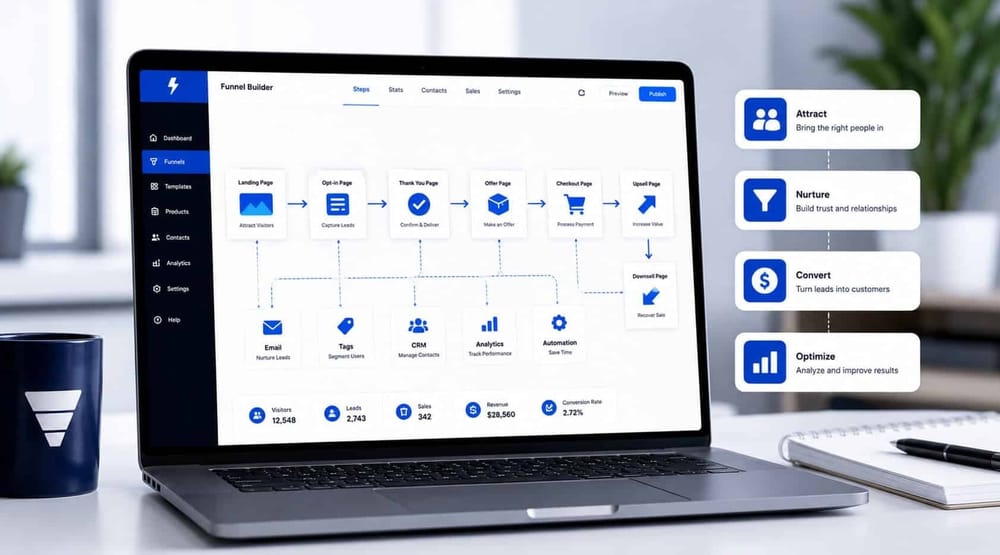
A sales and marketing funnel is the end-to-end path that turns cold strangers into loyal, paying customers through structured steps-from first click to repeat purchase. Think of it as your business model for client acquisition, mapped out visually so every stage is intentional and measurable.
The marketing funnel attracts and nurtures demand. The sales funnel converts that demand into revenue. Here's a simple example: a YouTube ad catches attention → a landing page collects an email → an email sequence builds trust → a strategy call qualifies the lead → a paid coaching program closes the deal. That entire chain is your conversion funnel.
In 2024–2026, funnels are no longer just a handful of pages stitched together. They are complete systems combining traffic acquisition, content, automation, CRM pipelines, and human sales conversations. The traditional sales funnel-or what some call the purchase funnel-has evolved into an integrated engine.
This article is written from the perspective of Funnel Builders Expert, a B2B agency building done-for-you funnels for online coaches, consultants, and course creators. What follows will show you how marketing and sales funnels work together, what funnel metrics to track, and how to prioritize your next funnel project.
Marketing Funnel vs Sales Funnel: Core Differences
A marketing funnel is the part of your marketing strategy that moves people from completely unaware to "problem aware" and "solution aware." It uses content, paid ads, and lead magnets to educate potential customers and build trust before any sales conversation happens. Marketing funnels focus on generating leads and brand awareness across multiple channels.
A sales funnel is the set of steps from "qualified lead" to "paying client." It covers applications, qualification calls, proposals, and closing. Sales funnels aim to convert leads into paying customers through direct interaction and structured sales conversations.
Here's the quick comparison:
- Marketing funnel = top of the funnel and middle of the funnel. Uses content to engage leads at various stages. Owned by the marketing team, media buyers, and content creators.
- Sales funnel = bottom of the funnel and post-purchase. Sales funnels focus on direct interactions to facilitate purchases. Owned by the sales team, sales representatives, and closers.
For coaches and consultants, a marketing funnel might look like a webinar funnel or a lead magnet funnel. A sales funnel might be a call booking workflow paired with follow-up sequences and closing scripts.
Both serve the same customer journey and support the buyer's journey, but require different skills: media buying and content creation on one side, sales conversations and offer design on the other.
How Marketing and Sales Funnels Work Together
Think of marketing and sales funnels as two halves of one pipeline. Traffic enters the marketing funnel, gets warmed and educated, then qualified leads hand off into the sales funnel. After the close, clients cycle back into marketing for retention, upsells, and referrals.
Here's how a typical timeline looks:
- Day 1: Prospective customers click a Meta ad and download a lead magnet.
- Days 2–14: A nurture email sequence delivers relevant content, case studies, and social proof.
- Day 14: The lead books a strategy call via a dedicated booking page.
- Day 17: Discovery call with a sales rep uncovers goals and fit.
- Day 21: Proposal delivered; deal closes.Day 22+: Onboarding sequence, then upsell and referral flows.
Misalignment between marketing and sales kills results. If your ads promise rapid growth but your sales call pitches a slow-burn consulting engagement, conversion rates tank and refund risk spikes.
The fix is shared definitions. Both teams should agree on what constitutes marketing qualified leads (interest + budget + problem fit), a Sales Qualified Lead (confirmed by sales to warrant outreach), and a closed client. Funnel Builders Expert typically maps this entire system inside a single CRM so both marketing and sales teams see the same data-no dropped leads, no guesswork.
Marketing Funnel Stages: From Awareness to Loyalty
The marketing funnel typically includes four stages: awareness, consideration, conversion, and loyalty. The classic AIDA model-Attention, Interest, Desire, Action-summarizes these traditional marketing funnel stages, though modern funnels add a loyalty layer.
Top of the Funnel - Awareness
Awareness is the first stage where potential customers learn about a brand. Your job here is building customer awareness at scale. Businesses utilize search engine optimization and content marketing to attract prospects in the awareness stage. Paid ads, social media posts, podcasts, and YouTube videos also drive reach. The goal: generate leads and pull your target audience into the funnel.
Middle of the Funnel - Consideration
Interest is the middle of funnel stage where prospects start researching solutions. Consideration involves potential customers evaluating options and comparing solutions. This is where you educate potential customers through case studies, comparison content, live workshops, and email sequences. Lead nurturing through automated email sequences builds trust during the consideration stage. Marketing funnels use content to engage leads at various stages, and delivering relevant content here is what separates a warm lead from a cold one.
Bottom of the Funnel - Conversion
Conversion is the stage where leads become paying customers. Focused landing pages, offer pages, and checkout flows do the heavy lifting. Minimizing checkout friction increases conversion rates during the decision stage. Every unnecessary form field or confusing navigation element costs you clients.
Loyalty and Advocacy
Loyalty aims to turn new customers into repeat buyers through engagement. Retention and advocacy occur post-purchase as businesses aim to convert customers into repeat buyers. Customer loyalty strategies increase repeat purchases by 60–70%, while loyalty programs can boost customer retention by 5–10%. Post-purchase engagement-onboarding emails, check-ins, community access-can increase customer loyalty by 50%. Referral programs help convert satisfied customers into advocates for the brand. Providing excellent customer service and keeping existing customers engaged is often more profitable than acquiring new ones.
Sales Funnel Stages: From Lead to High-Value Client
A practical sales funnel strategy for high-ticket services typically follows five steps. The sales funnel includes stages like lead generation and closing, and each stage serves a specific function in the buying process:
- Lead Generation: Capturing contact information from target customers who've expressed interest.
- Qualification: Checking fit, budget, and readiness. This prevents your sales team from wasting time on unqualified leads.
- Discovery Call: Uncovering pain points, goals, and the specific opportunity. This is where direct interaction matters most.
- Proposal / Negotiation: Framing the solution with clear ROI. The negotiation stage is crucial for developing a deal with leads that matches their situation.
- Close & Onboarding: Securing payment, then activating a strong onboarding flow. Effective onboarding can significantly reduce churn rates after the purchase. Sales funnels aim to provide a seamless purchasing experience from first call to first result.
Decision is the bottom of funnel stage where prospects evaluate specific options before buying. For a $3,000– $10,000 coaching program, typical call close rates of 20–40% are realistic when leads are well-qualified by the marketing funnel. According to DMForge benchmarks, the median show-to-close rate is around 30%, with top performers hitting 50%.
Sales funnels focus on converting leads into paying customers-and Funnel Builders Expert designs these workflows and automations so that sales representatives or founders know exactly what to do at each step.
Digital Marketing Funnel Channels and Tactics
A modern digital marketing funnel uses multiple marketing channels at different stages. Over half of businesses use at least eight marketing channels to reach their target customers, though coaches and consultants should resist the urge to be everywhere.
Here's how channels map to funnel stages:
Funnel Stage
Channels & Tactics
Awareness
Google Ads, Meta Ads, social media ads, social media outreach, SEO, YouTube, podcasts
Consideration
Email sequences, retargeting ads, blog content, webinars, social media posts
Conversion
Sales pages, VSLs, call booking pages, checkout pages
Loyalty
Onboarding emails, community platforms, upsell campaigns
Inbound marketing (SEO, content marketing, YouTube) builds long-term organic reach. Paid ads (Meta, Google) accelerate results when you need faster feedback loops. The choice depends on your budget and growth timeline.
Concrete marketing materials that move people through funnel stages include lead magnets, evergreen webinars, challenge funnels, and mini-courses. You can create engaging content that serves double duty-building trust while pre-qualifying your audience.
The key principle: avoid spreading thin across 10+ channels. Build one to three strong digital marketing funnels per core offer, stabilize profitability, then branch out. For coaches building their marketing systems, focused marketing campaigns consistently outperform scattered marketing efforts.
Landing Pages: The Conversion Hubs of Your Funnel
A landing page is a focused page with one specific goal: collecting an email, booking a call, or selling a product. Unlike a general website homepage, a conversion-focused landing page inside a funnel strips away distractions and drives a single action.
Key landing page elements:
- Promise-driven headline that speaks directly to your target audience's pain or desire
- Social proof: testimonials, case studies, client logos
- Concise offer explanation that answers "what do I get and why should I care?"
- Single call-to-action (one button, one next step)
- Minimal navigation (no menu bar sending people elsewhere)
Map your landing pages to funnel stages:
- Top of the funnel: Lead magnet squeeze pages (aim for 35–50% opt-in rate from warm paid traffic)
- Middle of the funnel: Webinar registration or case-study pages
- Bottom of the funnel: Application pages, call booking pages, sales pages
Funnel Builders Expert designs and tests landing pages specifically for coaches and service providers, focusing on call bookings and qualified applications. The difference between a generic page and a funnel-optimized page often means doubling your conversion rates.
Funnel Metrics and KPIs You Must Track
A funnel is only as good as its data. If you can't track metrics at every stage, you're flying blind. Businesses track conversion rates at each funnel stage to identify drop-offs, and analyzing funnel performance helps businesses prioritize areas for optimization.
Here are the key metrics by stage:
Stage
Metric
Benchmark (Coaching/Consulting)
Top of Funnel
Impressions, CTR, Cost per Click
CTR 1–3% for cold ads; CPL €2–€15
Lead Capture
Opt-in rate
35–50% good, 50%+ great
Nurture
Email open rate, click rate
Open 25–40%, click 5–15%
Call Booking
Booking rate from leads
8–15% from live webinar pitch
Show-Up
Show rate of booked calls
70–80% with reminders
Close
Close rate from show
30% median, 40–50% top performers
Long-term
LTV, churn/refund rate, payback period
LTV ≥ 3× CPA for profitability
Common metrics for funnel performance include lead conversion rate and customer acquisition cost. Cost per acquisition (CPA) measures marketing spending per new customer. Customer lifetime value (LTV) predicts the total value from a customer over their entire customer lifetime. Effective customer relationships can improve customer lifetime value by 30%.
Conversion rates measure the frequency of successful conversions at each stage. Data and optimization are crucial for identifying where prospects drop off in a funnel. Use Google Analytics for traffic-level data, and your CRM for pipeline-level data.
Small improvements in key funnel stages can lead to significant business results. Funnel optimization at each stage reduces prospect drop-off rates-sometimes a single headline change on a landing page can shift your entire ad spend efficiency.
Designing a Combined Marketing and Sales Funnel
Here's how to architect a single system that covers both marketing funnel stages and sales funnel stages for a specific offer-say, a 12-week coaching program launching in Q1 2026:
- Paid ad (Meta or Google) drives traffic to an education-first piece of content
- Lead magnet page captures email in exchange for a high-value resource
- Nurture sequence (7–14 days) delivers case studies, frameworks, and proof to nurture customers toward readiness
- Webinar or VSL presents the full methodology and invites applications
- Application page collects qualifying information
- Discovery call confirms fit, uncovers goals, presents offer
- Close secures payment
- Onboarding sequence activates the client
- Upsell/referral flow extends customer lifetime value
CRM and marketing automation tools connect every step through tagging, lead scoring, and pipeline stage moves. Automated reminders and "no-show" sequences support the sales team and increase conversion at the bottom of the funnel.
Funnel Builders Expert's core service is building these unified client acquisition systems-not isolated pages or one-off marketing campaigns. The result is a system where every dollar of ad spend is traceable from click to client.
Using Customer Feedback to Optimize Your Funnel
Surveys provide direct feedback from customers about their experience, and building structured loops for customer feedback at multiple stages is what separates good funnels from great ones.
Collect user feedback at these moments:
- After opt-in: "What's your biggest challenge right now?" (one-question survey)
- After first call: Post-call questionnaire asking what almost stopped them from booking
- After purchase: Onboarding survey to calibrate expectations
- At 30–90 days: NPS-style email to measure customer success and satisfaction
This qualitative data reveals why leads drop at a specific funnel stage. Maybe the offer was unclear, or the call booking process felt too aggressive. You gain valuable insights that no analytics dashboard can provide.
Feed this data back into copywriting, objection handling on calls, landing page tweaks, and overall customer experience improvements. Personalized marketing increases customer engagement by 76%-and personalization starts with understanding what your audience actually thinks.
Funnel Builders Expert routinely uses customer and prospect feedback to iterate messaging and improve conversion rates over time.
Automation, CRM, and Tech Stack for Scalable Funnels
Once a business crosses €10,000/month and wants predictable growth, marketing automation and customer relationship management systems become non-negotiable. According to Martech.org research, approximately 86% of organizations use a CRM and 77% use marketing automation platforms.
Automation handles repetitive funnel tasks:
- Lead tagging and segmentation by funnel stage
- Follow-up email sequences triggered by behavior
- Pipeline stage moves when a call is booked or completed
- Reminder sequences for no-shows and pending proposals
The critical principle: integrate your ad platforms, landing page software, and CRM so that funnel metrics are visible end-to-end. Only about 41% of marketers say their customer journeys are mostly or fully automated-which means the majority are still leaving revenue on the table.
Don't over-complicate your tech stack. Start with one main CRM/automation platform instead of a patchwork of disconnected tools. Funnel Builders Expert helps clients choose, configure, and maintain their tech stack so founders can focus on delivery and leadership-not debugging broken integrations.
Common Funnel Mistakes (and How to Fix Them)
Effective sales funnels require ongoing testing and optimization. Here are six mistakes we see repeatedly:
- Sending all traffic to a homepage. Your homepage serves many purposes; a funnel page serves one. Fix: replace homepage traffic with a dedicated landing page tied to one specific offer.
- Weak or generic offers. If your messaging could apply to anyone, it resonates with no one. Fix: sharpen the target audience, specify the outcome, and use proof early.
- Ignoring middle-funnel nurturing. Jumping straight from ad click to sales call skips the trust-building that the sales process demands. Fix: invest in email sequences, retargeting, and content that addresses objections before the call.
- Poor follow-up and no-show management. Booked calls often have a 25–30% no-show rate. Fix: automated SMS and email reminders, plus a reschedule sequence for no-shows.
- Not tracking funnel metrics. Many businesses can't tell you their cost per lead or close rate by source. Fix: establish shared definitions, capture every stage in your CRM, and build a simple dashboard.
- Running too many funnels at once. Webinar, challenge, VSL, evergreen-all at the same time with limited traffic. Fix: focus on one primary funnel per offer, stabilize it, then test variations.
Before rebuilding everything, run simple A/B tests on headlines, offers, and calls-to-action. Often the biggest ROI comes from fixing the earliest broken stage in the buying journey.
Funnel Builders Expert works as a partner to audit existing funnels, identify bottlenecks using data, and prioritize the highest-impact fixes first.
FAQ: Sales and Marketing Funnels
How do I know if I need a new funnel or just need to optimize the one I have?
Look at your current funnel metrics. If conversion rates at each stage are within reasonable industry benchmarks but profit margins are tight, optimization-better headlines, stronger email sequences, improved call scripts-is likely enough. If the funnel doesn't match your current offer, audience, or business model anymore, a redesign is warranted. Run a quick diagnostic: check ad-to-landing-page conversion, landing-page-to-lead conversion, lead-to-call booking rate, and call close rate. The stage with the biggest drop-off is your real bottleneck.
What is a good conversion rate for a landing page in a coaching or consulting funnel?
For a well-targeted lead magnet page receiving paid traffic, 25–45% opt-in rates are realistic. For a warmed email list clicking through to a call booking page, 15–30% application rates are achievable. These numbers depend heavily on traffic quality, offer clarity, and trust built in previous funnel stages. If you're below 20% on a lead magnet page, your headline or offer likely needs work before you increase ad spend.
Can I run both a webinar funnel and a simple application funnel at the same time?
Focus on one primary digital marketing funnel per core offer until it is profitable and stable. Splitting limited traffic between multiple funnel types slows your learning cycle and makes funnel metrics harder to interpret. Once your main funnel is consistently converting, test an additional format with a portion of your budget.
How long should my nurture sequence be before I ask for a call or sale?
For high-ticket coaching and consulting offers, a typical range is 5–10 emails over 7–21 days. Mix value-driven content with clear invitations to book a call. Warmer traffic-referrals, long-term subscribers, or loyal customers on your list-often converts faster than cold ad traffic and may need fewer nurture steps. The key is matching sequence length to buyer readiness, not using a one-size-fits-all approach.
How does Funnel Builders Expert work with clients on funnels?
Funnel Builders Expert typically starts by auditing your existing marketing and sales funnels to identify where revenue is leaking. From there, we design a complete client acquisition system-ads, landing pages, email sequences, CRM pipelines, and automation workflows-then implement and test it. Ongoing optimization is built into the process. The model is done-for-you, so coaches, consultants, and course creators can focus on delivering results and creating content instead of wrestling with tech and media buying.
Website.
Ecommerce Website
Blog Website
Website Design
Web Management
WordPress Website
SEO - AIO
AI Optimization
Local SEO
On-Off Page
SEO Audits
Technical SEO
Paid Advertising
Display Ads
Meta Ads
Google Ads
Linkedin Ads
TikTok Ads
CRM Automation
CRM Setup
Email Marketing
Lead Management
Pipeline Automation
SMS Marketing
Disclaimer: This site is not affiliated with or endorsed by Google or Meta™. All content is for educational purposes only and does not guarantee results or earnings. Your success depends on your own efforts, experience, and circumstances. Financial examples are illustrative, not promises. Always seek professional advice before making business or financial decisions. By using this site, you agree we are not liable for outcomes based on this information.
2026 © Funnels Builders Expert, a Sydney Website Design Agency product - Privacy Policy - Terms & Conditions