Marketing Funnel Types: How to Choose the Right Funnel Strategy for Your Business
A marketing funnel is a framework for mapping the customer journey from discovery to purchase, and only about 5% of buyers are "in-market" at any given time. That means 95% of the people who encounter your business are not ready to buy today. Without a structured funnel, you waste budget talking to the wrong people with the wrong message at the wrong stage.
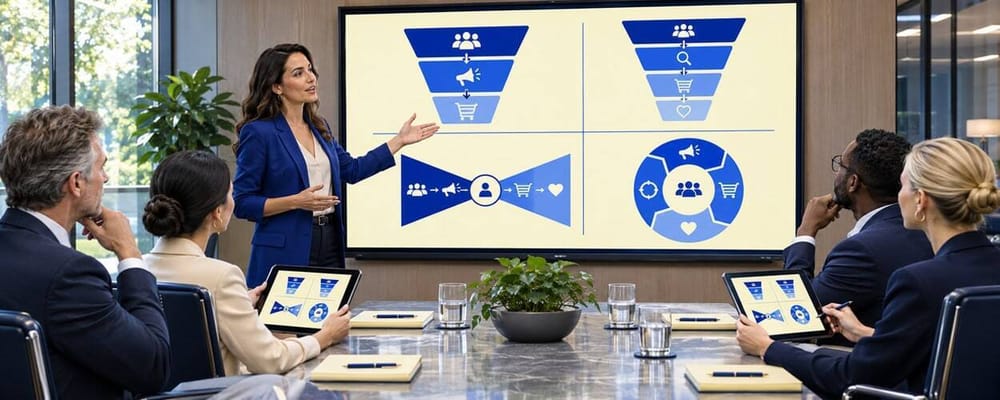
This guide breaks down every major marketing funnel type, from the basic 3-stage model to the AIDA marketing funnel, TOFU-MOFU-BOFU, bowtie, flywheel, and beyond. You will learn what each model does, when to use it, and how to match it to your offer, sales cycle, and growth targets.
Key Takeaways
- A marketing funnel represents customer journey stages before purchase. Different funnel types (basic, AIDA, granular, TOFU-MOFU-BOFU, bowtie, flywheel) serve different marketing goals, sales cycle lengths, and business models. Picking the wrong one wastes ad spend and loses qualified leads.
- Marketing funnels are important because they convert a vague marketing strategy into a step-by-step funnel strategy. Each stage of the marketing funnel shows where potential customers drop off and where to invest to improve conversions. Full-funnel strategies achieve 45% higher ROI than single-stage campaigns.
- The basic marketing funnel and AIDA marketing funnel work well as starting points for solopreneurs and local service providers. Granular or full funnel marketing models suit established brands, B2B companies, and higher-ticket offers like coaching and consulting where multiple decision makers and longer buying cycles are involved.
- Local service providers, coaches, and consultants can combine content marketing, paid ads, and marketing automation at each funnel stage to build predictable lead flow and increase sales. Funnel Builders Expert designs and implements these systems for businesses ready to scale.
What Is a Marketing Funnel?
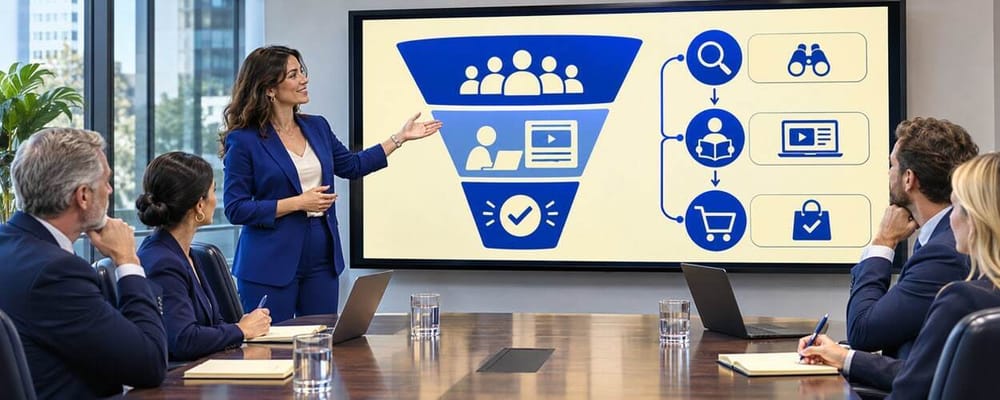
A marketing funnel models how potential customers move from first hearing about your business to becoming paying customers and, eventually, loyal customers who refer others. The classic stages are awareness, consideration, decision, and loyalty. The marketing funnel has been used for over a century; E. St. Elmo Lewis introduced early versions of the AIDA model in the late 19th century, originally for structuring print advertisements.
The "funnel" metaphor works because the numbers narrow at each stage. Many people land at the top of the funnel through search engines, ads, or social media posts. Fewer move into consideration. Fewer still reach the bottom of the funnel and convert. A business might lose 80-90% of initial exposure before reaching the purchase stage, depending on industry, traffic quality, and offer strength.
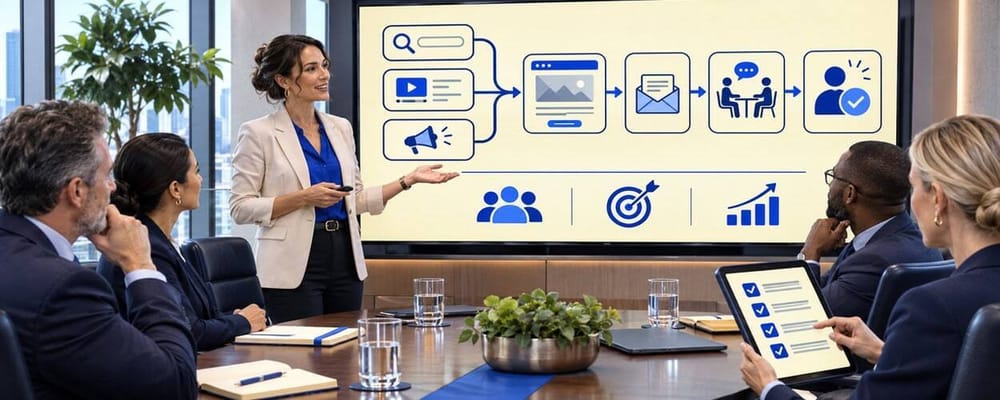
Modern funnels are less linear than textbook diagrams suggest. Prospective customers jump between Google, Meta, email, webinars, and referrals. They may revisit multiple marketing funnel stages before buying. This demands flexible funnel designs that account for re-entry and cross-channel behavior. The rest of this article compares every major funnel model and shows how to apply each one as part of a practical marketing funnel strategy.
Why Are Marketing Funnels Important for Your Marketing Strategy?
The marketing funnel is essential for understanding customer behavior and optimizing the conversion process. Without one, your marketing efforts lack structure: you run campaigns without knowing which stage they serve, and you cannot diagnose why leads stall. Marketing funnels help identify drop-off points in customer journeys so you can fix them.
Key benefits of mapping your funnel:
- Better targeting of potential customers. Someone at the awareness stage needs different messaging than someone comparing your service to a competitor's. Your marketing team can tailor ads and content to each stage rather than blasting one generic message.
- Forecasting revenue. If you know your conversion rate from MOFU to BOFU is 2%, and from TOFU to MOFU is 10%, you can calculate how much traffic you need to hit a revenue goal.
- Identifying leaks. If 500 people download your lead magnet but only 2 book a call, the problem sits in your middle of the funnel nurture sequence, not your awareness ads.
- Saving budget. Mapping a funnel focuses ad spend where it moves the needle. Retargeting at the bottom of the funnel often costs less per acquisition than running broad awareness campaigns alone.
For B2B coaches, consultants, and local service providers, funnels support client acquisition across sales cycles that span weeks or months. A coaching business selling $25,000 programs cannot close from a cold ad. It needs webinars, case studies, and sales calls staged across funnel steps to nurture leads and build trust. Only 28% of marketers find their funnel strategies very successful, which means the majority still have room to improve how they structure their entire marketing and sales funnel.
Basic Marketing Funnel (3-Stage Model)
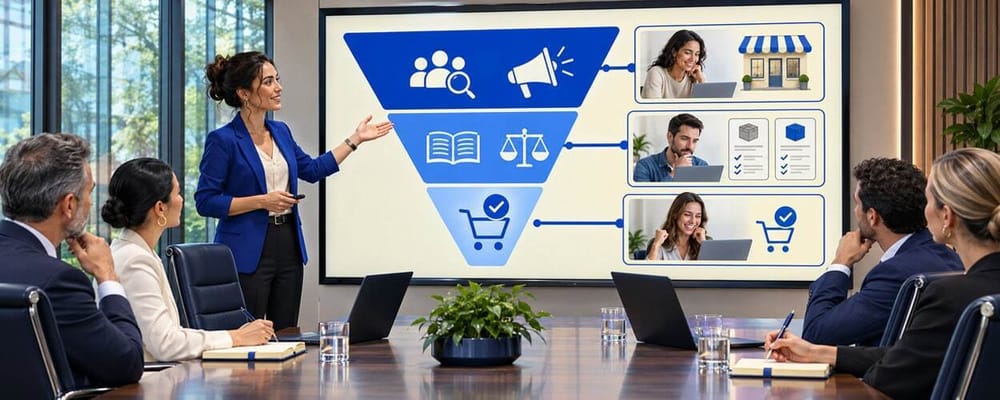
The basic marketing funnel has three stages: awareness, consideration, and conversion. This funnel model suits local service businesses and early-stage teams that need a clear, easy-to-track structure before layering on complexity. The sales process stays visible because there are only three sets of KPIs to monitor.
Typical marketing activity at each stage:
Stage
Goal
Tactics
KPIs
Awareness
Reach your target audience
Local SEO, Google Ads for broad terms, short-form social content
Impressions, click-through rate, new visitors
Consideration
Educate and nurture leads
Downloadable guides, case studies, email sequences
Opt-in rate, email open rate, content downloads
Conversion
Turn leads into paying customers
Free consultations, proposals, strong CTAs, customer testimonials
Booked calls, close rate, revenue
Here is a concrete example. A kitchen remodeler in 2026 runs Google Ads targeting "kitchen remodeler near me" (awareness). The ad drives visitors to a landing page offering a "Kitchen Renovation Guide" as a lead magnet (consideration). After downloading, prospects receive a nurture email sequence and a CTA to book a free design consultation (conversion). The marketing and sales teams track impressions, guide downloads, and booked consultations to measure funnel health at each stage.

AIDA Marketing Funnel (Attention, Interest, Desire, Action)
The AIDA model includes Awareness, Interest, Desire, and Action stages. Elias St. Elmo Lewis formalized this progression in the late 1800s, and it remains one of the most widely taught frameworks for structuring persuasive messages. AIDA is best applied in advertising and sales communications to structure persuasive messages, from landing pages to video sales letters.
Each stage in practical terms:
- Attention. Hook your target audience with a bold, specific claim. Ad copy example: "How to double your leads in 30 days without hiring a sales team."
- Interest. Feed relevance with educational content. Blog posts, short videos, or emails that explain your methodology and share relevant content.
- Desire. Build emotional and logical reasons to choose you over alternatives. Customer testimonials, ROI numbers ("clients generated $100,000+ in 6 months"), and competitor comparisons create desire.Action. Remove friction and drive conversion. "Book your 1-on-1 strategy call now," "Limited spots this month," or "Join with a full money-back guarantee."
For coaches and consultants, AIDA structures an entire campaign arc. A Meta ad generates Attention. The ad clicks through to a VSL (video sales letter) that builds Interest and Desire using case studies and process breakdowns. The VSL ends with an Action CTA to book a strategy call. Compared to the basic marketing funnel, the AIDA marketing funnel adds granularity in the middle stages (Interest vs. Desire), which helps when selling higher-ticket offers where the buyer's journey is longer and more emotionally complex.

Granular and Full Funnel Marketing Models
A granular marketing funnel breaks the customer journey into more detailed funnel stages: Awareness, Engagement, Consideration, Evaluation, Conversion, Onboarding, Retention, and Advocacy. Granular funnels segment stages further for tailored messaging, which is why they suit businesses selling high-ticket B2B services where the sales cycle involves multiple decision makers and stretches over weeks or months. B2B funnels are typically more complex than B2C marketing funnels because of these longer timelines and committee-based buying.
Full funnel marketing means planning campaigns for every stage, from the first touchpoint through repeat purchases and referrals, rather than focusing only on bottom-of-funnel conversions. A well-optimized funnel can achieve 45% higher ROI compared to single-stage campaigns, according to Amazon Ads research showing that brands using full-funnel ad strategies saw up to 3× higher brand awareness, 2× consideration lift, and 2× purchase lift.
Concrete example: a coaching business earning €20,000+/month uses YouTube ads for awareness, a lead magnet funnel for engagement, an evergreen webinar for evaluation, sales calls for conversion, and automated onboarding sequences plus review requests for retention. At each stage, marketing automation workflows trigger emails, reminders, and follow-ups without manual work.
The trade-off: granular funnels require more content, more automation, and more tracking. If your tools and team cannot support that complexity, start simpler and add stages as your data matures.

TOFU, MOFU, BOFU: Funnel Stages by Depth
The TOFU-MOFU-BOFU framework divides the buyer's journey into three stages: Top, Middle, and Bottom of the Funnel. These labels group marketing funnel stages by the prospect's level of awareness and readiness to buy.
- Top of Funnel (TOFU) focuses on building brand awareness. A TOFU contact is problem-aware or solution-aware but not yet comparing providers. Awareness is the top stage of the marketing funnel where potential customers first discover the brand.
- Middle of Funnel (MOFU) aims to nurture interest and trust. A MOFU lead has opted in, is reading case studies, and is comparing options. This is where you convert prospects from curious to qualified.
- Bottom of Funnel (BOFU) drives conversions and builds loyalty. A BOFU lead is ready to talk to your sales team, request a demo, or sign a contract. Sales qualified leads live here.
TOFU maps onto AIDA's Attention and the awareness stage; MOFU maps onto Interest and the consideration stage; BOFU maps onto Desire/Action and the decision or purchase stage.
Content stack example for a local consultant:
- TOFU: Blog posts and YouTube videos answering "How to solve [problem]" and SEO-optimized articles for lead generation
- MOFU: Downloadable guide comparing solutions, nurture emails addressing objections, webinar replays
- BOFU: Sales page with case studies, free strategy session booking page, proposal templates
This structure makes content planning concrete: "We need 3 TOFU blog posts, 2 MOFU case studies, and 1 BOFU comparison page this month." It also enables precise media buying, where TOFU uses broad audiences and BOFU uses retargeting and high-intent search queries.
Customer-Centric Funnel Types: Bowtie and Flywheel
Customer-centric funnels focus on enhancing the customer's journey and promoting repeat business. Two models stand out.
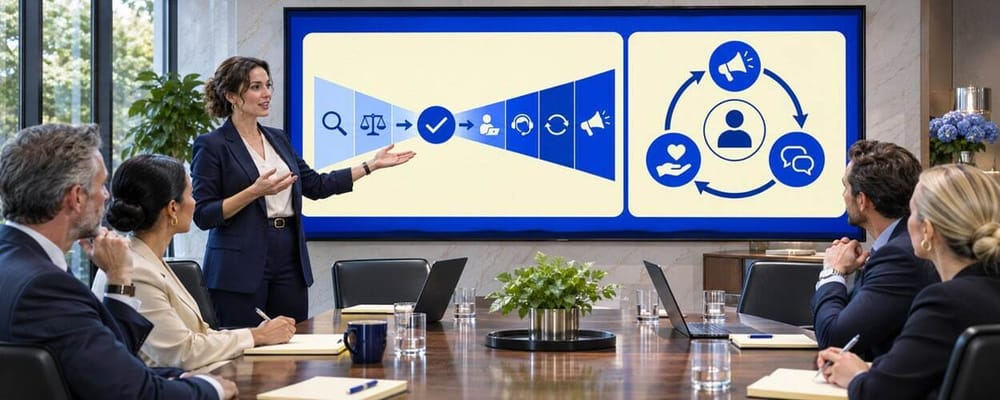
The bowtie funnel model merges acquisition and post-purchase phases. The left side is the classic funnel (awareness through purchase). The right side covers onboarding, retention, upsell, and advocacy. The shape resembles a bowtie, and it forces marketing and sales teams to plan for what happens after the sale, not just before it.
The Flywheel model redefines the funnel as a continuous cycle emphasizing customer retention and loyalty. Popularized by HubSpot's inbound marketing methodology, the flywheel replaces the linear funnel with circular momentum: Attract, Engage, Delight. Satisfied existing customers feed new initial brand awareness through referrals, reviews, and repeat purchases. According to Shopify's research, ecommerce brands that explicitly manage retention and advocacy stages see measurable gains in repeat purchase rate and referral traffic.
Why this matters in 2026: subscription services, memberships, loyalty programs, and recurring retainers make customer lifetime value and churn reduction primary metrics. A digital marketing agency that automates onboarding check-ins, gathers customer testimonials at 30 and 90 days, and triggers referral campaigns turns existing customers into brand advocates. Increasing customer retention by even 5% often raises profit margins by 20-25% in service industries. Transactional funnels that end at the sale leave that revenue on the table.

Other Notable Marketing Funnel Frameworks (REAN, STDC, Content Funnels)
Several alternative frameworks label marketing funnel stages differently depending on team preferences and measurement goals.
REAN (Reach, Engage, Activate, Nurture) structures campaigns across marketing channels like Google Ads, Meta Ads, and email. "Activate" targets micro-conversions (newsletter signup, app install) before the main sale. "Nurture" keeps prospects warm over time. This works well for businesses with long consideration stages.
See-Think-Do-Care (STDC), developed by Avinash Kaushik at Google, takes a customer-centric view. "See" is the largest addressable audience. "Think" is those considering solutions. "Do" is those ready to act. "Care" is existing high-value customers. It explicitly includes post-purchase care, aligning with the flywheel model.
The content marketing funnel matches content types to customer needs at different stages of the buying journey. Educational content sits at the top of the funnel, evaluative and comparison content fills the middle, and persuasive, offer-driven valuable content occupies the bottom. This lens helps marketing teams plan asset production and measure content marketing performance by stage.
Which framework fits which purpose:
Framework
Best For
REAN
Multi-channel media buying and campaign structure
STDC
Customer-centric measurement and Google Analytics reporting
Content funnel
Editorial planning and content marketing calendars
AIDA
Ad copy, landing pages, and sales communications
TOFU/MOFU/BOFU
Budget allocation and retargeting strategy
These are not different funnels in a technical sense; they are alternative labels for similar stages. Pick the one your team finds clearest and keep naming consistent across marketing campaigns.
Choosing the Right Funnel Type for Your Business
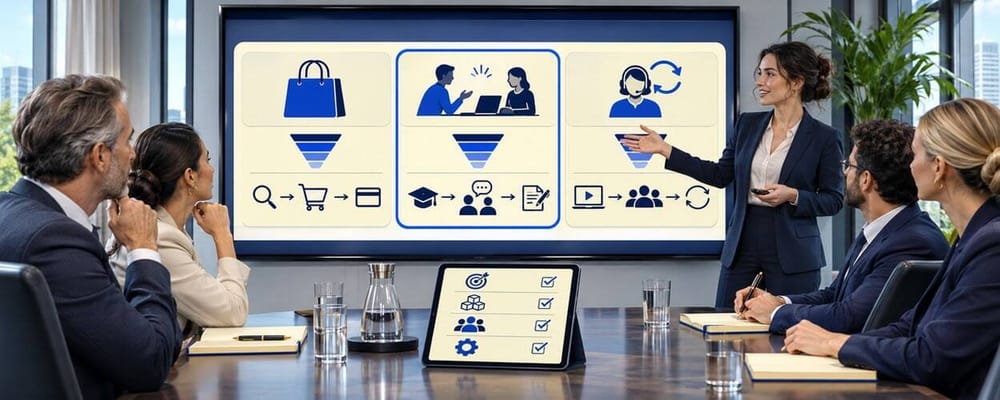
Different business models utilize various types of marketing funnels to suit their specific needs. There is no single "best" funnel type. The right choice depends on:
- Offer price point. A $500 service can close from a basic marketing funnel. A $25,000 coaching program needs a granular funnel with webinars, applications, and sales calls.
- Sales cycle length. If your sales process closes in under 7 days, a 3-stage funnel works. If it takes 30-90 days, you need MOFU nurturing stages.
- Decision-makers involved. B2B sales with multiple decision makers require more touchpoints and educational content at each marketing funnel stage.
- Channel mix. If you run paid ads, organic SEO, email, and webinars, TOFU/MOFU/BOFU or a granular model helps allocate budget by stage.
Decision checklist:
- Do you rely on sales calls to close? → Add a BOFU qualification stage.
- Is your sales cycle longer than 14 days? → Add MOFU nurture sequences.
- Do you sell subscriptions or retainers? → Use a bowtie or flywheel to track customer satisfaction and repeat sales.
- Can you track micro-conversions at each stage? → If yes, consider a granular funnel. If no, start with 3-5 stages and add complexity as your marketing automation and tracking mature.
Different marketing funnel models serve various strategic purposes, influencing the customer's experience and decision-making. Funnel Builders Expert typically audits existing customer journeys first, assesses current conversion rates at each stage, then recommends the simplest funnel capable of reaching the client's 6-12 month revenue targets.
Strategies and Tactics for Each Funnel Stage
Marketing funnels utilize various strategies to guide prospects through the purchasing process. Effective funnel strategies prioritize the delivery of the right message at the right time to reduce friction. Regardless of which funnel model you choose, similar principles apply at each funnel stage: attract prospects, capture contact information, nurture leads, convert prospects into buyers, and retain them for future purchases.
TOFU tactics (attract and increase brand awareness):
- Local SEO targeting "[service] near me" queries
- Educational blogs and YouTube videos answering common questions
- Short-form social media posts on Instagram, TikTok, and LinkedIn
- Awareness-focused Google and Meta Ads with soft CTAs ("Learn more," "Watch the video")
- Reddit ads, which increase brand awareness by 83% and action intent by 5.46% according to platform data
MOFU tactics (nurture and qualify):
- Lead magnets: checklists, guides, templates offered via a lead acquisition strategy
- Webinars and live Q&A sessions that address objections
- Case studies and comparison guides that differentiate your solution
- Email nurturing sequences delivering relevant content over 7-21 days
- Dynamic Product Ads that streamline personalized recommendations for users returning to your site
BOFU tactics (convert and close):
- Tailored landing pages with targeted advertising for high-intent keywords
- Free strategy sessions, demos, or trial offers
- Proposal follow-ups with testimonials and proof of results
- Capcom's campaign, for instance, resulted in a 90% excitement rate for their game by structuring bottom-of-funnel creative around social proof and urgency
For coaches, consultants, and local service providers, the entire customer journey from first click to long term relationships and repeat sales depends on executing the right marketing tactics at each stage.
Metrics and KPIs for Different Marketing Funnel Types
Measuring conversion rates at each stage of the funnel helps identify areas for improvement. Digital marketing funnels track customer journeys across online channels, so your marketing funnel metrics must match your funnel's complexity.
TOFU metrics:
- Impressions and reach (how many people see your marketing messages)
- New users in Google Analytics
- Click-through rate (CTR), which shows the percentage of ad impressions that result in clicks
- Engagement rate (time on page, video watch percentage)
- Customer acquisition cost at the awareness level
MOFU metrics:
- Lead conversion rate (visitor-to-lead), measuring how well you attract prospects into your pipeline
- Cost per lead (CPL)
- Email open and click rates
- Webinar attendance rate
- Content consumption depth (pages per session, scroll depth)
BOFU metrics:
- Conversion rates measure the percentage of leads that become customers
- Cost per acquisition (CPA) measures the cost to acquire a new customer
- Return on ad spend (ROAS) calculates revenue generated per advertising dollar spent
- Average deal size
- Sales cycle length (days from first touch to close)
Retention and lifecycle metrics (for bowtie/flywheel funnels):
- Repeat purchase rate and future purchases frequency
- Churn rate
- Customer lifetime value indicates the total revenue from a customer over time
- Net Promoter Score and review volume
Use CRM and automation tools to track these over time. Without reliable funnel metrics, you cannot diagnose where potential customers drop off or calculate your marketing performance accurately.
How Funnel Builders Expert Designs and Implements Funnel Strategies
Funnel Builders Expert is a B2B services agency specializing in building done-for-you marketing funnels and client acquisition systems for coaches, consultants, course creators, and local service businesses. If you want to understand what a funnel builder does in practice, here is the typical process.
- Discovery and offer audit. The team reviews your current offer, pricing, and traffic sources to identify which funnel model fits your sales process.
- Customer journey mapping. Existing data (ad accounts, CRM, analytics) reveals where leads enter, stall, and convert. This audit exposes leaks.
- Funnel type selection. Based on your price point, sales cycle, and team capacity, the team selects the simplest funnel capable of reaching your 6-12 month revenue targets.
- Full system build. The team designs and deploys the entire marketing system: ads (Google, Meta), conversion-focused landing pages, email automation, CRM integration, and follow-up workflows that support each funnel stage from awareness to booked appointments.
Funnel Builders Expert operates via a global network of certified funnel builders and automation specialists in the US, Canada, UK, Australia, and New Zealand. That gives clients local market insight combined with global best practices for funnel marketing and actionable strategies tuned to their region.
If you want help choosing or upgrading your marketing funnel type for scalable lead generation, request a funnel audit or strategy session with the Funnel Builders Expert team.
FAQ: Marketing Funnel Types
Below are answers to common questions not fully addressed in the sections above.
Which marketing funnel type is best for a coaching or consulting business?
Coaches and consultants selling high-ticket programs benefit most from a TOFU-MOFU-BOFU or granular funnel that includes webinar or VSL stages, application forms, and sales calls. A simple 3-step traditional marketing funnel often lacks the nurturing stages needed to build trust before a $5,000-$25,000 purchase decision. The consideration stage is where most coaching prospects either commit or disappear, so investing in MOFU content (case studies, webinars, email sequences) makes the difference.
Can I mix different funnel models, like AIDA and TOFU-MOFU-BOFU?
Mixing is common and practical. Many marketing teams use AIDA to write ad copy and landing page scripts within a broader TOFU/MOFU/BOFU content marketing funnel structure. The models are labeling systems, not competing architectures. The key is keeping naming consistent across your marketing and sales teams so everyone measures the same stages.
How many funnel stages do I really need?
Start with three to five clearly defined stages (awareness, consideration, decision, onboarding, retention) and add more only when data shows a meaningful behavioral difference that justifies separate marketing tactics. A six-stage funnel is pointless if you cannot track the transitions between stages. Only about 5% of buyers are "in-market" at any time, so your stages should reflect how you warm up the other 95%.
Do local service businesses need advanced funnel types?
Many local businesses thrive on a basic marketing funnel plus solid follow-up automation. However, those in competitive markets (like home services in major cities) benefit from more granular funnels with retargeting stages, review-generation sequences, and referral triggers that turn satisfied clients into brand advocates and drive long term relationships.
How often should I update or change my marketing funnel strategy?
Review funnel performance monthly for small tweaks: adjust ad creative, swap underperforming lead magnets, or test new email subject lines. Perform a deeper funnel strategy audit every 6-12 months, especially if your offers, pricing, or traffic sources change. The marketing funnel works best when treated as a living system, not a one-time build.
Website.
Ecommerce Website
Blog Website
Website Design
Web Management
WordPress Website
SEO - AIO
AI Optimization
Local SEO
On-Off Page
SEO Audits
Technical SEO
Paid Advertising
Display Ads
Meta Ads
Google Ads
Linkedin Ads
TikTok Ads
CRM Automation
CRM Setup
Email Marketing
Lead Management
Pipeline Automation
SMS Marketing
Disclaimer: This site is not affiliated with or endorsed by Google or Meta™. All content is for educational purposes only and does not guarantee results or earnings. Your success depends on your own efforts, experience, and circumstances. Financial examples are illustrative, not promises. Always seek professional advice before making business or financial decisions. By using this site, you agree we are not liable for outcomes based on this information.
2026 © Funnels Builders Expert, a Sydney Website Design Agency product - Privacy Policy - Terms & Conditions