Marketing Funnel Stages: How to Turn Attention Into Revenue
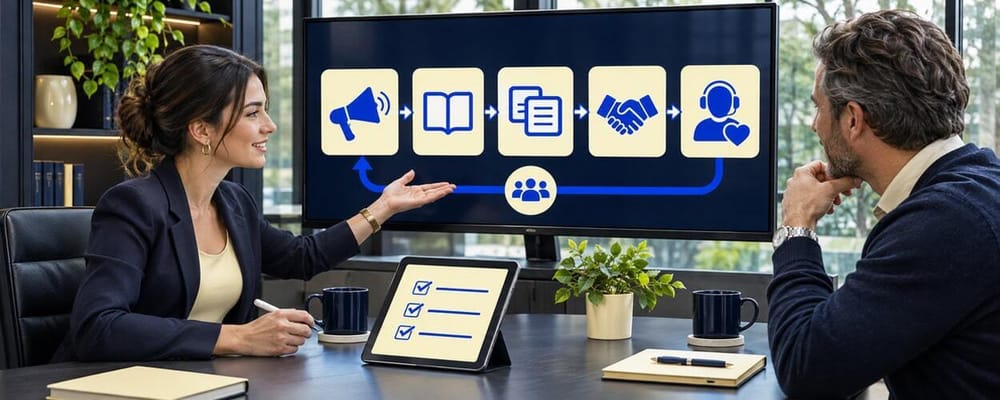
- A modern digital marketing funnel runs through five stages-Awareness, Interest/Discovery, Consideration, Conversion, and Retention-each with distinct goals, content types, and key performance indicators.
- Coaches, consultants, and service businesses need a full funnel digital marketing approach that connects upstream awareness efforts to downstream conversion and retention, not just "buy now" ads.
- Landing pages, marketing automation, and content marketing must work together across channels like Google Ads, Meta Ads, Local SEO, and email marketing to attract potential customers, nurture leads, and convert them into long-term clients with high customer lifetime value.
- Optimizing every stage of the marketing funnel turns sporadic inquiries into a predictable, scalable client acquisition system-and fixing even one weak stage often lifts the performance of the entire funnel.
- Funnel Builders Expert specializes in building done-for-you funnel systems that map the customer journey across every channel, from first click to loyal advocacy.
Introduction: Why Marketing Funnel Stages Still Matter
Your prospective customers are bouncing between Instagram Reels, AI search assistants, podcast episodes, and Google results-sometimes in a single afternoon. The buying process has never been more fragmented, which is exactly why structured marketing funnel stages are more critical now than at any point in the last decade.
Marketing funnel stages describe the progression a person takes from total stranger to paying customer and, ultimately, to loyal advocate. The traditional marketing funnel (AIDA: Awareness, Interest, Desire, Action) served well in the era of print ads and TV spots. But the digital marketing funnel stages used in 2026 extend far beyond that first sale, accounting for multi-channel touchpoints, automation, and retention loops that drive real profitability.
This article is written for coaches, consultants, and service businesses generating at least €10,000+/month who are ready to replace random referrals with a repeatable marketing funnel strategy. If that sounds like you, keep reading.
At Funnel Builders Expert, we build and manage complete client acquisition systems for service-based businesses worldwide. The rest of this piece walks through each stage of a successful marketing funnel and sales funnel marketing, including the best digital marketing strategies, content types, and key metrics to track at every step.
What Is a Marketing Funnel? (Traditional vs Digital)
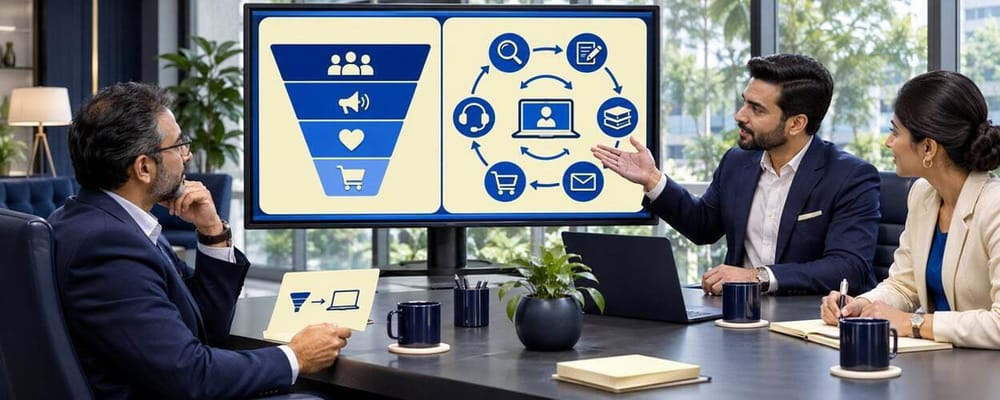
A marketing funnel is a visual model of the customer's journey from the first moment someone encounters your brand to the point where they become a repeat buyer and advocate. It's used to plan targeted campaigns, create content, and set up automation at every step.
The traditional marketing funnel-AIDA-moves linearly from Awareness to Interest, Desire, and Action. It works for simple, one-touch scenarios. Modern digital marketing funnel stages go further: they include post-purchase retention, advocacy, and looped re-engagement because that's where the real revenue compounds.
Digital tracking, CRM systems, and marketing automation platforms have made funnels data-driven in 2025–2026. Instead of guessing, marketing teams now measure progression between stages and identify exactly where prospects drop off.
A quick distinction: a marketing funnel covers the full spectrum from awareness content and lead generation through to nurturing. A sales funnel is narrower-it picks up once a prospect is qualified and moves through proposals, calls, and closing. In a coaching or B2B service business, the marketing funnel feeds directly into the sales process, and both need to be engineered together.
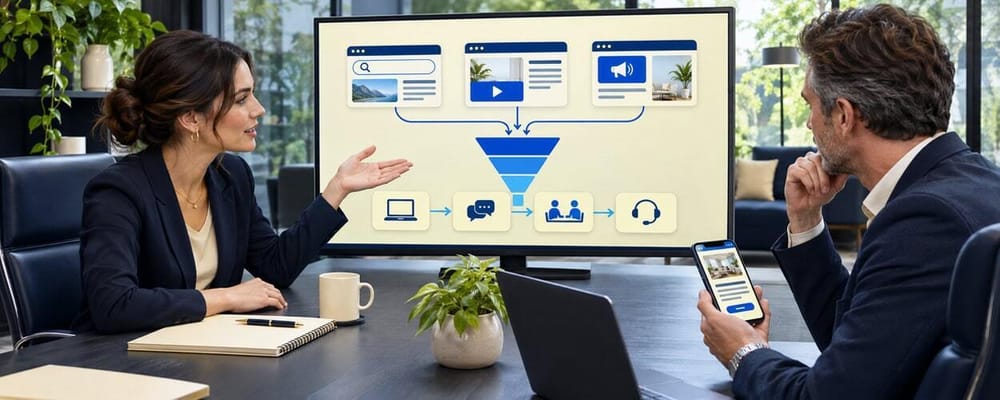
Picture the funnel shape: at the top of the funnel, you have the widest volume of people-high reach, low intent. As prospects move downward, volume shrinks but intent rises. By the bottom, a smaller group of highly motivated buyers is ready to act.

Core Digital Marketing Funnel Stages (The 5-Stage Model)
The marketing funnel has five stages: awareness, discovery, consideration, conversion, and retention. This 5-stage digital marketing funnel provides a practical framework for any service-based business or coaching brand building systems in 2026.
Here's the quick map:
These digital marketing funnel stages differ from pure sales funnel stages because they include every online brand interaction-not just the sales call or checkout.
A quick example: a business coach runs cold Meta Ads targeting service-business owners (Awareness), drives them to a blog post titled "Why Your Lead Gen Has Stalled" (Interest), invites them to a live webinar with case studies (Consideration), offers a strategy call on a focused landing page (Conversion), then enrolls them into a group program with structured onboarding and community access (Retention).
Each of the following sections deep-dives into practical strategies, content types, and KPIs for every stage.

Stage 1: Awareness – Top of the Funnel
The awareness stage focuses on building visibility and sparking interest. The goal is simple: get in front of the right target audience, name the problem they're experiencing, and earn enough curiosity for a first click or view. In the awareness stage, potential customers realize they have a need and discover the brand.
Top of the funnel channels that work in 2026:
- Google Search and Performance Max campaigns
- Meta Ads (Facebook and Instagram)
- YouTube pre-roll and Shorts
- TikTok organic and paid
- Local SEO and Google Business Profile
- Organic social media posts
Effective Marketing Strategies for the awareness stage include SEO, content marketing, and social media marketing to widen reach with problem-aware messaging. Awareness content includes blog posts and social media updates-problem-focused, educational, lightly branded. Think "5 Reasons Service Businesses Lose Leads in 2026" rather than a hard sales pitch. The purpose is to attract potential customers who don't know you yet and spark interest in exploring further.
The key metrics for the awareness stage include impressions, website traffic, and social media engagement. Awareness KPIs include impressions and click-through rates, plus branded search volume growth and cost per engaged view. Keep in mind: roughly 98.6% of website visitors fail to convert into leads, making this the biggest leak in most funnels.

Stage 2: Interest & Discovery – Turning Clicks Into Curiosity
Once people are aware, the Interest/Discovery stage is about getting them to self-educate and explore your brand more deeply. Discovery content helps visitors define their problems and solutions-this is where you move from "that brand looks interesting" to "I need to learn more."
Practical assets for this stage:
- Informative blog posts and pillar pages
- Explainer videos and short-form content series
- Quizzes and self-assessment tools
- Downloadable checklists and ungated guides
- Educational content like how-to walkthroughs
Smart landing pages and on-site UX matter here. Internal links, content hubs, and suggested posts keep visitors exploring instead of bouncing. Create landing pages with clear next steps-newsletter sign-ups, quiz completions, or webinar registrations-that move visitors into your ecosystem.
Retargeting ads play a critical role in this stage. Google Display, Meta remarketing, and YouTube remarketing can bring people back to educational resources they've already engaged with, keeping your brand top-of-mind through social media channels and display networks.
In the Interest stage, key metrics include email subscriptions and engagement with content. Track time on site, pages per session, content downloads, video view completion rate, and email sign-ups triggered by your content marketing funnel.

Stage 3: Consideration – Middle of the Funnel
During the consideration stage, prospects actively evaluate different solutions and compare brands. They understand their problem and are weighing you against competitors-and against doing nothing. In the consideration stage, prospects evaluate if the product meets their needs.
This is where your marketing efforts must build trust through depth, not volume. Consideration content should include case studies and customer reviews. Specific assets for this consideration phase include:
- Comparison pages and "how we're different" content
- Detailed service pages explaining your process
- Customer testimonials and video case studies
- FAQs that address specific pain points
- "How we work" content tailored to your product or service
Strategies to nurture leads during the consideration stage include offering lead magnets, free trials, and sending targeted emails to lower risk for prospective customers evaluating the product or service. Email marketing and marketing automation workflows should nurture leads with behavior-based sequences-not random newsletters. Educational mini-courses, drip campaigns, and personalized solutions sent based on what someone downloaded or watched outperform generic blasts every time.
Retargeting ads can re-engage potential customers in the consideration stage, bringing them back to webinar replays, case study pages, or service breakdowns they viewed but didn't act on.
During the consideration stage, metrics such as demo requests and product engagement help measure effectiveness. Consideration KPIs include engagement rate and time on site, plus marketing-qualified leads (MQLs), webinar registrations, reply rates to nurture emails, and booked discovery calls from warm lists. Industry benchmarks show MQL-to-SQL conversion averages 15–30%, while elite performers push 50–70% through sharper ICP targeting and faster follow-up.

Stage 4: Conversion – Bottom of the Funnel
The conversion stage is where leads become paying customers. In the conversion stage, prospects are ready to buy and need reassurance to finalize their decision. Your job: make it effortless.
High-converting bottom-of-the-funnel assets include:
- Focused landing pages with a single call-to-action
- Offer pages for coaching programs with clear pricing and packaging
- Booking funnels for consultations or strategy sessions
- Application pages for high-ticket programs
Effective strategies for the conversion stage include simplifying the purchase process and providing social proof. Landing pages should have clear calls to action and special offers. Conversion content should clarify offers and reduce friction-remove unnecessary form fields, use mobile-first design, add trust badges and customer testimonials, and include FAQs on the page itself.
Specific marketing tactics for coaching and service businesses: limited enrollment cohorts, time-bound bonuses, "strategy session" booking funnels, and automated follow-up sequences for no-shows. These client acquisition strategies ensure you don't lose prospects who were ready but got distracted.
Conversion KPIs include conversion rate and cost per conversion. Also track cost per lead by marketing channel, cost per booked call, show-up rate, close rate (opportunity to closed deal), and revenue per lead. Conversion metrics include sales volume and cart abandonment rates. Benchmarks: SQL-to-opportunity conversion averages 38–45%, and opportunity-to-close runs 19–28% on average-with top performers reaching 35–40%.
Stage 5: Retention & Customer Lifetime Value
The retention stage aims to keep customers engaged after their first purchase. The funnel doesn't end at the sale-real profit is created by maximizing customer lifetime value and reducing churn.
Retention content includes onboarding and usage reminders. For coaches and service businesses, effective retention strategies include:
- Structured onboarding with clear milestones
- Milestone check-ins and quarterly business reviews
- Members-only communities or group calls
- Email newsletters, which can significantly improve customer engagement and retentio
Retention strategies can increase customer lifetime value by 30% to 50%. Personalized promotions can increase customer retention rates by 10% to 15%. Loyalty programs can boost repeat purchases by 20% to 30%-these programs encourage repeat business and build brand loyalty over time. High customer satisfaction scores correlate with lower churn rates, so tracking NPS and CSAT matters.
Automation opportunities here are enormous: renewal reminders, satisfaction surveys, upsell and cross-sell campaigns triggered by engagement, and referral program invitations for satisfied customers. Loyalty and advocacy effectiveness can be gauged by customer retention and referral rates.
Retention KPIs include customer lifetime value and repeat purchase rate. Also track churn rate, average contract length, upsell revenue percentage, and referral-driven revenue. Many high-performing coaching businesses see 30–40%+ of total revenue from upsells and renewals-making existing customers your most profitable asset.

The Traditional Marketing Funnel (AIDA) vs Modern Full Funnel Digital Marketing
The AIDA model-Awareness, Interest, Desire, Action-dates back to early 20th-century advertising theory. It works for linear scenarios: someone sees a newspaper ad, gets curious, wants the product, and walks into a store. Clean. Simple. Limited.
Full funnel marketing in 2026 looks different. Multiple touchpoints, retargeting layers, email automation, and multi-device behavior mean that a prospective customer might see a video ad in January, read case studies in March, and finally book a call in May. This non-linear path is the norm, not the exception, and your funnel strategy must account for it.
Funnel Builders Expert combines both frameworks: the clarity of AIDA for sales copy and messaging architecture, plus the depth of modern lifecycle stages from first click to long-term client. An effective marketing funnel in 2026 requires thinking in systems, not isolated campaigns, to match the customer journey across channels and over time.
Aligning Marketing Channels and Content to Each Funnel Stage
Here's a practical mapping guide for pairing each stage with the strongest marketing channel and content types:
Funnel Stage
Primary Channels
Content Types
Awareness
SEO, Meta Ads, YouTube, TikTok
Social media posts, blog articles, short videos
Interest
Blogs, video series, remarketing
Guides, quizzes, pillar pages, podcasts
Consideration
Email, webinars, retargeting ads
Case studies, customer reviews, FAQ pages
Conversion
Sales pages, landing pages, direct-response ads
Offer pages, booking funnels, pricing pages
Retention
Email, communities, CRM
Onboarding content, usage reminders, loyalty programs
This is how a content marketing funnel supports progression instead of random posting. Create content with a purpose: each piece should move someone from one stage to the next.
Where do landing pages fit? You should create landing pages for specific, single-goal conversions at Interest (lead magnets), Consideration (webinar registrations, lead acquisition), and Conversion (calls, applications, purchases).
Audit your own marketing funnel by labeling every asset you have by funnel stage. You'll quickly spot gaps-most businesses discover they have a pile of awareness content and almost nothing for the consideration phase or retention.
Defining KPIs for Each Stage of Your Digital Marketing Funnel
Every digital marketing funnel needs stage-specific KPIs instead of only tracking overall revenue or ROAS. Tracking KPIs helps optimize marketing strategies at each funnel stage and prevents you from throwing budget at the wrong problem.
Top-of-funnel KPIs: impressions, reach, new sessions, video views, cost per engaged visit, and social media engagement.
Mid-funnel KPIs: lead magnet opt-ins, email list growth, webinar registrations, MQLs, engagement rates on nurture emails, and time on site.
Bottom-of-funnel KPIs: booking rate for calls, sales conversion rate, cost per acquisition (CPA), average deal size, and close rate.
Post-purchase KPIs: customer lifetime value, repeat purchase rate, referral volume, retention rate, and upsell revenue percentage. According to Funnel's 2026 Marketing Intelligence Report, 72% of marketers have plenty of data but struggle to extract actionable insights-stage-specific KPIs solve this by giving each metric a clear "home" in the funnel.
B2B vs B2C Marketing Funnel Stages (and Where Coaches & Consultants Fit)
B2B funnels typically feature longer sales cycles, multiple stakeholders, and a heavier emphasis on the consideration and education stages. The sales process often includes discovery calls, proposals, and relationship-building before a deal closes.
B2C funnels push more volume at the top of the funnel and rely on emotional, faster decisions at the bottom. Paid advertising with direct-response offers can compress the journey significantly.
Coaches, consultants, and course creators sit on a hybrid spectrum: B2B-style consideration depth (prospects need trust, proof, and dialogue) combined with B2C-style media and content (short-form video, social media channels, direct-response landing pages). A coaching funnel might use Meta Ads plus a video sales letter and automated enrollments for a group program, while a consulting funnel might run LinkedIn content plus webinars plus strategy calls for high-ticket engagements.
Funnel Builders Expert tailors funnel architecture and automation logic differently for each: high-ticket, relationship-based offers need stronger consideration-stage systems, while lower-ticket one-to-many products benefit from streamlined conversion paths with less manual sales involvement.
Using Automation to Nurture Leads Through the Funnel
Manual follow-up breaks down the moment a business scales past a handful of leads per week. At that point, potential customers slip through the cracks, no-shows go unfollowed, and warm leads go cold. Automation fixes this.
Core automation components for a service business include:
- CRM with pipeline stages mapped to funnel stages
- Email sequences triggered by user behavior (downloads, page visits, webinar attendance)
- Lead scoring that flags when someone crosses from MQL to SQL
- Trigger-based workflows that respond to actions like cart abandonment or no-show booking
Practical examples: nurture cold webinar leads with a 14–30 day email sequence that shares educational content, case studies, and a soft invitation to book a call. Reactivate old leads who engaged three months ago but never converted. Automatically follow up with no-shows to optimize funnel performance at the conversion stage.
The goal of automation is to nurture leads, personalize solutions at scale, and prevent leaks between marketing funnel stages-not to spam prospects with irrelevant offers. HubSpot's 2026 State of Marketing report found that 49% of marketers now use AI for personalized content, and automation ease-of-use is the top factor in platform selection.
How Funnel Builders Expert Designs Full Funnel Systems
When a new client comes to Funnel Builders Expert, the process starts with mapping existing customer journeys and diagnosing stage leaks. Where is website traffic dropping off? Which funnel metrics show a bottleneck? Is the problem awareness (not enough leads), consideration (leads aren't converting to calls), or retention (clients leave after 90 days)?
From there, we build a full funnel digital marketing roadmap. A typical done-for-you system includes: funnel strategy, architecture and copywriting, landing page design, tracking setup, search engine optimization, Google Ads, Meta Ads, and automation workflows that connect every stage.
In early 2026, we rebuilt a coaching funnel for an online business consultant whose paid advertising was driving traffic straight to a homepage with no clear next step. By adding a content marketing funnel with a lead magnet, a consideration-stage webinar sequence, and a dedicated booking page, their cost per booked call dropped by 40% within 75 days. Similarly, in 2025 we helped a home improvement contractor implement a local SEO and Google Ads system with stage-matched landing pages-awareness content fed into estimate requests, which converted into booked consultations at twice their previous rate.
Our certified funnel specialists operate across the US, Canada, UK, Australia, and New Zealand. Each understands their local market while working within a unified methodology. If you're looking to build or optimize your own marketing funnel into a system that delivers predictable lead generation and stronger customer relationships, Funnel Builders Expert is built for exactly that.
Common Marketing Funnel Mistakes (and How to Fix Them)
Here are the most frequent errors we see-and how to fix each one:
- Only running bottom-of-funnel "buy now" ads. This happens because it feels like the fastest path to revenue. Fix: allocate 50–60% of paid media budget to top-of-funnel awareness to build a pipeline, not just harvest existing demand.
- Ignoring retention entirely. Businesses focus all marketing efforts on new acquisition and forget that retention strategies can increase customer lifetime value by 30% to 50%. Fix: build a post-purchase email sequence with onboarding, check-ins, and upsell offers.
- No clear KPIs by stage. Teams track revenue and ROAS but can't pinpoint where the funnel leaks. Fix: define key performance indicators for each stage and review them monthly-awareness through retention.
- Sending everyone to the same homepage. A homepage isn't a landing page. Fix: create landing pages matched to intent-one for lead magnets, one for webinars, one for booking calls.
- No follow-up for leads who don't buy immediately. Most B2B buyers need multiple touches. Fix: build automated nurture sequences that optimize campaigns over 14–90 days instead of giving up after one email.
- Coaches relying only on referrals or organic social. This works until it doesn't-referrals are unpredictable and unscalable. Fix: build a scalable acquisition system with paid advertising and email marketing alongside organic efforts.
Fixing even one weak stage often lifts the performance of the entire funnel. Start with the biggest leak.
FAQ: Marketing Funnel Stages in 2026
How many stages should my marketing funnel have?
Most small to mid-sized service businesses do well with four to five core stages: Awareness, Interest, Consideration, Conversion, and Retention. Internally, you can add micro-steps like "discovery call completed" or "proposal sent," but your marketing teams should keep the model simple enough to act on. The right number of funnel stages depends more on your decision complexity and sales cycle length than on industry buzzwords.
How long does it take to see results from a new funnel?
Cold traffic funnels for coaching or high-ticket services typically need 60–90 days of testing and optimization before delivering consistent results. Awareness and Interest metrics usually improve first-more leads, lower cost per lead-followed by improved conversion rates and higher revenue per lead as messaging and follow-up sequences are refined. A funnel is a system to be iterated weekly or monthly, not a one-off campaign you set and forget.
What budget should I allocate to each stage of the funnel?
A strong starting split for paid advertising: roughly 50–60% to top-of-funnel awareness, 25–35% to mid-funnel nurturing and remarketing, and 10–20% to bottom-of-funnel conversion and retention campaigns. Service businesses with limited creative assets may start heavier on mid- and bottom-of-funnel while building out awareness content. Adjust monthly based on cost per acquisition, ROAS, and which stage is currently the main bottleneck.
Can I use the same content across all funnel stages?
While your core positioning stays consistent, the angle, depth, and call to action should change from stage to stage. A broad "problem awareness" video can be repurposed into a detailed webinar for the consideration phase and a short case-study clip for conversion-each with different CTAs. Misaligned content, like a hard sales pitch served to cold traffic, is a common cause of poor funnel performance and high ad costs.
When should I rebuild my funnel versus optimize the existing one?
If your core offer, target audience, or market positioning has changed significantly since 2024–2025, a more substantial funnel redesign is usually warranted. Otherwise, focus on iterative optimization: split-testing landing pages, subject lines, offers, and ad creatives while keeping the overall funnel structure intact. Funnel Builders Expert typically reviews funnels quarterly for structural changes and weekly for tactical optimizations in active campaigns. Funnel strategy should be revisited at least quarterly due to fast-changing ad platforms and user behavior.
Website.
Ecommerce Website
Blog Website
Website Design
Web Management
WordPress Website
SEO - AIO
AI Optimization
Local SEO
On-Off Page
SEO Audits
Technical SEO
Paid Advertising
Display Ads
Meta Ads
Google Ads
Linkedin Ads
TikTok Ads
CRM Automation
CRM Setup
Email Marketing
Lead Management
Pipeline Automation
SMS Marketing
Disclaimer: This site is not affiliated with or endorsed by Google or Meta™. All content is for educational purposes only and does not guarantee results or earnings. Your success depends on your own efforts, experience, and circumstances. Financial examples are illustrative, not promises. Always seek professional advice before making business or financial decisions. By using this site, you agree we are not liable for outcomes based on this information.
2026 © Funnels Builders Expert, a Sydney Website Design Agency product - Privacy Policy - Terms & Conditions