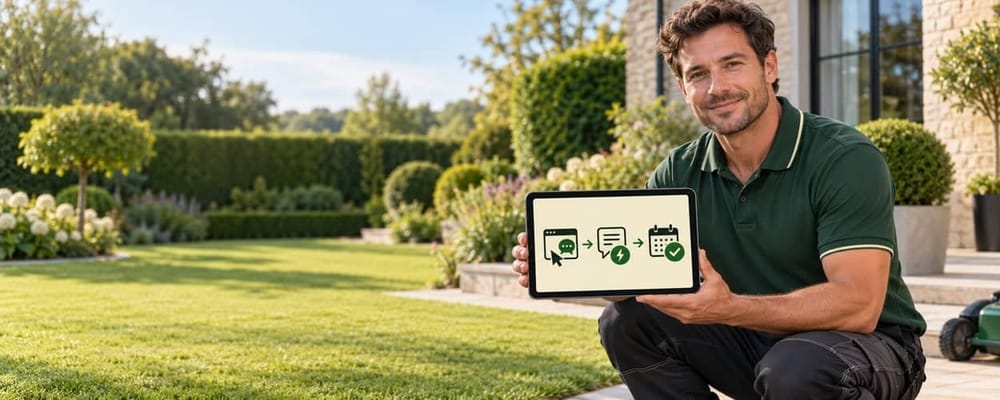
Marketing Automation for Landscapers: Turn Clicks into Booked Jobs on Autopilot
Most landscaping businesses run on referrals, hustle, and hope. The phone rings during spring, the calendar fills up, and then the chaos begins: missed calls, forgotten follow-ups, estimates sitting in inboxes for days. Marketing automation for landscapers changes that equation entirely, turning every inquiry into a tracked, nurtured opportunity that moves toward a booked job without requiring you to be glued to your desk.
This guide breaks down the exact workflows, tools, and strategies any landscaping company can use in 2026 to capture more leads, respond faster, and build a predictable pipeline of recurring revenue.
Key Takeaways
Marketing automation helps a landscaping business respond to leads instantly, nurture quotes through multi-step follow-ups, and fill the job calendar without piling on more admin hours. One example: R.I. Lawns used automations inside Service Autopilot to handle new-lead confirmations, scheduling texts, and dispatch notifications, saving roughly 32 hours per month of manual labor. Marketing automation can streamline client acquisition for service-based businesses of any size. Funnel Builders Expert builds these done-for-you systems specifically for local service businesses, including landscaping companies across the US, Canada, UK, and Australia.
The biggest wins for landscaping companies come from automated lead capture on the landscaping website, Google Ads, and social media, combined with fast follow-up via SMS and email within two to five minutes of every inquiry. Automating lead capture allows immediate acknowledgment of customer inquiries, which is critical when local homeowners are comparing three or four companies simultaneously.
Automation connects website forms, a landscaping CRM, route optimization tools, payment processors, and review platforms into one seamless workflow from first click to final payment. Relying on automated workflows can help convert leads into recurring clients without added manual work. When you combine local SEO, Google Ads, content marketing, and social media marketing with automation, you create predictable lead flow and more recurring maintenance contracts.
This article covers concrete automation workflows, tool comparisons, and next steps any landscaping company can apply in 2026, whether you are a solo operator or running multiple crews across several service areas.
Why Marketing Automation Matters So Much for Landscaping Businesses
Picture a typical spring 2026 week for a busy landscaping company owner. Sixty-plus calls come in for seasonal cleanups and lawn care estimates. Rain delays push Thursday's jobs to Friday. Two new leads from Google Ads sit unread in a Gmail tab for three days. By the time you call back, those homeowners already hired the next company that picked up the phone. Now contrast that with an automated system: every form submission triggers an instant SMS, every missed call gets a follow-up text within 90 seconds, and every accepted estimate auto-creates a job in the scheduling board. Same week, completely different outcome.
Marketing automation for landscapers means software-driven workflows that capture leads, send follow-ups, segment contacts by service type, and trigger tasks across your operation without manual effort. It is not a single app but a connected system designed specifically to handle the speed and volume that landscaping operations demand.
Seasonality makes this even more critical. Spring cleanups, summer maintenance, fall aeration, and winter prep create fixed revenue windows. If past clients are not reactivated or estimate requests are not answered within minutes, those opportunities vanish. For local businesses relying on repeat work, consistent lead nurture is the difference between a packed calendar and scrambling for jobs in July.
The typical problems are painfully familiar to landscaping owners: missed calls when lawn care crews are in the field, slow quote responses that stretch into days, forgotten follow-ups for homeowners who requested estimates but did not immediately convert, lost repeat customers who simply were never asked to rebook, and underused email lists of past clients gathering dust.
Automation builds a 24/7 front office that works alongside the owner and crews. It is not another app that adds complexity. It is the system that eliminates the bottlenecks that cost you more jobs every season.
Core Components of an Automated Landscaping Marketing System
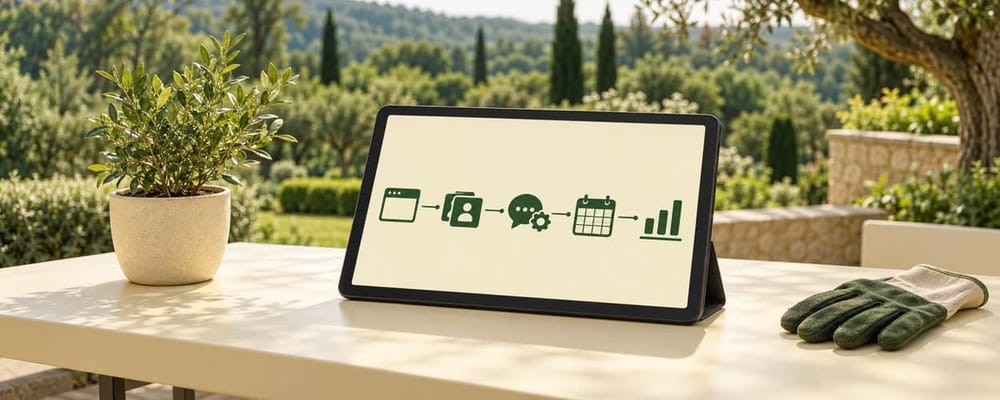
Every landscaping company moves customers through the same lifecycle: stranger visits your website, becomes a lead by submitting a form or calling, receives an estimate, gets scheduled for a job, completes the work, and ideally becomes a repeat maintenance customer who refers neighbors. Automation can plug into every single stage. Firsthand Lawns built a system where the assessment-to-draft-quote process took roughly 30 seconds after data capture, fundamentally changing how many estimates they could process per day.
The essential building blocks include a landscaping CRM with pipeline management, a website or funnel with lead capture forms on every service page, email and SMS marketing tools integrated with the CRM, a calendar or booking system for estimates and site visit scheduling, a payment processor for invoicing, and a review platform for automated review requests.
Funnel Builders Expert typically glues these together into a single system rather than leaving landscaping companies juggling five to seven disconnected tools that require manual data entry between each one. The approach mirrors what we do for other service industries, as outlined in our guide on essential marketing automation workflows.
The core concept is triggers and actions. For example: "New Google Ads lead submits a lawn care form" is the trigger. The actions that fire automatically: add to landscaping CRM, send a thank-you SMS, notify the office via email or Slack, and start a seven-day nurture sequence. Even small landscaping businesses can start with a minimal stack-website form plus simple CRM plus email and SMS-and later integrate advanced platforms like Service Autopilot or route optimization software as volume grows.

Choosing and Setting Up a Landscaping CRM for Automation
A generic CRM often fails landscapers because it was never built for recurring routes, seasonal services, crew dispatch, or property-level records. Many owners end up patching gaps with Zapier hacks and spreadsheets that break mid-season when volume spikes. Using CRM software can save landscaping businesses several hours weekly, but only if the CRM actually fits the workflow.
What to look for in a strong landscaping CRM from an automation perspective: lead capture integration with website forms and call tracking, pipeline stages mapped to estimates, scheduled jobs, and job completion, tagging for services and locations, two-way sync with email and SMS tools, and mobile access for crews.
Common platforms worth evaluating include Jobber, which is a field service management software well suited for smaller crews with solid quote follow-up automations. Service Autopilot is designed for recurring lawn care routes and high-volume operations with 150-plus accounts. Housecall Pro is a CRM and scheduling software popular for residential landscaping. Aspire is built for larger landscaping businesses with complex operations, and Yardbook offers a budget-friendly entry point. Any of these can sit inside a broader automated marketing system that Funnel Builders Expert builds around them.
Structure your pipelines simply: New Lead, Estimate Scheduled, Estimate Sent, Won, Recurring Maintenance or Project Complete, Review and Referral Request. Each stage should trigger automated customer communication. Use precise field names and tags-"Lawn Care – Weekly Mow," "Hardscaping – Patio Installation 2026," "Commercial Contracts – Office Park"-so automation flows target the right audience with the right message. The best CRM for your business is the one that actually gets used and integrates cleanly with the rest of your stack.

Automated Lead Capture from Website, Service Pages, and Paid Traffic
Every key entry point-homepage, service pages, landing pages for Google Ads, social media marketing profiles-should have conversion-focused forms tied directly into the landscaping CRM. Research shows 75% of prospects judge credibility based on website quality, and a one-second delay in load time can drop conversions by up to 7%. Your landscaping website should load in under three seconds, because five out of ten people will leave if it loads slowly.
Set up dedicated landing pages for different landscaping services and locations. A page targeting "Lawn Care in Austin" and another for "Patio Installation in Denver" each with their own form and tracking parameters lets you measure Google Ads and paid social ROI down to the service level. Creating location-specific service pages improves local SEO rankings and keeps your campaigns organized. Simple CTAs like "Get Your Free Quote" can significantly improve conversion rates over vague buttons.
Form design best practices for landscaping companies: keep fields minimal-name, address, phone, email, service needed, preferred time. Include a clear promise such as "free quote within 24 hours" and trust elements like online reviews and real project photos from past work.
Automation can route leads based on form choices. Residential versus commercial, lawn maintenance versus hardscaping, and city or ZIP code can each trigger different nurture sequences and internal notifications to the right estimator or property managers on your team.
For missed calls, implement call-tracking numbers on your Google Business Profile and ads. When a prospect calls and does not reach the office, automation sends a text within one to two minutes asking if they would like to receive a quote by SMS. Automated phone answering captures leads 24/7 for landscapers. Tools like HelloMateAI serve as a 24/7 AI phone agent for landscapers who cannot always pick up during busy days. Since 76% of mobile searchers visit a nearby business within 24 hours, capturing demand in that window is non-negotiable.
Instant Response: SMS and Email Follow-Up That Wins the Job
Lowering lead response time increases the likelihood of conversion for service inquiries. In landscaping, where homeowners often submit forms to three or four companies simultaneously and hire whoever responds first, speed wins. R.I. Lawns implemented automated confirmations at the five-minute mark, with quotes following within two hours, and saw immediate improvements in booking rates.
Landscaping businesses benefit from automating email or SMS follow-up sequences. Consider that 99% of people check their email daily, email marketing averages a 2.8% conversion rate, and personalized follow-ups can drive up to six times higher transaction rates. Email marketing can yield a 3,600% ROI, making it one of the highest-return channels available.
Example SMS script: "Hi [Name], thanks for reaching out to [Company]. We received your request for a lawn care estimate. We'll have it to you by [Time]. Could you send photos of your yard so we can get started?" Example email: confirm receipt, set expectations for timeline, include a gallery of similar projects with before-and-after images.
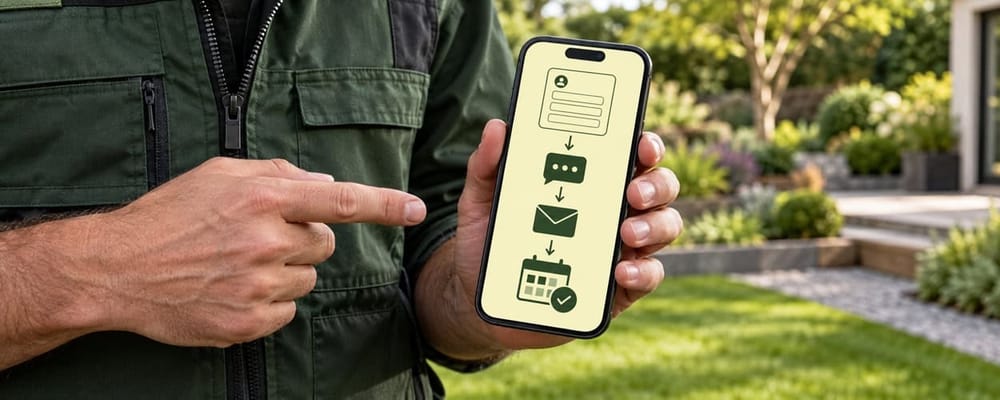
Set up multi-step follow-ups: Day 0 instant SMS plus email, Day 1 reminder, Day 3 "still interested?" nudge, Day 7 final check-in. All sequences automatically pause if the job is booked inside the landscaping CRM. Funnel Builders Expert connects these sequences to the CRM pipeline so that moving a lead to "Estimate Scheduled" or "Won" automatically stops sales follow-ups and starts pre-service reminders instead. Automated follow-ups can increase transaction rates by six times compared to manual outreach.
For compliance in 2026, include consent checkboxes on forms for SMS and email, provide easy opt-out links in every message, and keep your messaging relevant to the service type and location the prospect inquired about.
Automating Local SEO and Content Marketing for Landscapers
Local SEO, Google Business Profile optimization, and content marketing bring in high-intent traffic year-round. A fully optimized Google Business Profile can increase leads by 60%, and landscaping companies can see a 748% ROI from SEO over time. Since 76% of mobile searchers visit a nearby business within 24 hours, local visibility is everything for landscaping services.
Build a content calendar around landscaping seasons in specific regions: spring fertilization tips for Chicago, drought-tolerant landscaping guides for Phoenix, fall aeration scheduling for Atlanta. Pre-schedule blogs, emails, and social posts so your landscaping marketing runs consistently even during your busiest weeks.
Automate repurposing: one completed project becomes a photo gallery on a service page, a before-and-after Instagram reel, a YouTube short, and an email to your list about the transformation. Video content can increase conversions by up to 80%. High-quality project photos increase engagement and local rankings, so regularly uploading project photos to your Google Business Profile and website matters.
Use tools that auto-post Google Business Profile updates and social media snippets, and trigger automated review requests every time a job in the CRM is marked completed. HomeGreen Landscaping gained 340-plus reviews in six months with this approach, averaging a 4.9 rating. Evergreen guides like "How much does sod installation cost in 2026 in Dallas?" can be scheduled and re-promoted every season automatically, feeding your content marketing engine with minimal ongoing effort. This strategy aligns with what we cover in our guide on SEO for lead generation.

Automating Google Ads and Paid Campaigns for Landscaping Companies
Google Ads generate faster leads than SEO, making them one of the quickest ways for a landscaping business to fill the calendar in 2026. But without automation connecting campaigns to real booked jobs, you are optimizing for clicks instead of revenue.
Funnel Builders Expert structures search campaigns around specific landscaping services and locations-"lawn mowing near me," "retaining wall contractor in Nashville," high intent searches like "weed control service [city]"-and sends all traffic to high-converting service pages or funnels. PPC campaigns should target specific keywords for effectiveness, and landscaping ads perform best when they match the exact service and geography the homeowner searched for. Facebook Ads can target homeowners in specific neighborhoods, making them powerful for reaching property managers and local homeowners who have not yet searched but fit the profile.
Conversion tracking and offline conversion imports are critical. When a lead from Google Ads becomes a paying landscaping customer in the CRM, that data is pushed back to Google to optimize bids and keywords. This means the algorithm learns which clicks actually produce booked jobs and recurring routes, not just form fills.
Budget automation tips: increase bids during spring cleanups and seasonal cleanups when demand surges, reduce spend during winter in cold climates, and pause ad groups for services like lawn care during off-season months. A/B testing can improve ad performance significantly-test "Get a Free 24-Hour Quote" against "Get a Same-Day Lawn Care Estimate" to find what drives more conversions in your market.
Retargeting ads built from CRM data let you reach past landscaping customers who have not booked in the last twelve months with seasonal offers, automated upsells for services like fall aeration or patio installation, and reactivation campaigns. This approach to client acquisition turns paid ads from a one-shot expense into a compounding system.
Automated Social Media Marketing and Reputation Management
Landscapers win trust visually. Since 78% of businesses rely on social media for revenue and 93% of consumers read online reviews before hiring services, automating consistent photo and video posting keeps the brand visible while crews work in the field. Offline marketing like yard signs, truck wraps, and direct mail still generate awareness, but offline channels need to drive people online where automation takes over.
Set up a simple workflow: when a job is completed and marked with a "Showcase" tag in the landscaping CRM, it triggers a draft social post featuring before-and-after images with a short caption. This keeps your feed filled with real project photos without requiring the owner to remember to post.
Automate review requests via SMS and email linking directly to Google Business Profile. Sequence: immediate request after job completion, a three-day reminder, then a final nudge. Businesses with over 82 reviews generate up to 54% more revenue, and businesses with strong reviews rank higher in local searches. Automated reviews can improve local SEO and visibility for service businesses, feeding positive ratings back into map pack rankings and lowering cost per lead from Google Ads.
Funnel Builders Expert builds dashboards showing which campaigns and posts actually drive calls, form fills, and booked landscaping jobs-not just likes and follows. Similar to how we approach marketing funnels for pool builders, the focus is always on revenue-generating metrics.

Integrating Marketing Automation with Scheduling, Route Optimization, and Field Operations
Marketing automation should not end at the quote. It should connect into job scheduling, crew dispatch, route optimization, and payment for landscaping companies. When a quote is accepted, the system should automatically create a job, assign it to a route, and notify the crew-minimizing office admin time.
Integrations with platforms like Service Autopilot or similar route optimization tools can automatically create jobs and recurring visits once a quote is accepted. Concrete example: a homeowner in Orlando requests weekly mowing via a service page, automation sends the quote, the client e-signs, the job is pushed into the scheduling system, and the system automatically assigns the best route for the Thursday crew. Cloudflow's AI optimizer reduces daily drive time by 20 to 30 percent, and better route optimization combined with automated scheduling allows landscapers to complete more installations or mow more lawns per week.
Automated reminders-24-hour SMS, morning-of email with job details-reduce no-shows and surprise cancellations, especially for higher-ticket hardscaping projects that require coordinated crews and materials. Automated invoicing reduces cash flow problems in landscaping operations by sending payment requests immediately after job completion rather than waiting for manual entry. The workflow from marketing to payment becomes one connected pipeline.
Lifecycle Campaigns: Turning One-Time Jobs into Recurring Revenue
The most profitable landscaping businesses focus on lifetime value, not just the first job. Automation makes consistent follow-ups realistic even with hundreds of clients. Email marketing can yield $36 to $42 for every $1 spent, making lifecycle email campaigns one of the highest-margin activities a landscaping company can run. Email campaigns can promote seasonal services effectively by hitting inboxes at the exact right time.
Specific lifecycle campaigns to automate: new customer onboarding explaining what to expect and how to prepare for the first site visit, a 30-day satisfaction check-in, seasonal reactivation sequences for spring cleanups, fall aeration, and winter pruning, and upsell flows from basic mowing to fertilization, from simple beds to full landscape design. Automation can generate reminders for seasonal services to increase customer retention without any manual work from office staff.
Example: every February, past clients in a given ZIP code automatically receive a sequence of emails and SMS messages about booking spring lawn care slots before they fill. Marketing automation enables customer segmentation for personalized marketing communications, so commercial contracts get different messaging than residential accounts. Seasonal marketing campaigns can be automated to reach existing clients at the right time, based on their service history and property type.
Referral automation is equally powerful. After a customer leaves a five-star review, they receive a follow-up asking them to refer neighbors, sometimes linked to a simple incentive such as a free mid-season lawn treatment. Referral programs can increase leads by 30% or more, and HomeGreen Landscaping saw a 23% reactivation rate from dormant leads contacted through automated sequences.

Tracking, Reporting, and Optimizing Your Automated System
Marketing automation is only as good as the data you review. Many landscaping owners set up workflows and never look at them again. Landscapers should know which channels, keywords, and campaigns actually generate profitable booked jobs, not just leads.
Key metrics to track: cost per lead by source, cost per booked job, average job value by service type, recurring versus one-time job ratio, response time to new leads, review volume and rating, and job costing accuracy. These numbers tell you where to invest more and where to cut.
Funnel Builders Expert sets up centralized dashboards pulling in data from Google Ads, local SEO, social media, and the landscaping CRM so owners can see performance at a glance. This mirrors the approach used by Oceans Edge Landscaping, which ran nightly reports combining form leads, chat leads, and analytics into a single view.
Run simple monthly optimization cycles: pause underperforming keywords, improve under-converting service pages, adjust automation timing, and test different subject lines or SMS scripts for better response. A/B testing in 2026 is accessible even for small landscaping businesses-test form headlines, landing page layouts, and ad creative systematically. Track which version generates faster leads and more booked jobs, then scale the winner.

Working with Funnel Builders Expert to Automate Your Landscaping Company
Funnel Builders Expert is a global network of funnel builders and automation specialists focused on local service industries, including landscaping companies in the US, Canada, UK, Australia, and New Zealand. Rather than offering isolated marketing tactics, we build complete lead acquisition systems that cover the full lifecycle from first click to recurring revenue.
The typical engagement roadmap includes discovery of current lead sources, mapping the client journey, selecting or refining a landscaping CRM, building funnels and landing pages per service and city, and then wiring up automation, paid ads, and local SEO into one system.
Deliverables include high-converting service pages for every landscaping service you offer, Google Ads campaigns targeting specific cities and service areas, email and SMS nurture workflows for every pipeline stage, review-generation automations tied to job completion, and integrated dashboards that show real ROI.
The goal is to create one coherent client acquisition system that the landscaping business can rely on through busy 2026 seasons and beyond-not a pile of disconnected tools. If you want to see where your current landscaping marketing has gaps that automation could close, book a strategy session with our team and we will map it out together.

Common Pitfalls and Best Practices in Landscaping Marketing Automation
The wrong automation can annoy prospects or break operations. Many owners get excited and build overcomplicated workflows that nobody on the team understands. Others fail to keep CRM data clean, send generic messages that ignore location and season, or leave leads stuck in a pipeline stage without clear next steps.
Best-practice guidelines: start small with two to three core automations-new lead follow-up, automated review requests, and seasonal reactivation. Document every workflow so anyone on your team can understand and troubleshoot it. Test all messages on your own phone and email before deploying them to prospects.
Involve office staff and crew leaders in planning. If your automation sends a "crew is on the way" text but does not account for rain delays, it will erode trust instead of building it. Schedule changes, equipment breakdowns, and weather shifts are realities of landscaping operations that your workflows need to handle gracefully.
Marketing automation is an ongoing improvement cycle, not a one-time project. Incremental changes-a better subject line here, a faster follow-up there, a cleaner CRM tag structure-can significantly impact lead volume and profitability over the 2026 season and beyond.
Frequently Asked Questions about Marketing Automation for Landscapers
These FAQs address common concerns landscaping companies have before automating their marketing.
Do I need a landscaping-specific CRM to start with marketing automation?
While landscaping-specific CRMs with route optimization and recurring job features are ideal long term, smaller landscaping businesses can begin with a simple CRM integrated into their website and upgrade later as volume grows. The best landscaping CRM for you depends on your current size-Jobber works well for smaller teams, while Service Autopilot or Aspire fit larger operations. The key is choosing tools that integrate with email, SMS, and booking systems so automation runs smoothly when you add more crews, services, and commercial contracts.
How quickly can a landscaping company see results from marketing automation?
Most landscaping businesses notice improved response times and more booked estimates within the first 30 days, especially when instant SMS and email follow-up is added to existing lead sources like Google Ads and local SEO. Full benefits from lifecycle campaigns, content marketing automation, and review volume growth typically build over three to six months as the contact database compounds. HomeGreen Landscaping saw 340-plus reviews and significant lead reactivation within six months of launching their automated system.
Will automation replace my office staff or just support them?
Automation handles repetitive tasks-data entry, reminder emails, basic follow-ups, client communication confirmations-so office teams can focus on higher-value work like quoting complex projects and handling customer experience issues. For multi-crew landscaping companies, human oversight is still essential for pricing, scheduling nuance, and field decision-making. Using CRM software can save landscaping businesses several hours weekly, but the goal is to redirect that time, not eliminate people.
Is marketing automation only for large landscaping companies with many crews?
Solo operators and small teams often benefit the most because automated follow-up keeps their small pipeline active while they are on-site working. AI tools and simple automation prevent leads from being lost during busy days when you cannot respond quickly. As the landscaping business scales and adds more crews, the same automation foundation expands with more segments, service lines, and integrations without starting from scratch.
How much should I budget for tools and services to automate my landscaping marketing?
Basic tools for a small landscaping business might run a few hundred dollars per month, covering CRM, email marketing, SMS, and call tracking. Service Autopilot entry pricing starts around $49 per month, but automation features require higher tiers near $499 per month. Jobber mid-tier runs about $139 per month. Focus on return on investment: track how many extra booked jobs and recurring contracts automation brings in, and reinvest a portion of that additional revenue into improving and scaling the system. For done-for-you service including funnel builds, ad management, and automation wiring, costs are higher but the ROI typically justifies the investment within the first season.

Website.
Ecommerce Website
Blog Website
Website Design
Web Management
WordPress Website
SEO - AIO
AI Optimization
Local SEO
On-Off Page
SEO Audits
Technical SEO
Paid Advertising
Display Ads
Meta Ads
Google Ads
Linkedin Ads
TikTok Ads
CRM Automation
CRM Setup
Email Marketing
Lead Management
Pipeline Automation
SMS Marketing
Disclaimer: This site is not affiliated with or endorsed by Google or Meta™. All content is for educational purposes only and does not guarantee results or earnings. Your success depends on your own efforts, experience, and circumstances. Financial examples are illustrative, not promises. Always seek professional advice before making business or financial decisions. By using this site, you agree we are not liable for outcomes based on this information.
2026 © Funnels Builders Expert, a Sydney Website Design Agency product - Privacy Policy - Terms & Conditions