
Local SEO for Landscapers: How to Rank Higher on Google Maps and Win More Local Jobs
Most homeowners looking for a landscaper never scroll past the first three results on Google Maps. If your landscaping business isn't showing up there, you're handing jobs to competitors who are. This guide breaks down exactly how to fix that.
Key Takeaways
Local SEO helps landscaping companies, lawn care companies, and hardscaping contractors show up in Google Maps and "near me" searches. Since 93% of online experiences start with a search engine, local visibility is what separates booked-out crews from crews sitting idle. The right landscaping SEO strategy turns local searchers into estimate requests and closed jobs.
A fully optimized Google Business Profile, fast website load time, and strong local reviews are the three biggest levers for ranking in the Google Maps 3-pack in 2026. These three factors account for the majority of what Google evaluates when deciding which landscapers to show first.
Landscapers should start SEO work at least one season before peak months. If you want to dominate March through June, begin optimizing in October through December, because rankings take time to build. This guide is written from Funnel Builders Expert's perspective as a done-for-you local SEO and client acquisition partner for landscaping businesses.
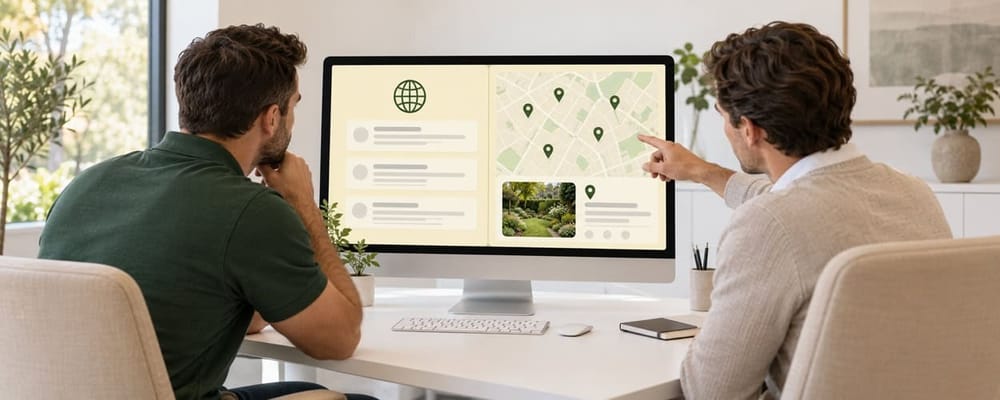
What Is Local SEO for Landscapers (and How It Differs From General SEO)?
Local SEO focuses on ranking a landscaping business in a specific service area rather than nationally. Instead of competing for broad terms like "landscaping ideas," you're targeting searches like "landscaper in Denver," "lawn care service Columbus Ohio," or "retaining wall contractor near me." Effective local SEO targets customers within a roughly 30-mile radius, which is exactly where most landscaping companies operate.
For landscaping services, local SEO aims to win visibility online in three places: the Google Maps 3-pack (those top three map listings with star ratings), the organic results below it on search engine results pages, and discovery searches within Google Maps itself. The difference between local SEO and paid ads is straightforward. SEO, or search engine optimization, is slower to build but creates long-term visibility and a lower cost per lead. Paid ads stop generating leads the moment you stop paying. Funnel Builders Expert combines local SEO with high-converting funnels so that website traffic from Google actually turns into estimate requests and booked projects, not just clicks.
Why Local SEO Is Critical for Landscaping Companies in 2026
In 2026, most homeowners start their search for landscapers on Google. Ninety-three percent of online experiences start with a search engine, and 42% of people doing a local search click results in the map block. Property owners typically only look at the first page and often only the top three to five results. If a landscaping company isn't in that group, they're effectively invisible to potential customers.
Local SEO brings in higher-intent leads, people who are already searching for services like lawn care, hardscaping, irrigation repair, or landscape design. These aren't casual browsers. They're homeowners ready to hire. Strong local search rankings can also stabilize revenue across seasons by driving consistent quote requests for recurring services such as mowing, fertilization, and spring cleanups. SEO can improve visibility and generate leads over time, making it a strategic asset that increases business valuation and resilience rather than just delivering more clicks to your website.
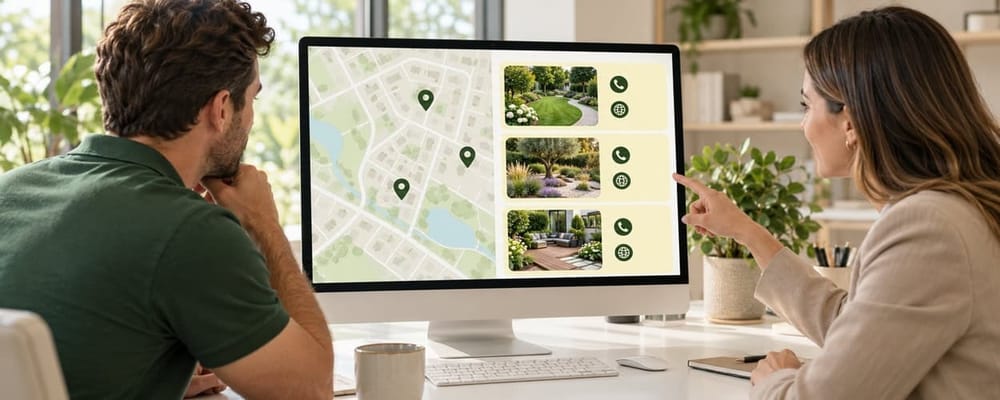
How Google Maps and the Local "3-Pack" Work for Landscaping Businesses
The Google Maps 3-pack is the cluster of three business listings with star ratings shown above normal search results when someone types "landscaper near me" or "lawn care [city]." Since 42% of local searchers click results in the map block, landing in these three spots is where the money is for most landscaping companies.
Three main ranking factors determine which landscapers appear. Proximity to the searcher contributes roughly 55% of the predictive power for map pack positions. Relevance, meaning your categories, services, and keywords match what someone is searching for, is the second factor. Prominence, which includes reviews, backlinks, and overall authority, rounds out the picture. According to benchmarking data from 684 landscaper listings across 40 US cities, the typical listing in the map pack has 25 reviews and a 4.9-star rating.
Consider two landscaping businesses in the same city offering the same services. The one with a fully filled-out Google Business Profile, dozens of recent detailed reviews, a well-structured website, and consistent citations will outrank a competitor with fewer reviews and a vague online presence almost every time. Service-area landscaping businesses without a storefront can still rank well using hidden addresses and properly configured service areas. Appearing in both the 3-pack and the organic listings below dramatically increases click-through rates and call volume.
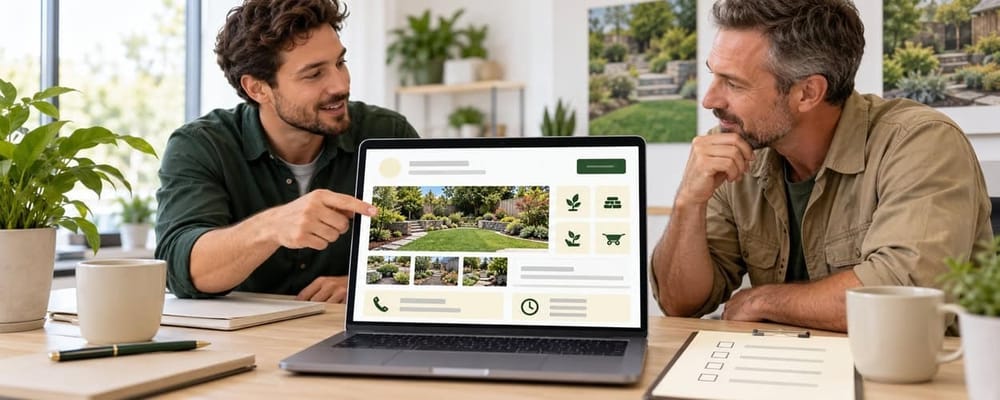
Setting Up and Optimizing Your Google Business Profile for Landscapers
Claiming and verifying a Google Business Profile is essential for local visibility. A complete Google Business Profile boosts local search visibility and serves as the foundation of local SEO for every landscaping company and lawn care provider. Regularly updated Google Business Profiles improve local rankings, so this isn't a set-it-and-forget-it task.
Start by choosing the right primary category. In benchmarking data, 70.6% of top landscaper map pack listings used "Landscaper" as their primary category. If lawn care service is your core revenue, use that instead. If you're primarily a landscape designer, choose accordingly. Your primary category should match your highest-margin offering.
Secondary categories should cover real services you genuinely provide, such as tree service, snow removal service, fence contractor, or gardener. Misrepresenting your services can lead to suspension. Fill out every GBP field: business name (without keyword stuffing), address or service area, phone number, website URL, opening hours including seasonal hours, and detailed service descriptions. Add high-quality photos of completed projects showing before-and-after lawns, patios, outdoor kitchens, and irrigation installs. Publish weekly GBP posts with seasonal offers, tips, and promotions. Use messaging and call tracking numbers where appropriate. Keep your business details on GBP consistent with your website and citations to avoid confusing Google.
GBP Categories and Local Citations for Landscaping Companies
Precise categories and consistent citations help Google trust your business and rank it higher in local search. Citations are mentions of your Name, Address, and Phone number across the web. Google prioritizes businesses with consistent NAP across directories.
To choose the right GBP categories, match your main profit center. If mowing is your core recurring revenue, "Lawn care service" should be your primary category. Check what competitors ranking in your city use and adjust. You can test different secondary categories over time to see what moves the needle.
Citations should be built on local directories including Apple Maps, Yelp, Houzz, Angi, HomeAdvisor, local chamber directories, and industry sites relevant to the green industry. Landscaping businesses should correct NAP inconsistencies on major directories and data aggregators like Neustar Localeze, Foursquare, and Data Axle. Use the same business name format and phone number everywhere. Avoid using tracking numbers in citations unless handled through advanced NAP strategies. Consistent online mentions enhance authority in local searches and signal to search engines that your landscaping business is legitimate and established.

Website Essentials for Local SEO: Speed, Mobile, and Service Pages
Google uses your website as a "trust anchor" for your GBP. A weak site limits map pack rankings even if your profile is strong. Mobile optimization is crucial for ensuring quick access to information by prospective clients. Mobile users account for over 60% of internet traffic, and Google prioritizes mobile-friendly sites for search rankings.
Here are the performance targets every landscaping website should hit: aim for a load time under 3 seconds on mobile. Eighty-three percent of users expect websites to load in under 3 seconds, and page load time affects user retention significantly. Use compressed images for portfolio photos and before-and-after galleries, preferably in modern formats like WebP. HTTPS and mobile-responsive design are non-negotiables in 2026. One case study showed a landscaping company dropping load time from 13.6 seconds to 1.6 seconds, which contributed to a 578% increase in visibility.
Structure your landscaping website with these core pages: a home page focused on your primary city and main services, dedicated SEO-friendly service pages for lawn care, landscape design, hardscaping, irrigation, and tree services, plus city or area pages for key suburbs and towns in your service area. Creating dedicated service and location pages enhances website SEO effectiveness. Each service page should include clear H1 headings using target keywords like "Lawn Care in Tampa, FL," service descriptions, landscaping cost ranges or starting prices, FAQs, and strong calls-to-action such as "Request a Free Estimate by Friday." Creating service-specific landing pages targets higher-value searches and converts visitors at a much higher rate. Funnel Builders Expert can rebuild or optimize landscaping websites to improve load time, SEO structure, and conversion rate simultaneously.
Local Keyword Research for Landscaping SEO
Effective landscaping SEO starts with understanding exactly how local customers search for services. High-intent local keywords are critical for attracting customers close to the point of purchase.
Use tools such as Google Keyword Planner, Google Search Console, and free options like Google Autocomplete and "People Also Ask" to find phrases like "landscaping company + [city]," "lawn care service + [city]," "paver patio installation + [city]," and "commercial landscaping + [city]." A good keyword research tool will also reveal search volume and competition levels so you can prioritize.
Mix "landscaping" and "lawn care" keywords to capture both high-ticket design and install projects and recurring maintenance work. Understand the difference between informational keywords like "how much does landscaping cost in Dallas" and transactional keywords like "landscaper near me" or "sod installation Phoenix quote." Map informational keywords to blog posts and helpful articles, and transactional keywords to service pages and landing pages. Using keywords naturally improves content quality and search rankings. Avoid low-quality terms like "cheap" unless that's a deliberate positioning choice. Include real neighborhood and city names in your keyword combinations for maximum local relevance.
On-Page Local SEO: Turning Landing Pages into Local Lead Machines
On-page SEO aligns your website pages with how local homeowners and property managers search, boosting both rankings and conversions. Localized content improves search visibility for specific services and areas.
Apply these specific on-page tactics: use city plus service in page titles, such as "Landscape Design & Lawn Care in Charlotte, NC – [Brand]." Write compelling meta descriptions that include local cues and a call-to-action. Include the city or service area naturally in H1s and subheadings. Embed your NAP on every page in the footer and include an embedded Google Maps location on contact and main service pages.
Add localized content elements by mentioning local neighborhoods, HOAs, and landmarks. Include testimonials with city names and job types, for example, "They did an excellent job on our paver patio in Westfield, NJ." Each page should feature strong calls-to-action like a form, phone number, or "Book a consultation" button that may link into a funnel or CRM system set up by Funnel Builders Expert. High-quality content can generate inquiries from serious buyers when structured this way.
Reviews, Reputation, and Conversion: Turning Happy Clients into Local Ranking Power
For landscaping businesses, Google reviews are both a ranking factor and a conversion booster. Customer reviews boost authority and brand trust. Positive reviews on Google improve local SEO rankings and directly increase calls and form submissions. Review signals account for roughly 20% of local pack ranking factors.
Request reviews strategically by job type. For design and build projects, ask right after the final walkthrough and again 30 to 45 days later when plants have filled in. For lawn care and maintenance, ask after two to three successful visits when results are visible. For commercial accounts, request detailed testimonials at contract renewal. Send review links via SMS and email and provide simple prompts so clients mention services, city, and results, such as "They installed our new sprinkler repair system in Plano and cut our water bill by 25%."
Reply to every review, positive and negative, professionally. Include subtle keyword signals in your responses like "Thank you for trusting us with your backyard landscaping in Spokane." Funnel Builders Expert can automate review requests and follow-ups via CRM and marketing automation, ensuring a steady stream of fresh reviews so potential clients always see recent feedback.
Link Building and Local Authority for Landscaping Businesses
Quality local backlinks act like "votes of confidence" for your landscaping website and help it rank higher than competing landscaping companies. Backlinks from reputable sources enhance website credibility and rankings, and high-quality backlinks increase search engine visibility.
Practical, white-hat link building opportunities for landscapers include sponsoring local youth sports teams or community gardens and getting links from their websites. Engaging in community sponsorships can earn local backlinks that improve search visibility. Partnering with local nurseries, garden centers, and home builders for resource pages and project features is another top notch approach. Publishing project spotlights on local real estate, home improvement, or HOA blogs builds authority in the landscaping industry.
Avoid buying spammy links or using link schemes. Penalties in 2026 can severely damage hard-earned local search rankings. Targeting 5 to 15 high-quality local links over a year is more valuable than hundreds of low-quality directory links. Backlinks from high-authority sites enhance credibility far more than volume. Funnel Builders Expert can design and run safe, localized link-building campaigns tailored to your market and service mix.

Seasonal Content Strategy: Filling Your Schedule Before Busy Season
Landscaping demand follows predictable seasonal patterns. Spring cleanups, summer outdoor living projects, fall aeration, winterization, and snow services in cold regions all have their own search cycles. "Landscaping near me" peaks at roughly 165,000 searches in March and April, dropping to about 49,500 in December.
Blog posts, landing pages, and GBP posts should be published 60 to 90 days before the peak search season. Publish spring lawn cleanup content by January to capture homeowners planning ahead. Landscaping websites can see traffic growth of 257% in three months when seasonal content is timed correctly.
Concrete content ideas include "Spring Lawn Cleanup Checklist for Homeowners in [City]," "Best Backyard Patio Ideas for [City] Summers," "When to Aerate Your Lawn in [Region]," and "How Much Does a New Landscape Design Cost in [Year] in [City]?" Each seasonal piece should link to relevant service pages for aeration, fertilization, or patio installation to guide readers into booking. Share these across social media channels for additional reach. Funnel Builders Expert can build editorial calendars tied to local climate patterns and integrate them into email and social campaigns for maximum impact.

Tracking Results and Scaling Your Landscaping SEO with Funnels and Automation
Serious landscaping businesses treat local SEO as an investment and track ROI using data, not guesses. Tracking SEO performance metrics helps businesses understand lead generation effectiveness and ensures every dollar spent is accountable. SEO can increase conversions by up to 350% when combined with proper tracking and funnel optimization.
Key metrics to monitor monthly include calls and form submissions from organic search and Google Maps, rankings for main city plus service keywords, website traffic to key service pages and city pages, and conversion rate from visitor to lead and from lead to booked job. Tools like Google Analytics, Google Search Console, GBP Insights, and call tracking numbers can tie leads back to specific pages and keywords. Technical SEO audits should also be performed quarterly to catch issues before they hurt rankings.
Funnel Builders Expert connects local SEO traffic into done-for-you funnels. Clicks from Google go to conversion-focused landing pages. Leads are captured into a CRM. Automated follow-ups via SMS and email nurture quotes into closed deals, similar to what we build for other home service businesses. Once a landscaper sees consistent lead flow from one city, they can scale into nearby cities using additional city pages, more GBPs where eligible, and replicated funnels to generate leads and win more customers in every service area.

FAQ: Local SEO for Landscapers
These frequently asked questions tackle common, practical concerns landscapers raise once they start investing in local SEO and digital marketing.
How long does it take for a landscaping company to see results from local SEO?
Most landscapers begin seeing early movement in Google Maps and organic traffic within 6 to 12 weeks if they consistently optimize GBP, fix website issues, and publish content. Competitive metro areas or brand-new domains may take 6 to 12 months to reach top positions for high-value keywords like "landscaper + city." Start your SEO strategy at least one season before peak demand. For example, begin in Q4 2026 to dominate spring 2027 searches during busy season.
Can I handle local SEO myself, or do I need an agency?
Solo landscapers and small lawn care companies can handle basics like GBP setup, asking clients to leave reviews, and adding a few dedicated pages on their own. However, multi-crew, growth-focused landscaping businesses often benefit from partnering with a specialist agency like Funnel Builders Expert for SEO services, technical SEO, keyword research, funnels, and automation. A hybrid approach works well: the owner handles photos, reviews, and job stories while the agency manages strategy, client acquisition systems, and campaign execution.
How important is website load time for a local landscaper's rankings?
Extremely helpful to get right and extremely damaging to ignore. Slow load time hurts both rankings and conversion rates. If your site takes 4 to 5 seconds on mobile, many visitors bounce before ever calling. Target sub-3-second mobile load times and use tools like PageSpeed Insights or GTmetrix to identify issues. Image-heavy landscaping portfolios need proper compression and modern formats like WebP to keep your site fast for the more than 60% of visitors browsing on mobile devices.
Should my landscaping business focus on "lawn care" or "landscaping" keywords?
Both matter. "Lawn care" captures recurring maintenance jobs like mowing, fertilization, and weed control. "Landscaping" captures higher-ticket landscape design, installation, and hardscaping projects. Structure your site with separate service pages optimized for each intent, and use GBP services and categories to reflect both where applicable. Funnel Builders Expert often builds separate funnels for maintenance versus project work so messaging and offers match each audience.
What if I service multiple cities but only have one physical location?
Service-area landscaping businesses can list all covered cities in their GBP service area while keeping a single primary address hidden if needed. Create unique, value-rich city pages for each major target city, showcasing completed projects, reviews, and photos specific to those locations. Ranking in multiple cities takes time and strategic effort, but it is achievable with strong site structure, localized content, and real jobs completed in each area. This multi-city approach is how the most successful landscaping companies scale beyond their immediate neighborhood.

Website.
Ecommerce Website
Blog Website
Website Design
Web Management
WordPress Website
SEO - AIO
AI Optimization
Local SEO
On-Off Page
SEO Audits
Technical SEO
Paid Advertising
Display Ads
Meta Ads
Google Ads
Linkedin Ads
TikTok Ads
CRM Automation
CRM Setup
Email Marketing
Lead Management
Pipeline Automation
SMS Marketing
Disclaimer: This site is not affiliated with or endorsed by Google or Meta™. All content is for educational purposes only and does not guarantee results or earnings. Your success depends on your own efforts, experience, and circumstances. Financial examples are illustrative, not promises. Always seek professional advice before making business or financial decisions. By using this site, you agree we are not liable for outcomes based on this information.
2026 © Funnels Builders Expert, a Sydney Website Design Agency product - Privacy Policy - Terms & Conditions