
How Do I Create a Sales Funnel? A Practical Guide for Coaches, Consultants, and Course Creators
If you sell coaching, consulting, or online courses, you already know that talent alone doesn't fill your calendar. What fills it is a system - and that system is a sales funnel. Here is exactly how to build one that works.
Key Takeaways
An effective sales funnel is a step-by-step path that moves strangers from the awareness stage all the way to becoming paying customers. For coaches, consultants, and course creators, it replaces unpredictable outreach with a repeatable, automated selling process. An effective sales funnel guides customers from awareness to advocacy, meaning it doesn't just close a deal - it creates fans who refer others.
The four core funnel stages are:
- Awareness stage - prospective customers discover you through ads, content, or referrals.
- Interest stage - they opt in for a free lead magnet, join your list, or attend a webinar.
- Consideration stage - they evaluate your offer against competitors using case studies, emails, and targeted content.
- Decision stage - they book a call, submit an application, or complete a purchase.
You can build a simple, effective sales funnel with just a landing page, a lead magnet, an automated email sequence, and a sales call or checkout page. And if you're already generating $10,000+/month and want to scale without managing tech and ads yourself, Funnel Builders Expert builds these systems done-for-you so you can focus on delivery.
What Is a Sales Funnel (and Why It Matters in 2026)?
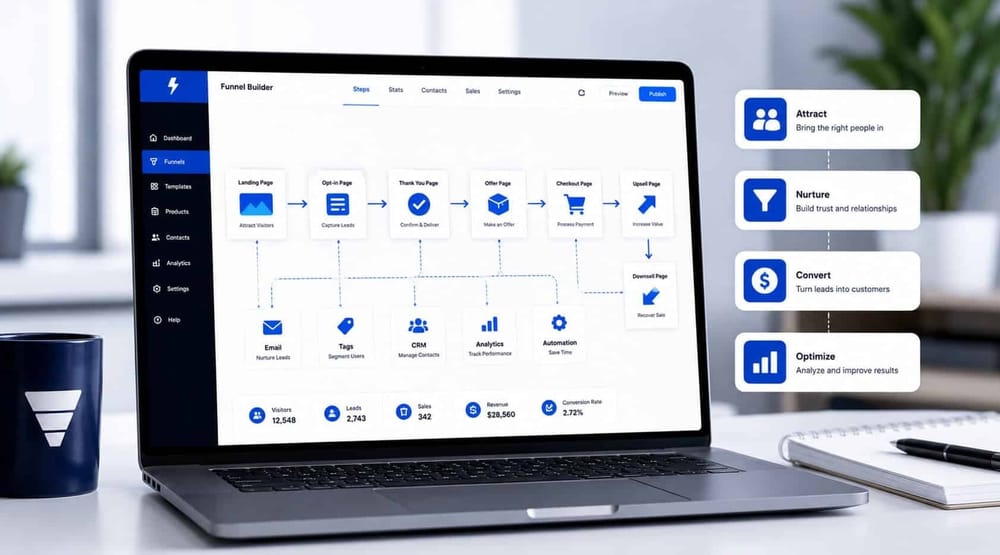
A sales funnel is a visual map of the customer journey from first click to paid client. It tracks every touchpoint - ads, landing pages, nurture emails, calls, and checkout - and shows where prospects drop off. It differs from a broader marketing funnel, which often includes top-level brand awareness and post-purchase loyalty. Most marketing funnels use a 3-stage model (Awareness, Consideration, Decision), but a sales funnel adds a dedicated interest stage to capture contact details before the prospect starts comparing solutions.
Sales funnels help visualize customer journeys and optimize each stage to drive conversions. Here is how leads flow through:
- Awareness → A potential buyer clicks an ad or finds your blog post.
- Interest → They download your free lead magnet and join your email list.
- Consideration → They read case studies, watch testimonials, open nurture emails.
- Decision → They book a strategy call or click "Enroll Now."
A simple, effective sales funnel lets online coaches and consultants turn cold traffic from Google Ads, Meta Ads, or Local SEO into booked calls and program enrollments around the clock. Most funnels lose money because stages are disconnected - the ad doesn't match the landing page, there are no follow up emails after opt-in, nobody follows up after missed calls. This article fixes that, step by step.
Breaking Down the 4 Core Sales Funnel Stages
Before you build anything, you need to understand what must happen at each stage. Sales funnels typically consist of four stages: awareness, interest, consideration, and action. Here is what success looks like at each.
Awareness stage. The awareness stage introduces prospects to your brand or product or service. Someone sees a social media post, a Google ad, or a YouTube video. The goal is capturing the customer's attention - not selling. You want the right message reaching the right people.
Interest stage. In the interest stage, prospects begin to explore your specific solutions. They opt in for a lead magnet, register for a webinar, or follow your social media. This is where the sales funnel begins building a relationship.
Consideration stage. The consideration stage involves evaluating options before making a purchase. Potential customers compare you to competitors, read your case studies, and consume your email campaigns. You provide prospects with valuable content that makes the decision easier.
Decision stage. The action stage is when a prospect completes a purchase, books a call, or submits an application. Frictionless scheduling, clear pricing, and strong social proof are non-negotiable.
An effective sales funnel also includes a post-purchase mini-stage for onboarding, collecting testimonials, and generating referrals. This is where your customer base grows through word of mouth, not just ad spend.
Step 1 – Define Your Ideal Client and Customer Journey
You cannot create an effective sales funnel until you know exactly who it's for. Understanding the customer journey is crucial for effective marketing funnels, and the sales funnel should reflect the customer's buying preferences and experiences.
Build a customer persona that covers:
- Niche - leadership coaching, executive consulting, digital product creation
- Revenue level - are they pre-revenue or already at €10k+/month?
- Pain points - unpredictable income, low enrollment, client no-shows
- Current solutions tried - DIY marketing, freelancers, a different agency
Map a realistic buying journey. A mindset coach in Austin might discover you through Instagram reels, opt in via a 7-day mindset reset challenge, receive story-driven emails with case studies, then book a 1:1 strategy session. A B2B consultant in London might find you through Google search, download an audit checklist, and apply through a high-ticket application page. Using surveys can provide valuable insight into customer needs and preferences at each stage.
At Funnel Builders Expert, we interview new clients and review their CRM data, call recordings, and analytics to build this journey map before touching any funnel software.
Step 2 – Capture the Customer's Attention in the Awareness Stage
The goal here is simple: consistently generate more leads from the right target audience and send them to a focused landing page. Local SEO and targeted advertising are critical for driving traffic to sales funnels, especially for service-based businesses.
Traffic sources that work for coaches and consultants in 2026:
- Local SEO - Google Business Profile optimization, location-specific pages
- Evergreen YouTube content - how-to videos, problem-focused walkthroughs
- Google Ads and Meta Ads - paid advertising on platforms like Google and Facebook boosts brand awareness and reaches potential buyers fast
- Strategic partnerships - joint webinars, podcast guest spots, affiliate deals
Content optimization strategies improve search engine rankings and inbound traffic, so don't neglect organic channels. Align your ad hooks and social media posts with the pain points you identified in Step 1. If your audience struggles with "unpredictable revenue," your ad copy should say exactly that.
To create content that works at the awareness stage, focus on educational short videos, podcast snippets, carousels, and problem-focused blog posts. Every piece should lead to one clear action: click through to your lead magnet or landing page.
Step 3 – Build a High-Converting Landing Page
The landing page is the central capture point of your marketing funnel. It must be laser-focused on a single offer and one CTA. According to research covering 2.4 million sessions, the average landing page conversion rate sits around 4.84%, but top-quartile pages hit 6.9–9.8%.
Your landing page needs:
- A clear headline that mirrors your ad promise
- A short subheadline clarifying the outcome
- 3–5 bullet benefits showing tangible benefits
- A simple form (3 fields maximum)
- Social proof - testimonial quotes, client logos, or specific numbers
To boost conversions, remove site navigation so users aren't distracted, reduce form fields to the essentials, and keep copy scannable. Mobile speed matters - slow pages kill conversion rate.
Your thank you page can double as a micro decision stage. Use it to present a low-ticket "tripwire" offer, a short application, or a calendar link to qualify and segment leads early. Funnel Builders Expert designs and tests landing pages differently for webinar funnels, application funnels, and lead magnet funnels depending on the price point of the main offer.
Step 4 – Create a Strategic Lead Magnet That Starts the Relationship
A lead magnet is a high-value free resource that solves a specific problem and bridges the gap between the awareness and interest stages. Lead capture involves providing a valuable resource in exchange for contact information - that's the fundamental deal you're making with your audience.
Lead magnets that work for online coaches and consultants in 2026:
- 7-day action plans or challenges
- Mini-workshops or recorded trainings
- Scorecards and audit checklists
- Niche-specific swipe files or templates
The free lead magnet must connect directly to your core paid offer. A pricing checklist that naturally leads into a premium coaching package generates qualified leads. A generic "productivity tips" PDF does not. Misaligned magnets attract the wrong people and waste your marketing efforts.
Deliver the lead magnet instantly via email automation and set expectations on the thank you page about what happens next in the customer journey begins. Funnel Builders Expert helps clients test different lead magnet angles to find which generates the most qualified leads at the lowest cost per lead from Google Ads and Meta Ads.
Step 5 – Nurture Leads Through the Interest and Consideration Stages
Most funnels fail between opt-in and purchase. The prospect downloaded your lead magnet, and then… nothing. No follow-up, no story, no reason to care. Nurturing leads builds trust through email sequences and educational content, and the data backs this up: lead nurturing increases conversion rates by 50%, and companies that excel at lead nurturing generate 50% more sales-ready leads. Lead nurturing can also reduce the sales cycle by 23%.
Here is a basic 7–10 day email sequence structure:
- Immediate delivery - send the lead magnet, confirm next steps
- Story-based email - share a client transformation or personal origin story
- Case study - demonstrate results with specifics
- Objection handling - address the top 3 reasons people don't buy
- Clear CTA to core offer - invite them to book a call or enroll
Educational content helps engage users at every stage of the funnel and helps them recognize your brand's ability to solve their problems. Mix formats: written emails, short loom-style videos, links to pillar blog posts, and repurposed webinar snippets. Email nurturing campaigns can increase engagement by 33%.
Retargeting ads can convert users who visited your landing page but did not purchase or opt in. Segmentation - tagging based on link clicks, webinar attendance, or quiz results - allows more tailored follow-ups during the consideration stage. Segmented campaigns generate roughly 30% more opens and 50% more click-throughs than generic blasts.
Funnel Builders Expert connects Meta Ads, Google Ads, and CRM systems so leads receive coordinated nurture messages across email, ads, and SMS, with sales teams and marketing teams aligned on timing and follow-up - all visible in one dashboard.
Step 6 – Present Your Core Offer at the Decision Stage
The decision stage is where converting prospects into paying customers actually happens. This is where your sales strategy must be airtight.
Structure your decision-stage asset based on your business model:
Business Model
Decision-Stage Asset
Key Element
High-ticket coaching
Application funnel (booking page + form)
Qualifying questions + calendar
Group programs
Sales page with enrollment CTA
Detailed breakdown + payment plans
Digital product or course
Order form / checkout page
Pricing clarity + instant access
Effective offer creation focuses on solving a specific problem for your audience. Your unique value proposition should make it obvious why you're different from competitors. Include clear pricing, payment plan options, testimonials with specific results, and FAQs that handle every objection before a sales rep or sales teams ever get involved.
Give one primary CTA - "Apply for a Strategy Call" or "Enroll Now" - and optionally a secondary CTA like "Chat with us on WhatsApp." Avoid too many competing choices. Unique selling propositions differentiate your product from what other companies offer, so make yours prominent. Funnel Builders Expert often scripts simple call frameworks and follow-up automations so every application or cart abandon gets a structured sequence of reminders.
Step 7 – Automate Follow-Up, Onboarding, and Retention
A truly effective sales funnel doesn't stop at the sale. Marketing automation improves efficiency in managing leads and customer relationships on both sides of the buying process. Retaining customers is crucial for maximizing lifetime value after the sale, and effective lead nurturing can improve customer retention by 27%.
Set up basic post-purchase automation:
- Welcome emails with access instructions for courses or programs
- Onboarding checklists and kickoff call calendar links
- Timed campaigns at 30, 60, and 90 days to request testimonials, offer renewals, or invite clients into higher-tier programs
Providing exceptional customer support at this stage enhances customer retention and loyalty. Use your CRM to track client milestones and trigger personalized check-ins - not just generic newsletters. As your business grows, these lifecycle systems become the engine behind referrals, upsells, and a compounding customer base.
Funnel Builders Expert specializes in building these lifecycle systems so coaches and consultants don't have to manually manage follow-ups or tech integrations.
Step 8 – Measure, Fix Leaks, and Optimize Your Effective Sales Funnel
Every marketing funnel launches imperfectly. Analytics and optimization are essential for tracking sales funnel performance, and continuous optimization involves testing various aspects of the funnel to improve results. Tracking customer behavior in sales funnels reveals drop-off points that silently drain your ad budget.
Key metrics to monitor by funnel stage:
Funnel Stage
Key Metric
Healthy Benchmark
Awareness
Ad click-through rate
1–3% (varies by platform)
Interest
Landing page opt-in rate
25–45%+ (warm traffic)
Consideration
Email open / click-through
30%+ open, 3–5%+ click
Decision
Call-to-sale or checkout conversion rate
15–30% close rate
Key metrics to monitor include conversion rate, customer acquisition cost, and lifetime value. Optimizing requires understanding customer needs at each stage. Tracking customer behavior helps optimize marketing strategies and improve conversions over time. Effective sales funnels can increase conversion rates steadily when you commit to iteration.
How to diagnose leaks:
- Low opt-in rate? Landing page headline, form length, or ad-to-page mismatch.
- High bookings but low close rate? Sales process, offer positioning, or pricing issues.
- High email opens but no clicks? Weak CTAs or irrelevant content in the buying journey.
Run simple A/B tests: different hooks on ads, alternative headlines on landing pages, shorter versus longer order forms, or different guarantees. Funnel Builders Expert builds dashboards pulling data from Google Ads, Meta Ads, and CRM so clients can see the entire funnel performance in one place.
Realistic Funnel Examples for Coaches and Consultants
Theory is useful. Seeing how it works in practice is better. Here are three concrete scenarios you can model.
Lead Magnet → Nurture → Strategy Call (Business Coach, New York). A business coach runs Meta Ads targeting small business owners struggling to generate sales consistently. The ad sends traffic to a landing page offering a free "Revenue Roadmap" PDF. After opt-in, a 7-email sequence delivers the guide, shares case studies, handles objections, and invites prospects to book a free strategy call. The funnel drives conversions from cold traffic to booked calls in about 10 days.
Live Webinar → Replay Sequence → Application (Course Creator, London). A course creator selling a €2,000 group program promotes a live webinar through Google Ads and social media posts over 7 days. Attendees who don't buy live receive a 5-day replay sequence with urgency-driven emails, more social proof, and free trials of bonus modules. Applications feed into a short sales call for final conversion.
Local SEO → PDF Guide → Booked Appointment (Home Improvement Consultant, Sydney). A consultant ranks for "kitchen renovation consultant Sydney" using Local SEO and Google Ads. Visitors land on a page offering a "Renovation Cost Calculator" PDF. After opt-in, an email sequence shares before-and-after project photos and drives bookings for in-home consultations.
Choosing the Right Tools (or a Done-for-You Partner)
There are many sales funnel tools - ClickFunnels, Systeme.io, GoHighLevel, and more. Tech overwhelm slows down implementation, and most businesses spend weeks comparing platforms instead of generating leads.
When choosing, consider:
- All-in-one vs. assembled stack - all-in-one simplifies tech; assembled stacks offer more flexibility
- Required features - landing page builder with A/B testing, email automation, CRM with segmentation, payment integration, calendar or scheduling tool
- Budget - match the platform cost to your current revenue, not your projected revenue
Advanced setups combine funnels with Local SEO, Google Ads, Meta Ads, AI-powered routing, and CRM automation for a complete client acquisition system. Funnel Builders Expert builds and manages these systems end-to-end for established coaches, consultants, and course creators wanting a one-to-many, automated acquisition engine.
If you want clarity on what to build first, book a free funnel assessment where our team maps your current funnel, identifies leaks, and outlines a roadmap.
FAQs: Creating a Sales Funnel That Actually Converts
Below are answers to common questions about creating a sales funnel that we hear from coaches, consultants, and course creators every week.
How long does it realistically take to create a sales funnel from scratch?
A simple funnel - lead magnet, landing page, basic email sequence - can be built in 3–7 days if your copy and offer are ready. A full webinar or application funnel with proper testing typically takes 2–4 weeks. Using templates and a specialist agency like Funnel Builders Expert shortens build time so you can focus on driving quality traffic and refining your sales tactics.
Do I need a full website before building an effective sales funnel?
No. A focused landing page, lead magnet delivery system, and checkout or booking page are enough to start converting potential buyers. You can build your website and SEO authority in parallel over the following 3–6 months while the funnel is already capturing and nurturing leads in the same place.
What budget should I plan for ads to test my first funnel?
Plan €20–€50 per day on Meta Ads or Google Ads for at least 14 days to gather meaningful data, assuming a validated offer. For coaches and consultants already at €10,000+/month, allocating 10–20% of monthly revenue as a testing budget is common when aiming to close more deals with paid traffic.
How do I know if my sales funnel is working well enough to scale?
Track opt-in rates (25–45%+ for warm traffic is healthy), cost per strategy call or per sale relative to your margins, and consistent monthly return on ad spend. Only increase traffic budgets when those base metrics are stable for at least 30 days and your delivery systems - onboarding, fulfillment - can handle additional users.
Can Funnel Builders Expert help if I already have a funnel that's not converting?
Yes. A typical optimization engagement includes an audit of each funnel stage, analysis of tracking and attribution, copy and offer review, and implementation of quick-win tests. Request a funnel teardown where we review your ads, landing page, lead magnet, email sequence, and decision-stage pages to find and fix the biggest leaks first.

Website.
Ecommerce Website
Blog Website
Website Design
Web Management
WordPress Website
SEO - AIO
AI Optimization
Local SEO
On-Off Page
SEO Audits
Technical SEO
Paid Advertising
Display Ads
Meta Ads
Google Ads
Linkedin Ads
TikTok Ads
CRM Automation
CRM Setup
Email Marketing
Lead Management
Pipeline Automation
SMS Marketing
Disclaimer: This site is not affiliated with or endorsed by Google or Meta™. All content is for educational purposes only and does not guarantee results or earnings. Your success depends on your own efforts, experience, and circumstances. Financial examples are illustrative, not promises. Always seek professional advice before making business or financial decisions. By using this site, you agree we are not liable for outcomes based on this information.
2026 © Funnels Builders Expert, a Sydney Website Design Agency product - Privacy Policy - Terms & Conditions