
Customer Journey Funnels: How To Turn Cold Traffic Into Loyal Clients
Most coaches, consultants, and service businesses track clicks and leads but stop measuring the moment someone pays. The result: leaking revenue at every stage after the first sale. A customer journey funnel fixes this by giving you a measurable, automated system that covers every interaction from the first ad impression through referrals and repeat purchases. Here is how to build one.
Key Takeaways
- A customer journey funnel is a framework tracking customer progression from discovery to advocacy, combining a customer journey map with conversion metrics at each stage so you can find and fix drop-offs.
- The five customer journey stages (awareness, consideration, purchase, retention, advocacy) each require different marketing tactics tailored to the customer's state of mind, and measuring them lets you allocate budget based on conversion insights.
- Mapping customer journeys leads to faster sales cycles, averaging 18 times quicker, and companies using customer journey mapping see a 24% increase in customer satisfaction.
- Funnel Builders Expert builds done-for-you customer journey funnels combining sales funnels, paid ads, Local SEO, CRM, and automation for coaches, consultants, course creators, and local service businesses doing $10k+/month.
- This article walks through how to create a customer journey map, choose funnel metrics, and improve every stage of the customer lifecycle from first click to raving fan.
What Is a Customer Journey Funnel?
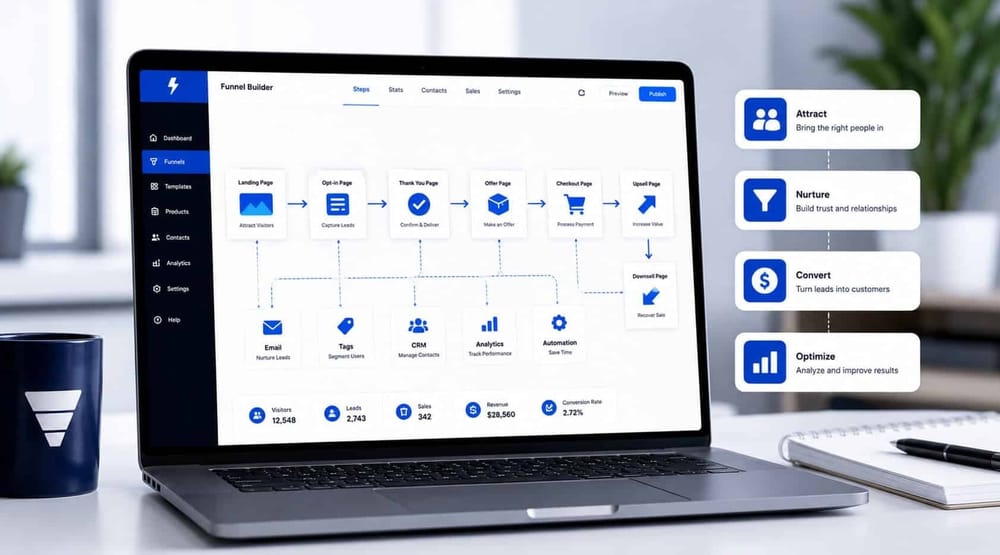
A customer journey funnel is the fusion of a customer journey map (a visual representation of how customers interact with your brand over time) with a measurable funnel that assigns conversion rates to each stage from first touch to advocacy. Unlike a generic sales funnel that ends at the purchase, a customer journey funnel continues through retention and the advocacy stage of the customer lifecycle.
For a coach or consultant, this looks concrete. A cold Meta Ad click leads to a webinar registration. That registration leads to a strategy call booking. The call converts to a paying customer. Onboarding moves the client into a group program. Three months later, that client refers two colleagues. Each transition has a number attached to it, and each number reveals where you are losing people or money.
Visualizing the entire customer journey as a funnel connects customer behavior, customer experience, and revenue in one view. You stop guessing which content or touchpoint matters and start seeing just what moves people forward. The rest of this article shows how to create a customer journey, map stages, and instrument funnels around them.
Customer Journey vs. Customer Journey Funnel vs. Customer Experience
Three terms get used interchangeably, but they describe different things. The customer journey is the sequence of all the interactions someone has with your brand, from first search to final review. Customer experience is how customers perceive those interactions; the emotions, friction, and satisfaction at each point. A customer journey funnel takes that path and overlays measurable stages with conversion metrics, turning a narrative into a system.
Here is the practical difference: the journey is the path, customer experience management is how that path feels, and the funnel is the path plus numbers. A coach might run the same webinar funnel but improve the experience by adding personalized SMS reminders, a clearer promise on the registration page, and a 24-hour follow-up video. Same funnel structure, better experience, higher show-up rate.
Funnel Builders Expert designs funnels starting from the customer's perspective, mapping the desired experience first, then layering in automation, copy, and media buying. Aligning all three gives you higher show-up rates, better close rates, and more advocacy without making the entire process feel pushy.
The Five Core Customer Journey Stages
The customer journey funnel typically consists of five core stages: Awareness, Consideration, Conversion, Retention, and Advocacy. These stages appear in most customer journey map templates used by both B2B and B2C brands.
For online experts and local service providers, the stages remain the same, but customer touchpoints shift. A coach relies on webinars and lead magnets; a plumber relies on Google Maps and phone calls. The underlying logic is identical.
Here is a concise breakdown of each stage:
- Awareness: Potential customers first learn about your brand or realize they have a problem you solve. Goal: earn attention.
- Consideration: Customers evaluate options, compare brands, and weigh credibility. Goal: build trust.
- Purchase: Customers decide to buy a product or service. Goal: remove friction and close.
- Retention: Keeping customers satisfied for repeat business, renewals, or continued engagement. Goal: deliver results.
- Advocacy: Satisfied customers promote your brand to others through referrals, online reviews, and case studies. Goal: multiply growth.
Later sections go deeper into funnel tactics, metrics, and automation for each stage.
Stage 1: Awareness Stage – Capturing First Attention
The awareness stage is where prospects notice they have a problem and discover your brand via search, social media, referrals, or Local SEO. Awareness is when potential customers first learn about a brand, and your job is to earn that initial awareness click, not push for a sale.
Typical awareness touchpoints for coaches and local experts include Google Ads, Meta Ads, YouTube content, TikTok clips, SEO blog posts, Google Business Profile listings, podcasts, and guest trainings. A lead acquisition strategy that covers multiple channels performs better than relying on a single source.
Consider a Melbourne fitness coach using Google Ads and Local SEO to appear when users search "online strength coach near me." In 2026, 83% of U.S. consumers used search engines in the prior 30 days to find a local business, while 52% used an AI tool for the same purpose. Social media posts, short-form video, and podcast appearances are additional channels to build brand awareness among your target audience.
The content focus at this awareness phase is problem-aware and educational. No hard sell. You are earning attention, not asking for credit card details. Customer behavior patterns in 2024-2026 show multi-device research and short-form content consumption before prospects ever visit a website, so your content needs to meet them where they scroll.
Stage 2: Consideration Stage – Nurturing Serious Interest
During the consideration stage, customers evaluate options and compare brands. They weigh your credibility, pricing, and track record against alternatives. This is where trust is built or lost.
Key touchpoints include website service pages, lead magnets (PDFs, checklists, mini-courses), email nurture sequences, testimonials, sales pages, comparison blog posts, and discovery calls. Customer journey mapping at this stage means listing the questions, fears, and objections your target customers carry before they book a call or enroll in a course.
Specific assets that work here:
- FAQ sections addressing the top five objections your sales teams hear on calls
- Case studies with dates and real numbers (e.g., "Client X went from 12 to 47 booked calls per month in 90 days")
- Side-by-side comparisons of your program versus alternatives
- ROI calculators for coaching programs
Funnel Builders Expert designs nurture flows (email + retargeting ads) tailored to the consideration stage to move people from "interested" to "ready to talk." According to BrightLocal research, 75% of consumers make a decision within 30 minutes of online discovery, which means your consideration-stage content needs to answer questions fast and remove doubt before the window closes.
Stage 3: Purchase / Conversion Stage – Turning Interest Into Revenue
The purchase stage occurs when customers decide to buy a product or service. For coaches and consultants, this usually means booking and showing up to a strategy call, signing a contract, or paying a deposit. For local businesses, it might be submitting a quote request or scheduling an appointment.
Typical conversion touchpoints include application forms, VSL (video sales letter) pages, checkout pages, sales calls, proposal emails, and payment links. Each of these steps is a potential drop-off point.
Practical ways to reduce friction:
- Simplified forms (three to five fields, not fifteen)
- Transparent pricing or clear "what to expect" language
- Risk-reversals: guarantees, cancel windows, trial periods
- Social proof placed next to call-to-action buttons
One concrete optimization: a Zoom sales call-booking funnel that adds SMS reminders and a pre-call "what to expect" video. This alone can lift show-up rates from 55% to 75%, which compounds into more closed clients from the same ad spend.
Measuring step-by-step conversion here is essential for funnel analysis: land → apply → schedule → show → close. If 100 people land on your application page and only 8 become clients, you need to know where the 92 dropped off.
Stage 4: Retention Stage – Extending Customer Lifetime Value
Retention focuses on keeping customers satisfied for repeat business. Loyal customers spend 31% more than new customers, and retention costs five times less than acquiring new customers. For coaching and service businesses, recurring contracts and upsells stabilize cash flow and compound profit.
Retention touchpoints include onboarding sequences, client portals, regular check-ins, progress reports, customer support team channels, renewal conversations, and upsell offers. A detailed customer journey map should include post-purchase emotions and expectations, not just marketing steps. What does your client feel on day 3? Day 30? Day 90?
Tactical elements that work:
- Automated onboarding emails walking new clients through the first seven days
- Welcome calls within 48 hours of purchase
- 30-day check-ins measuring progress against initial goals
- Quarterly business reviews for high-ticket clients
- "Win celebration" emails triggered by milestones (e.g., hitting a revenue target or completing a module)
Funnel Builders Expert often builds lifecycle automation using marketing automation workflows to trigger retention campaigns before contracts or subscriptions are due to renew.
Stage 5: Advocacy Stage – Turning Clients Into Promoters
Advocacy happens when satisfied customers promote a brand to others. This is the stage where customer loyalty turns into compounding growth, and where 59% of U.S. customers remain loyal for life after finding a brand they love.
Advocacy touchpoints include NPS or satisfaction surveys, review requests (Google, Trustpilot, Facebook), referral programs, affiliate schemes, and client communities. The advocacy stage loops back into the awareness stage of the customer lifecycle: every referral and review creates a new entry point for potential customers.
Concrete advocacy campaigns:
- 90-day "success story" outreach: ask clients at their peak results moment for a testimonial
- Referral bonuses for intro calls booked (e.g., $200 credit per qualified referral)
- VIP communities for top clients, giving them status and early access to new offers
Mapping customer journeys can lead to a 24% increase in positive social media comments when the advocacy stage is actively designed rather than left to chance. A well-built customer journey funnel plans for advocacy from day one by embedding "wow moments" into onboarding and delivery. The goal is to encourage customers to share their positive experiences without needing to be asked twice.
How Customer Journey Funnels Differ From Classic Sales Funnels
A classic marketing funnel maps TOFU (top of funnel) → MOFU (middle) → BOFU (bottom) → sale. According to HubSpot's 2026 analysis, many organizations still produce content without clarity on which stage each piece serves. The funnel stops at the purchase and ignores the entire customer lifecycle after that point.
A customer journey funnel is cyclical. It includes retention and advocacy, captures lifetime value, and measures customer experience metrics (NPS, churn rate, customer feedback trends) alongside front-end marketing funnel metrics (CPC, CPL, CPA). Effective funnels enhance targeted messaging according to customer intent and behavior at each stage of the customer, rather than blasting the same offer to everyone.
Here is a scenario that illustrates the gap: a consultant's funnel "works" on front-end ROAS; ads are profitable, leads are flowing. But onboarding is weak, clients churn after 60 days, and lifetime value stays flat. The sales process looks healthy, but the business stalls because the post-purchase journey is broken.
For high-ticket experts, most profit comes from back-end offers, renewals, and referrals. That makes the complete journey non-negotiable. Funnel Builders Expert builds funnels as end-to-end lifecycle systems, as explained in our guide on what a funnel builder does, not just lead-gen pages.
Creating a Customer Journey Map for Your Funnel
Customer journey mapping visualizes customer interactions with a brand across all touchpoints. It is the practice of visually plotting each interaction a persona has with your brand over time, and customer journey maps help identify customer pain points and opportunities that raw analytics miss.
The customer journey mapping process follows these steps:
- Define your customer persona: Age, role, goals, fears, budget, and how they buy. Creating a customer journey map involves defining buyer personas and touchpoints before anything else.
- List your stages: Awareness, Consideration, Purchase, Retention, Advocacy.
- Identify touchpoints per stage: Every place customers interact with your brand (ads, emails, calls, portals, reviews).
- Capture goals and emotions: What does the customer want at each stage? What are they worried about? What customer pain points exist?
- Mark pain points and opportunities: Where do they get stuck? Where could you add value?
Use real customer feedback (survey quotes, call transcripts, chat logs) rather than assumptions when filling in emotions and questions. Understanding customer journeys improves overall customer satisfaction because you design around reality, not guesses.
Companies using customer journey mapping see a 24% increase in customer satisfaction. Effective customer journey mapping can reduce customer service costs by 1000%. Companies using customer journey mapping also see an 18x faster sales cycle because bottlenecks become visible and fixable.
A simple customer journey map template organizes this as rows (Awareness → Consideration → Purchase → Retention → Advocacy) with columns for actions, emotions, touchpoints, and metrics.
Customer Journey Map Templates and Tools
A practical customer journey map template should contain: stages, goals, actions, touchpoints, emotions, metrics, and owners (who on your team is responsible for each stage).
Key template elements and considerations:
- Format: Whiteboards, spreadsheets, dedicated mapping tools (Miro, Lucidchart), or CRM views all work. Pick the one your team will actually use and update.
- B2B vs. B2C: B2B maps often need columns for multiple decision-makers. B2C maps tend to be simpler with a single buyer.
- Online vs. local: A coach's map emphasizes webinar flows and email sequences. A local service map emphasizes Google Maps, phone calls, and on-site visits.
- Live, not decorative: The map should be shareable and connected to real funnel data. A pretty PDF that sits in a folder is useless.
Funnel Builders Expert supplies filled-in templates tailored to coaches and local experts, covering the awareness stage through the advocacy stage. The point is not to obsess over design but to ensure the map reflects how existing customers and prospects actually move through your world.
From Journey Map to Automated Funnel: Turning Insight Into Systems
Once a customer journey map is clear, the next step is to design automation, content, and offers for each stage. The map is the blueprint; the funnel is the building.
Typical funnel assets per stage:
- Awareness: Ads (Google, Meta), SEO pages, social media engagement posts, podcast appearances
- Consideration: Lead magnets, nurture email sequences, retargeting ads, webinar replays
- Purchase: VSLs, call booking funnels, checkout pages, proposal templates
- Retention: Onboarding workflows, client portals, check-in automations
- Advocacy: Referral campaigns, review request sequences, loyalty programs
Marketing automation and CRM systems orchestrate emails, SMS, and task reminders based on stage changes. When a prospect downloads a lead magnet, the CRM tags them as "consideration stage" and triggers a five-email nurture sequence. When they book a call, the tag updates and the sales team gets a task. A marketing automation workflow handles this without manual effort.
A concise full funnel workflow: lead magnet opt-in → five-email nurture → webinar invite → application form → strategy call → new client pipeline stage → seven-day onboarding sequence → 30-day check-in → 90-day referral request. Each funnel stage requires different marketing tactics tailored to the customer's state of mind, and the automation ensures no one falls through the cracks.
Funnel Builders Expert serves as the done-for-you partner who translates journey maps into implemented, one-to-many systems so founders focus on delivery, not tech.
Funnel Analysis: Measuring Performance Across the Customer Journey
Funnel analysis is the process of measuring how many people move from one journey stage to the next, and where they drop off. Tracking drop-off rates between funnel stages allows businesses to optimize marketing strategies over time rather than guessing what to fix.
Unlike basic web analytics (pageviews, bounce rates), journey-aligned funnel analysis looks at stage-level transitions:
- Awareness → Consideration: How many ad clicks become lead magnet opt-ins?
- Consideration → Call Booked: How many nurtured leads book a strategy call?
- Call Booked → Client: How many calls convert to paying clients?
- Client → Retained: How many clients renew or buy again
- ?Retained → Advocate: How many leave reviews or refer?
Marketing funnels help allocate budget efficiently based on conversion insights at each stage. If your biggest leak is between "call booked" and "call attended," investing more in top-of-funnel ads will not help. Fix the show-up problem first.
Use both quantitative metrics (conversion rates, time between stages) and qualitative customer feedback to interpret drop-offs. A low show-up rate might mean your confirmation emails are landing in spam, or it might mean the perceived value of the call is unclear. Customer data and customer experience data together tell the full story.
Funnel Builders Expert builds dashboards that tie lead sources, ads, and pages back to journey stages for clear decision-making.
Key Metrics for Each Customer Journey Stage
Measuring relevant metrics at each funnel stage helps assess marketing effectiveness and customer engagement. Here are two to three recommended KPIs for each stage:
Awareness stage: Impressions, click-through rate (CTR), and cost per engaged visit from Google Ads, Meta Ads, and Local SEO. For local businesses, track Google Business Profile views and map pack visibility.
Consideration stage: Lead magnet opt-in rate, email open and click rates, time spent on key pages (pricing, testimonials), and webinar show-up rate. A webinar show-up rate below 25% usually signals weak reminder sequences or a mismatched audience.
Purchase stage: Application completion rate, strategy-call show-up and close rates, checkout conversion rate, and abandoned cart percentage. If your close rate on calls is below 20%, the issue is often qualification (wrong people on calls) rather than sales skill.
Retention stage: Churn rate, renewal rate, expansion revenue (upsells and cross-sells), and customer effort score. Track how long it takes a customer to get their first result; speed to first win predicts retention.
Advocacy stage: NPS (Net Promoter Score), review volume on Google and other marketing platforms, referral-sourced revenue, and social media engagement from client-generated content. Mapping customer journeys enhances overall customer satisfaction and loyalty when you measure and act on these numbers quarterly.
Using Customer Feedback to Improve Your Funnels
Direct customer feedback (surveys, interviews, testimonials, support tickets) should inform every change to your customer journey map and funnels. Customer journey insights help identify and fix pain points quickly, often faster than analytics alone.
Practical ways to collect feedback at each stage:
- Post-webinar: One-question poll ("What almost stopped you from attending?")
- Post-purchase: Three-question survey on expectations and first impressions
- Quarterly client check-ins: Structured calls reviewing goals, satisfaction, and suggestions
- Automated NPS campaigns: Sent at 30, 60, and 90 days post-purchase
Tag feedback by journey stage to spot patterns. If multiple clients mention "too many emails before the call," you have evidence to shorten the nurture sequence. One Funnel Builders Expert client reduced their pre-call email sequence from 12 emails to 5 and saw call-booking rates increase by 18% because the buying process felt less overwhelming.
Effective customer journey mapping improves customer satisfaction by identifying pain points that customer experience data alone cannot explain. Customer journey maps help businesses understand customer emotions and needs in context, not just in aggregate dashboards. Funnel Builders Expert often starts engagements by auditing both analytics and voice-of-customer data before rebuilding funnels.
Customer Journey Funnels for Coaches, Consultants, and Course Creators
This section is for online coaches, consultants, and course creators doing $10k+/month who want to scale without handling every piece of tech, copywriting, and media buying themselves. Here is how the overall customer journey maps to your business model.
A typical high-ticket coaching customer journey:
- Paid traffic or organic content reaches cold audience (awareness)
- Lead magnet opt-in captures contact info (consideration begins)
- Webinar, VSL, or challenge delivers value and presents the offer (consideration deepens)
- Application form qualifies prospects (purchase process starts)
- Strategy call closes the sale (conversion)
- Onboarding sequence and first coaching sessions deliver early wins (retention)
- Group program upsell or backend offer increases lifetime value (retention and expansion)
- Referral program and testimonial collection create new leads (advocacy)
One-to-many systems (evergreen webinars, automated challenges, email sequences) fit into each journey stage, letting a single coach serve hundreds of prospects without manually repeating presentations. As outlined in our guide on marketing for coaches, the biggest gaps this audience faces are no tracking of customer journey stages, manual follow-up, lack of retargeting, and inconsistent onboarding.
Funnel Builders Expert designs, builds, and manages these integrated funnels end to end, following client acquisition strategies proven across hundreds of expert businesses.
Customer Journey Funnels for Local Service Businesses
For tradies, home improvement companies, local professionals, and contractors across the US, Canada, UK, Australia, and New Zealand, the purchase process looks different but follows the same five stages.
A common local customer journey:
- Google search or map pack result (awareness)
- Website visit or Google Business Profile click (consideration)
- Quote request, phone call, or online booking (purchase)
- On-site visit and job completion (delivery and early retention)
- Follow-up message and review request (advocacy)
- Referral to neighbor, friend, or colleague (advocacy feeding back into awareness)
Local SEO, Google Ads, and call-tracking numbers integrate directly into a local customer journey map. As SEO for lead generation explains, appearing in the map pack for "[service] near me" queries is the single highest-leverage awareness channel for most local businesses. Research from Uberall shows that 52% of multi-location businesses lack clear CTAs on local pages, which means prospects who find the business cannot easily take the next step.
Automations that local businesses should implement:
- Missed-call text-back ("Sorry we missed you; reply to book a time")
- Service reminders (e.g., annual HVAC maintenance or gutter cleaning)
- Review request sequences triggered by job completion
- Referral incentives sent 7 days after service delivery
Funnel Builders Expert has local partners who understand city- and region-specific customer behavior and competition. For industry-specific examples, see our guides for electricians and pool builders.
Common Customer Journey Funnel Mistakes (And How To Fix Them)
Here are five mistakes that bleed revenue from otherwise good businesses:
Treating the funnel as "ads + landing page only." If your system stops at lead capture, you have a lead magnet, not a funnel. The fix: map every stage from initial awareness through advocacy and assign at least one automated touchpoint to each.
Ignoring retention. Without post-purchase systems, clients churn before you recover acquisition costs. Retention costs five times less than acquiring new customers, yet most coaches have zero automated onboarding. The fix: build a seven-day onboarding sequence and a 30-day check-in.
No clear metrics per stage. If you only track cost per lead and revenue, you cannot diagnose where the entire process is breaking. The fix: add conversion rates between each stage transition (ad click → opt-in → webinar → call → close → retain → refer).
Inconsistent follow-up. 75% of multi-location businesses have no referral program, according to Uberall's benchmark report. The fix: automate review requests and referral asks so they happen every time, not only when someone remembers.
Never updating the map. Customer needs change. Offers change. Marketing channels shift. A journey map from 2023 does not reflect 2026 reality, where over 52% of consumers use AI tools for local discovery. The fix: review your customer journey map and funnel performance every quarter and update after any offer, pricing, or traffic source change.
Many of Funnel Builders Expert's best results come from fixing these "boring basics" rather than inventing new offers.
Implementing Customer Journey Funnels With Funnel Builders Expert
Funnel Builders Expert works with clients through a structured process: discovery (auditing your current funnel and customer data), customer journey mapping workshop, funnel design, build, launch, and optimization cycles.
Deliverables typically include:
- An effective customer journey map covering the entire customer lifecycle
- Funnel wireframes, copy, and creative for each stage
- Ad campaigns across Google and Meta with audience targeting by journey stage
- CRM and automation setups with stage-based tagging and triggers
- Dashboards connecting lead sources to journey-stage conversion rates
Everything is built around the full customer lifecycle: attract, capture, nurture, convert, impress, and multiply. The outcomes this produces for clients are more booked qualified calls, lower cost per lead, higher client lifetime value, and more referrals.
If you want to keep customers happy, retaining customers beyond the first sale, and turn them into repeat purchases and referral sources, audit your existing customer journey funnels first. Identify your biggest drop-off. Then decide whether you want to fix it yourself or partner with a specialist team for done-for-you implementation.
An effective customer journey map, combined with measured funnel stages and automation, is the difference between a customer focused business that scales and one that stays stuck chasing new leads every month. Excellent customer service and a mapped delivery experience keep your support team efficient and your clients producing case studies instead of complaints.
FAQ About Customer Journey Funnels
How often should I update my customer journey map and funnel?
For most coach, consultant, or local service businesses, reviewing the customer journey map and funnel performance every quarter is a practical minimum. Update sooner if you change offers, pricing, major traffic sources, or see sudden shifts in key metrics like call-show rate or churn. A simple "hypothesis → test → update" loop tied to specific journey stages keeps the map accurate without turning it into a full-time project.
Do customer journey stages change for high-ticket vs. low-ticket offers?
The core stages (awareness, consideration, purchase, retention, advocacy) stay the same regardless of price. The depth changes. High-ticket offers have longer consideration stages with more touchpoints: calls, demos, sample sessions, multiple emails. Low-ticket funnels may compress the entire process into a single session where someone sees an ad, reads a sales page, and buys in 10 minutes. Map and optimize separately for each price level, even within the same business.
Is a customer journey funnel different for B2B vs. B2C?
The stages are consistent, but B2B journeys usually involve more stakeholders, longer consideration, and additional touchpoints like proposals and procurement approvals. Adjust content (case studies, ROI calculators) and automation logic to reflect who needs to say "yes" at each step. Funnel Builders Expert routinely adapts the same core framework for both solo decision-makers and multi-person buying committees.
Can I build an effective customer journey funnel without paid ads?
Yes. You can build a journey funnel with organic channels: SEO, content, partnerships, social media, and email list growth. The mapping and funnel structure are identical; only the awareness stage traffic sources change. Growth is usually slower. Once an organic funnel is validated and you know your stage-to-stage conversion rates, layering in Google Ads or Meta Ads can scale predictable lead flow faster because you already know the numbers work.
What's the first step if my current funnel is not working?
Start with a quick audit. Map your current customer journey: write down each step a prospect and client goes through, and add rough conversion rates where possible. Identify the biggest drop-off (e.g., ad click to opt-in, opt-in to webinar attendance, call booked to show-up) and focus on that single stage first. An external specialist, such as Funnel Builders Expert, can often spot obvious gaps and fixes within a single diagnostic session, giving you a clear action plan before any rebuild.
Website.
Ecommerce Website
Blog Website
Website Design
Web Management
WordPress Website
SEO - AIO
AI Optimization
Local SEO
On-Off Page
SEO Audits
Technical SEO
Paid Advertising
Display Ads
Meta Ads
Google Ads
Linkedin Ads
TikTok Ads
CRM Automation
CRM Setup
Email Marketing
Lead Management
Pipeline Automation
SMS Marketing
Disclaimer: This site is not affiliated with or endorsed by Google or Meta™. All content is for educational purposes only and does not guarantee results or earnings. Your success depends on your own efforts, experience, and circumstances. Financial examples are illustrative, not promises. Always seek professional advice before making business or financial decisions. By using this site, you agree we are not liable for outcomes based on this information.
2026 © Funnels Builders Expert, a Sydney Website Design Agency product - Privacy Policy - Terms & Conditions