
Awareness, Consideration, Conversion, Loyalty: How to Build a Full-Funnel System That Actually Sells
Key Takeaways
- The marketing funnel has four primary stages-awareness, consideration, conversion, and loyalty-and real customer journeys through the funnel are often nonlinear, meaning buyers loop between stages before committing.
- At Funnel Builders Expert, we build done-for-you marketing systems that turn the awareness consideration conversion loyalty model into a practical client acquisition engine for coaches, consultants, and course creators.
- Each funnel stage demands its own content, channels, and KPIs: blog posts and educational videos drive awareness, comparison guides and case studies power consideration, optimized booking funnels close conversion, and referral programs fuel loyalty.
- Optimizing for awareness consideration conversion loyalty as an interconnected system-not isolated tactics-is what fixes funnel leaks and drives sustainable growth.
- You will walk away with a concrete, stage-by-stage checklist you can apply to your own buying journey and buying cycle, plus FAQs addressing common implementation questions.

Introduction: Why Awareness–Consideration–Conversion–Loyalty Still Matters in 2026
The modern customer does not pick up the phone the moment they hear about you. They read blog posts on Google, watch educational videos on YouTube, scan LinkedIn carousels, compare pricing on review sites, and consume a median of six pieces of content before booking a single call. Content must align with buyer's journey stages, or you lose them at every turn.
The marketing funnel illustrates the customer journey from discovery to purchase-and beyond. Whether you call it a marketing funnel, a conversion funnel, a sales funnel, or a content marketing funnel, the underlying structure maps to the same buyer's journey: awareness, consideration, conversion, loyalty. The labels differ; the customer's path does not.
At Funnel Builders Expert, we specialize in building end-to-end funnel systems for online coaches, consultants, and course creators earning €10,000+/month who want to scale beyond inconsistent referrals. This article is the practical playbook: what to do at each stage, which content assets to create, which funnel metrics to watch, and how to connect everything with automation. Each section builds on the last-from theory, to examples, to a concrete plan you could hand to your marketing teams or agency tomorrow.

Marketing Funnel Basics: From Awareness to Loyal Advocate
A marketing funnel is a model tracking how strangers become loyal customers, moving through the awareness stage, consideration stage, conversion stage, and loyalty. Picture it as a filter: a broad audience enters at the top, and unqualified leads drop off at each stage, leaving a core of right customers at the bottom.
The marketing funnel narrows from awareness to conversion as prospects drop off at each stage. Many people discover your brand; fewer evaluate your offer; fewer still buy; and only a committed group become repeat business advocates. Cumulative trust builds through each stage of the marketing funnel, which is why skipping stages almost always backfires.
What is the difference between a marketing funnel, a sales funnel, and a content marketing funnel? In practice, they describe the same principle from different angles. A sales funnel emphasizes revenue events. A content marketing funnel emphasizes which assets drive each transition. For a coach selling a €5,000/month group program, the journey might look like this: a prospect sees a LinkedIn post (awareness), downloads a comparison guide (consideration), books and attends a strategy call (conversion), then renews and refers two colleagues (loyalty). Each stage of the funnel requires tailored content and clear calls to action-generic messaging fails everywhere.
These stages mirror the classic buying cycle and AIDA models, but are adapted for digital content buyers in 2024–2026 who research heavily before opting into anything. Real customer journeys through the funnel are often nonlinear; prospects bounce between awareness and consideration multiple times before converting.

The Awareness Stage: Turning Strangers into Problem-Aware Prospects
The awareness stage is the top of the funnel where potential customers first learn about a brand-and, critically, first realize they have a problem worth solving. Customer awareness generates potential interest, while conversion requires overcoming final objections much later. Your job here is simply to be found and be genuinely helpful.
Awareness stage content should focus on buyer pain points, not your offer. The awareness stage aims to educate, not sell. Top-of-funnel content includes blog posts and how-to videos that address the questions your target audience is already typing into Google. Effective awareness content builds trust and recognition before a prospect ever considers buying.
Strategies at the awareness stage include educational content and SEO to capture attention. Concrete examples for coaches and consultants:
- A blog post titled "How to Fill Your High-Ticket Coaching Program in 90 Days Without Cold DMs"
- A short YouTube explainer on "3 Reasons Your Funnel Isn't Converting (And What to Fix First)
- "A lead acquisition strategy guide offered as a free download
Key channels at this stage: an SEO strategy targeting problem-awareness keywords, Meta Ads and Google Ads for top-of-funnel reach, social media posts on LinkedIn and Instagram, short-form video, and local SEO for location-based services. According to Media Strategy Lab data, hook retention on short-form content averages around 37%-meaning your opening seconds determine whether someone stays or scrolls.
Effective awareness campaigns lead to higher consideration rates. Without them, every stage downstream starves.

The Consideration Stage: Educating and Positioning as the Obvious Choice
The consideration stage is the consideration phase where prospects actively compare potential solutions, searching terms like "best sales funnel agency for coaches" or "course launch system comparison." Consideration is the middle stage where prospects evaluate different solutions, and your goal is to move from "they know us" to "we are on their shortlist."
Content in the consideration stage should build credibility and trust. Product comparison guides help buyers evaluate their options effectively. Case studies demonstrate real results to potential buyers. Consideration stage content should focus on addressing buyer pain points with evidence, not promises.
Here is a critical data point: 69% of buyers engage with salespeople only after deciding on a solution. That means by the time someone books your call, they have already formed an opinion. Middle of funnel content demonstrates expertise and builds credibility-or someone else's content does it for them.
Strategies at the consideration stage include detailed product comparisons and case studies. Ideal assets:
- Comparison guides such as "Agency vs DIY vs In-House for Funnels in 2026"
- Case studies with specific revenue figures and timelines
- Effective marketing for coaches resources that show your depth
- In-depth webinars, email nurture sequences, and ROI-focused blog posts
At Funnel Builders Expert, we engineer this stage by running retargeting ads to website visitors, sending segmented email sequences, and hosting live Q&A sessions. CommuniPass benchmarks show free webinar registration pages convert at 8–14% from cold traffic and 18–28% from warm or retargeted audiences-proof that warming people through consideration content before asking for action matters enormously.

The Conversion Stage: Turning Warm Prospects into Paying Clients
The conversion stage is where prospects decide to make a purchase-booking a strategy call, paying a deposit, or signing a coaching agreement. Conversion is the bottom stage where prospects are ready to make a purchase decision, and everything here must reduce hesitation.
Strategies at the conversion stage focus on removing friction and offering clear CTAs. Bottom of funnel content reduces risk and encourages decisions. Specific bottom-of-funnel assets include:
- Sales pages with crystal-clear offers and customer testimonials
- Application forms that qualify without creating unnecessary friction-minimal friction is the goal
- Booking funnels with automated reminders (SMS + email) to reduce no-shows
- ROI calculators, product demos, and demo requests
- Limited-time offers, guarantees, or pilot projects that remove risk
- Free consultations that build trust and lower buyer hesitation
- Free trials, which can increase demo requests by 35%
Keep in mind that 62% of U.S. consumers look for promo codes when shopping online-price incentives and clear value framing matter even in high-ticket markets. Live demos help tailor pitches to specific buyer needs, especially for complex offers.
At Funnel Builders Expert, we optimize the conversion stage through A/B testing, which improves conversion rates by optimizing strategies around landing pages, ad-to-page message match, and multi-step booking flows. In one documented case, a fitness coach's funnel achieved 83% show-up rates and a 30% close rate from qualified calls, generating roughly $216,000 in monthly revenue from just $4,000 in ad spend. That kind of result comes from tightening every step between "interested" and "paid."

The Loyalty Stage: From One-Time Buyers to Long-Term Clients and Advocates
The loyalty stage is the post-purchase phase where the focus shifts from acquiring to retaining current customers, increasing customer lifetime value, and generating referrals. This is where satisfied customers become advocates who feed new awareness via customer testimonials, case studies, and word of mouth.
Loyalty programs and retention mechanics for coaching businesses include:
- Structured onboarding sequences that set expectations and deliver early wins
- Regular success check-ins and automated milestone messages
- Member-only trainings, private community access, and advanced playbooks
- Referral incentives that reward happy customers for bringing in new leads
- Post-program feedback sequences and upsell campaigns for advanced offers
Despite its importance, Gartner's 2026 CMO Spend Survey found that loyalty and retention spending has declined 29% since 2024, falling under 15% of total media spend. That is a mistake. Coaching product retention rates typically range from 35–65% depending on product type. Businesses that invest in loyalty drive higher customer lifetime and margins over time; those that don't bleed profit through constant re-acquisition.
At Funnel Builders Expert, we build loyalty systems using CRM automation: post-program feedback sequences, segmented newsletters for past buyers, and referral tracking that turns repeat business into predictable revenue. Loyalty connects back to awareness-creating a loop, not a straight line.

How the Content Marketing Funnel Aligns with the Buyer's Journey
The content marketing funnel maps directly to the buyer's journey. Top of the funnel (ToFu) equals awareness. Middle of funnel (MoFu) equals the consideration phase. Bottom of funnel (BoFu) equals the conversion stage. Loyalty extends beyond the initial content marketing funnel into post-purchase relationship building.
Effective marketing strategies connect all three stages of the funnel to guide customers from stranger to advocate. Consider a single prospect's path: they discover a blog post in February (awareness), download a comparison guide in March (consideration), attend a webinar in April (conversion surface), and then sign a six-month coaching contract. That is one buying journey-but most are messier. Prospects bounce between awareness and consideration, consume multiple content assets, and revisit your pricing page before making a final decision.
Mapping content to mindset at each stage:
- Loyalty: Success and expansion-"How do I get more value from this?"
- Conversion: Vendor choice-"Who should I buy from?"
- Consideration: Solution exploration-"What are my potential solutions?"Awareness: Problem discovery-"I have a problem, what is it?"
A customer journey map that reflects this reality-rather than assuming a purchase process moves in a straight line-is the foundation of every funnel we build.

Designing Content for Each Stage: Concrete Asset Ideas
Mapping content to funnel stages is where theory becomes execution. Here is a structured list of content assets per stage, framed as guidance your marketing teams can act on immediately.
Awareness content:
- Educational blog posts targeting problem keywords ("how to build a content marketing funnel," "what is awareness consideration conversion")
- How-to videos and educational videos that address pain points
- Pillar guides, checklists, and introductory resources reaching a broad audience
Consideration content:
- Comparison guides (e.g., "ClickFunnels vs GoHighLevel vs Done-For-You Agency in 2026") and product comparison resources
- Niche-specific case studies with revenue figures and timelines
- Live workshops, in-depth podcast episodes, and decision stage content that builds credibility
- SEO-driven lead generation content that captures mid-funnel search intent
Conversion content:
- Sales webinars with live Q&A addressing final objections
- Strategy call funnels with clear booking and follow-up flows
- Interactive ROI calculators, product pages, sample course modules
- Limited-time bonuses (e.g., valid until 31 December 2026) on landing pages
Loyalty content:
- Private community content and customer-only newsletters
- Advanced playbooks and implementation templates
- Referral-focused content explaining rewards and featuring success stories from loyal customers
Every asset should have a clear call to action pointing to the next stage. A blog post without a lead magnet link is a dead end. A webinar without a booking CTA is entertainment.

Metrics and KPIs: Measuring Progress from Awareness to Loyalty
Businesses should measure performance across the entire customer journey for optimization-not just at the point of sale. Strong website traffic but weak conversion rates suggests a middle or bottom leak, not a traffic problem.
Awareness metrics: Impressions, reach, organic search clicks, new visitors, social share rate, video hook retention (target 30–40% in first 3 seconds)
Consideration metrics: Time on site, content downloads, webinar registrations, email engagement rates, content touches per lead (aim for 5–8 before booking)
Conversion metrics: Booked calls, show-up rate (target 55–70%), close rate (20–40% on qualified calls), cost per acquisition, average order value
Loyalty metrics: Renewal rate, repeat purchase rate, referral rate, customer lifetime value, net promoter score
Regular evaluations of metrics improve funnel performance. We recommend reviewing core funnel metrics monthly and running a deeper funnel audit quarterly. At Funnel Builders Expert, we integrate tracking across local SEO, Google Ads, Meta Ads, and email/SMS automation using multi touch attribution models-because scattered spreadsheets hide the leaks that cost you the most.

Connecting the Dots with Automation and CRM
Marketing automation and CRM systems tie awareness consideration conversion loyalty into an interconnected system rather than four disconnected campaigns. The mechanism is behavioral tagging: when someone downloads a guide, they are tagged as "consideration." When they click a pricing page, they move to "conversion-ready." When they do nothing for 14 days, a re-engagement sequence fires.
Practical workflow examples:
- A lead downloads a comparison guide → tagged "MoFu" → receives a three-email nurture sequence → invited to a webinar → after attending, receives a booking link
- A prospect clicks the pricing page twice but does not book → triggered SMS reminder with a case study link → personal follow-up email from sales
- A client completes onboarding → automated milestone check-in at day 30, 60, 90 → referral request at day 90 → upsell offer at renewal window
At Funnel Builders Expert, we configure these flows for coaches and consultants using lead scoring, stage-based pipelines, and follow-up sequences for no-shows or lost deals. The goal: no lead falls through the cracks, and every interaction moves someone closer to the next stage or re-engages them if they stall.

Common Funnel Leaks (and How to Fix Them)
Most funnels do not fail everywhere-they leak in one or two specific places. Here are the most frequent problems and their fixes.
Leak 1: High traffic, low leads (Awareness → Consideration) Signs: Strong impressions and reach, but low lead magnet downloads or email signups. Fixes: Improve calls-to-action on blog posts. Make lead magnets more specific and valuable. Align your bio and social media posts with the landing page promise. In one case, rewriting a bio increased click-through rates by approximately 50%.
Leak 2: Strong interest, low booked calls (Consideration → Conversion) Signs: Many webinar attendees or guide downloads, but few demo requests or booked calls. Fixes: Add mid-funnel comparison guides and client acquisition case studies. Reduce form friction-one agency doubled call bookings within 60 days by cutting a six-step application form to three steps. Follow up with leads who engage but do not book.
Leak 3: Good sales, low retention (Conversion → Loyalty) Signs: Clients buy once but do not renew. Low referral rates. Fixes: Invest in structured onboarding. Track client progress with automated check-ins. Create community. Ask for referrals and customer testimonials at peak satisfaction moments. Build loyalty programs that reward continued engagement.
Leak 4: No measurement at all Signs: You cannot identify which stage is broken because you are not tracking funnel metrics by stage. Fix: Implement a CRM with stage-based tagging and review marketing campaigns weekly, not quarterly.

Full-Funnel Strategy for Coaches, Consultants, and Course Creators
For coaches, consultants, and course creators doing €10,000+/month, awareness consideration conversion loyalty plays out like this:
- Awareness: Publish educational content and run paid marketing campaigns targeting the right audience with problem-awareness messaging. Use an SEO strategy for organic discovery and Meta Ads for amplification.
- Consideration: Nurture with email sequences, retargeting ads, webinars, and proof-heavy content. Your potential customers are comparing you to competitors-make sure your marketing efforts position you as the obvious choice.
- Conversion: Optimize booking funnels for minimal friction. Run strategy calls with qualified leads. Use clear pricing and risk-reducing offers. Every effective channel should point to a single, optimized conversion funnel.
- Loyalty: Onboard with intention. Automate check-ins. Create content for current customers that deepens results and drives repeat business and referrals.
Lead generation, local SEO (where relevant), Google Ads, Meta Ads, and conversion-optimized funnels work together as a single system-not disconnected marketing goals. At Funnel Builders Expert, our done-for-you funnel builds bridge the gap between strategy and implementation, delivering predictable lead flow and more sales without requiring you to manage every technical detail yourself.
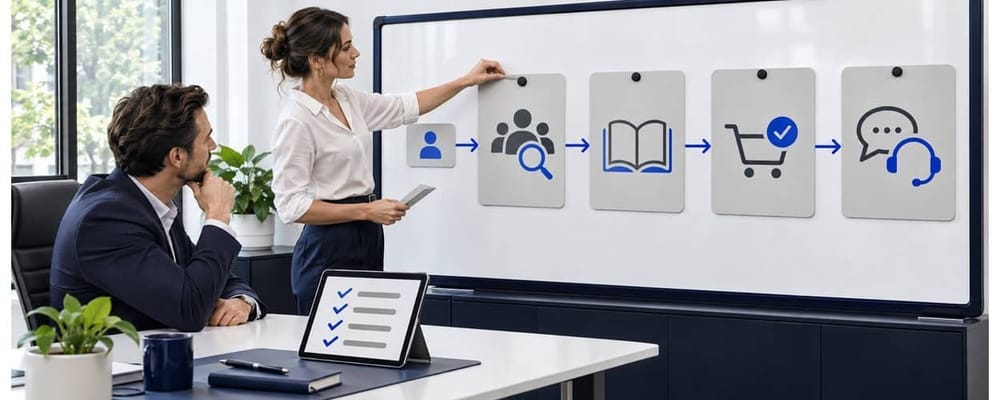
Step-by-Step: Mapping Your Own Awareness–Consideration–Conversion–Loyalty Funnel
Here is a simple checklist you can work through in a week to audit and map your current funnel:
- List all existing assets by stage. Which blog posts, guides, videos, and pages serve awareness? Which serve consideration? Conversion? Loyalty? Most businesses discover their mid-funnel is the thinnest.
- Identify gaps. No comparison guides in the consideration stage? No structured onboarding post-purchase? No retargeting ads bridging awareness to conversion? Document what is missing.
- Review KPIs for each step. Pull numbers: website traffic, lead magnet conversion rates, booked call show-up rates, close rates, renewal rates. Find the biggest percentage drop-that is your highest-priority leak.
- Prioritize one fix. Do not rebuild everything. Fix the single biggest leak first, measure results for 30 days, then move to the next.
- Map visually. Use a whiteboard, Miro, or slides to document how a stranger can logically progress to loyal customer through specific marketing campaigns and evergreen systems.
Run a quick workshop with your internal team or agency to align on buyer personas, key offers, and how each content asset moves people through the funnel. Create content only after the map is clear.

When to Bring in a Funnel Partner Like Funnel Builders Expert
DIY works until it does not. Here are signs it is time to bring in a specialist:
- Your buying cycle involves multiple offers, price points, or audience segments and you cannot manage them in a single system
- Revenue has plateaued despite increasing your marketing efforts and ad spend
- You are juggling disconnected tools-one for email, another for ads, a third for CRM-and nothing talks to each other
- You know you should be running retargeting ads, nurture sequences, and funnel optimization, but do not have the bandwidth or technical knowledge
A specialist partner like Funnel Builders Expert designs and implements a cohesive content marketing funnel, aligns ads and landing pages, configures automation, and continuously optimizes for conversion and retention. The result: coaches and consultants moving from inconsistent €10K months to stable €30K+ months within 90–120 days after installing a full-funnel system.
If your funnel is underperforming-or if "your funnel" is basically just a website-book a structured funnel review with our team. It is not a sales pitch; it is a diagnostic session where we identify exactly where your awareness consideration conversion loyalty system is leaking revenue and what to fix first.

FAQ: Awareness, Consideration, Conversion, and Loyalty in Practice
How is the buyer's journey different from the customer journey?
The buyer's journey usually covers the awareness stage, consideration stage, and decision or conversion stage up to the final purchase. The broader customer journey extends beyond conversion into loyalty, advocacy, renewals, and potential churn or reactivation. At Funnel Builders Expert, we design lifecycle systems that respect both journeys: acquisition and long-term relationship building through a complete customer journey map.
Do I really need different content for each funnel stage?
Yes. Using the same content everywhere usually leads to either low-quality leads (if too salesy at the top) or low conversions (if too educational and never asking for action). Start with a minimal set: one strong awareness blog post or guide, one or two mid-funnel comparison guides or case studies, and a focused conversion page or webinar. Then iterate-analyze which assets perform and fill remaining gaps in the content marketing funnel over time. You should create content matched to intent at every stage.
How often should I review and optimize my funnel?
Review core funnel metrics at least monthly and run a deeper funnel audit quarterly, especially for ad-driven funnels. Big structural changes-new offers, new markets-should trigger a fresh look at your awareness consideration conversion loyalty flows and associated content. We typically operate on ongoing funnel optimization cycles, testing incremental changes instead of full rebuilds every few months.
What's the best first step if my funnel is basically "just a website" right now?
Start by defining one core offer and building a simple, linear conversion funnel around it: awareness content → lead magnet or webinar → call booking → onboarding. Add a clear lead capture on the homepage, a focused follow-up sequence, and a dedicated conversion page before tackling advanced segmentation or multiple offers. Once the basic conversion funnel works, layer in more nuanced awareness and consideration assets like comparison guides and segmented nurture paths.
Can one business have multiple awareness–consideration–conversion–loyalty funnels?
Absolutely. Many growing businesses run parallel funnels for different personas, price points, or regions-for example, separate funnels for a group coaching program and a flagship course. But avoid starting with too many at once. Perfect one primary funnel before cloning and adapting it to new segments. A unified CRM allows tracking and optimizing multiple funnels without losing visibility into the overall customer base, ensuring your marketing goals remain aligned across every system.

Website.
Ecommerce Website
Blog Website
Website Design
Web Management
WordPress Website
SEO - AIO
AI Optimization
Local SEO
On-Off Page
SEO Audits
Technical SEO
Paid Advertising
Display Ads
Meta Ads
Google Ads
Linkedin Ads
TikTok Ads
CRM Automation
CRM Setup
Email Marketing
Lead Management
Pipeline Automation
SMS Marketing
Disclaimer: This site is not affiliated with or endorsed by Google or Meta™. All content is for educational purposes only and does not guarantee results or earnings. Your success depends on your own efforts, experience, and circumstances. Financial examples are illustrative, not promises. Always seek professional advice before making business or financial decisions. By using this site, you agree we are not liable for outcomes based on this information.
2026 © Funnels Builders Expert, a Sydney Website Design Agency product - Privacy Policy - Terms & Conditions