Automated Sales Funnel: How to Build Always-On Systems That Turn Clicks into Clients
Most business owners have experienced the same frustrating cycle: a great lead comes in, nobody follows up fast enough, and the opportunity disappears. An automated sales funnel solves that problem by turning your marketing and sales process into a predictable, always-on system. Below, you'll find everything you need to plan, build, and launch one in 2026.
Key Takeaways
- An automated sales funnel is a software-driven system that moves website visitors from initial awareness through to paying customers around the clock. Marketing automation transforms your sales process into a predictable system, and automation saves time while increasing conversion rates significantly.
- The sales funnel consists of five stages-awareness, interest, consideration, decision, and retention-and each stage requires tailored strategies, content, and follow-ups. By mapping the right offers and messaging to each stage, you guide potential customers without manual effort at every step.
- Businesses can scale lead generation without proportional increases in sales staff through automation. Using automated systems can also lower marketing costs by eliminating repetitive tasks, freeing your marketing team and sales team to focus on strategy and closing high-value deals.
- A step-by-step framework covers everything from choosing your tech stack and building landing pages to launching traffic and iterating with data-driven insights, so you can create automated sales funnels that reliably generate qualified leads and booked calls.
- Funnel Builders Expert provides done-for-you automated funnel systems for coaches, consultants, and local service businesses that want results without handling tech, ads, or complex integrations themselves.

What Is an Automated Sales Funnel in 2026?
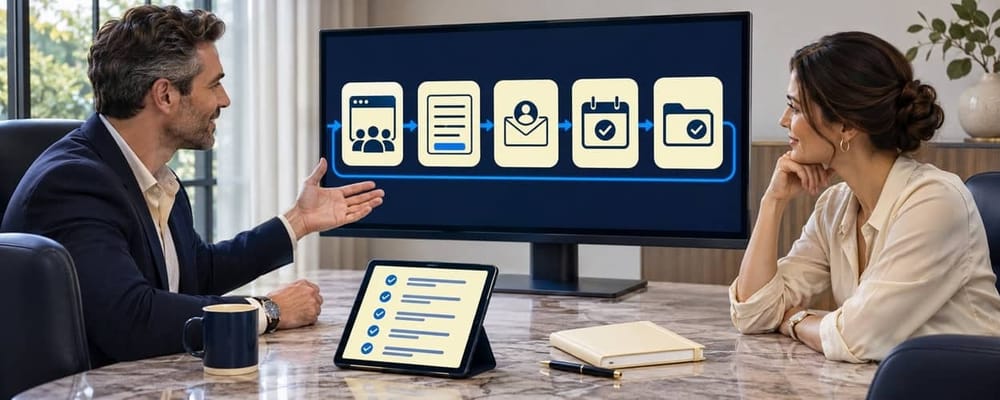
An automated sales funnel is a structured, software-driven process that moves strangers from their first click to becoming paying customers with minimal manual effort. Sales funnel software automates lead generation and nurturing processes, handling everything from capturing contact details to delivering follow-up emails, booking calls, and processing payments. Automated sales funnels can increase conversion rates significantly when the right messaging meets the right audience at the right time.
These funnels connect traffic sources like Google Ads, Local SEO, and Meta Ads to landing pages, an email marketing engine, a CRM, and online calendars. The entire process runs on automation tools that trigger actions based on customer behavior, so leads are nurtured and pre-sold automatically. Automated sales funnels streamline the customer buying journey from first impression to final purchase.
Here's a concrete 2026 scenario: an online consultant runs YouTube Ads targeting cold traffic. Clicks land on a lead capture page offering a free ebook. After opt-in, a 5-day personalized email sequence nurtures the lead and invites them to an evergreen webinar. Attendees who watch over 50% receive an automated offer with deadline urgency. The sales page handles checkout, and post-purchase onboarding fires automatically. Automated funnels can operate without human intervention for these repetitive steps, but "automated" doesn't mean "hands off forever." Humans still manage strategy, creative messaging, and periodic optimization.

Core Funnel Stages: From Awareness to Loyal Client
The sales funnel is shaped like a pyramid with wider sections at the top and narrower sections at the bottom. Here are the stages your target audience moves through:
- Awareness stage: The top of the funnel focuses on awareness and attracting potential customers. At the awareness stage, potential customers discover your business offerings for the first time. They have a problem but don't know you yet.
- Interest: Prospects begin engaging with your content. They're curious and want to learn more about possible solutions.
- Consideration stage: The middle of the funnel is where leads consider solutions and nurture relationships. The consideration stage involves leads evaluating your business as a solution alongside alternatives.
- Decision: The bottom of the funnel is where leads make actionable decisions and conversions occur. The decision stage focuses on closing the sale with personalized offers, guarantees, and clear proof.
- Retention: Post-purchase activities involve retention and upselling customers. A structured funnel can improve Customer Experience with relevant post-purchase offers while boosting retention and repeat purchases over time.
Automated sales funnels map content, offers, and follow-up emails to each specific funnel stage instead of blasting everyone with the same message. Each stage of the funnel requires specific strategies to guide prospects toward the next step.

How Automation Changes Each Funnel Stage
Here's how an automated funnel behaves differently from a manual process at each step:
Awareness stage: Instead of waiting days to respond to a new lead, automation delivers a welcome email sequence within seconds of opt-in. Pop ups and lead capture forms trigger instant delivery of your lead magnet, while retargeting ads keep your brand visible to new leads who didn't convert immediately.
Interest and consideration stage: Behavior-triggered follow-ups can significantly increase purchase rates by sending the right content at the right moment. If a prospect downloads a guide and then visits your pricing page, automation sends a case study email. If they don't open that, a comparison guide follows. This ensures personalized communication based on actual customer interactions rather than guesswork. Behavior-triggered follow-ups re-engage potential customers effectively at these critical moments.
Decision stage: The decision stage focuses on closing the sale with personalized offers. Automation triggers deadline sequences, cart abandonment recovery emails, and limited-time bonuses. A manual process would require your sales team to remember each lead and follow up individually.
Purchase and retention: Payment processing, confirmation emails, onboarding sequences, and feedback requests all fire automatically. Follow up emails for upsells and referral programs nurture loyal customers without anyone on your team lifting a finger. Behavior-triggered follow-ups re-engage customers at critical moments like abandoned carts or missed appointments.

Essential Components of an Automated Funnel
Every automated funnel is built from the same core blocks. Here's what each one does:
Component
Role
Traffic sources
Google Ads, Meta Ads, content marketing, Local SEO, referrals
Landing pages
Dynamic landing pages enhance user experience and boost conversion rates by matching visitor intent
Lead magnet
A free ebook, checklist, quiz, or mini-training used to capture contact info. Lead magnets are essential for capturing potential customers' information
Tripwire offer
A low-price "no-brainer" offer ($27–$47) to convert new leads into paying customers
Main offer
Your core product or service-an online course, coaching program, or done-for-you package
Email marketing engine / CRM
Captures leads, runs automated sequences, tags contacts, and scores engagement
Booking calendar
Integrated scheduling for coaching or consulting calls
Payment processor
Stripe, PayPal, or similar for checkout and subscriptions
Sales funnel software includes features like landing page builders and email automation to handle these elements in one place. Automated lead capture increases efficiency by organizing lead information quickly, so your sales pipeline stays full.
A funnel builder handles drag and drop editor page creation, opt-in forms, upsell pages, and simple automation rules. For deeper lead segmentation, long-term nurturing, and complex sales pipelines, a dedicated CRM or automation platform is the better fit. Automated lead capture increases efficiency and accelerates growth when these tools work together.
Types of Automated Sales Funnels (and When to Use Each)
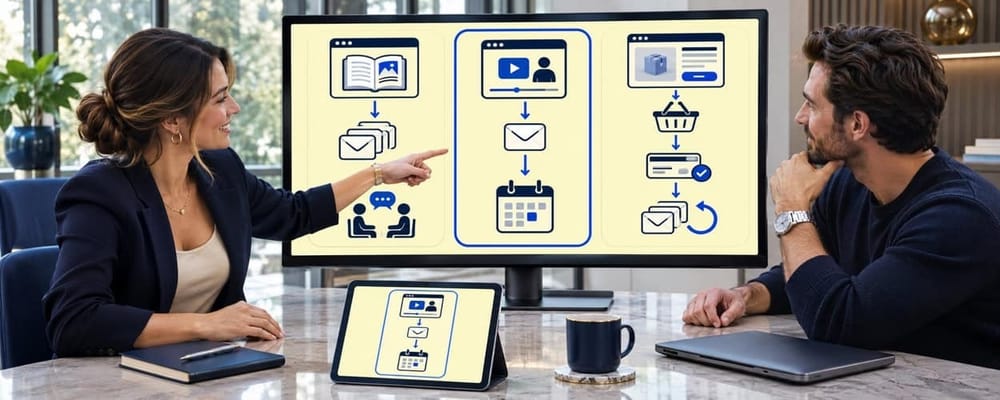
Different business models need different funnel structures. Here's an at-a-glance guide:
Lead generation funnel
- Structure: Ad → lead magnet opt-in → email nurture → tripwire or main offer
- Best for: Local service providers, B2B consultants, electricians, and professionals building trust before a sale
Webinar funnel (evergreen or live)
- Structure: Ad → registration → webinar attendance → offer or sales call
- Best for: Coaches, course creators, mid-to-high-ticket offers
- Benchmark: Registration-to-attendance rates typically hit 40–50%, with 10–20% of attendees converting to a booking or sale
Application funnel
- Structure: Content or ad → application form → qualification → sales call → close
- Best for: High-ticket consulting, custom services, premium coaching
Product launch funnel
- Structure: Pre-launch content → cart opens → urgency sequence → cart closes
- Best for: Course creators and digital product launches with defined timelines
Evergreen low-ticket funnel
- Structure: Always-on ads → tripwire → upsell to main offer
- Best for: Digital products, self-paced courses, online business models with impulse-buy entry points
A home improvement contractor might use a lead generation funnel-Google Ads targeting "roof inspection near me," a landing page to book the inspection, and automated reminders. A coach might use an evergreen webinar funnel, like Wardogs Academy, which rebuilt their automated webinar funnel and saw organic conversion rise from 0.3% to 1.2%, generating over $100,000 in sales in 22 days without ad spend.

Which Businesses Get the Biggest ROI from Automated Funnels?
Automated funnels deliver the strongest returns for businesses with proven offers, established demand, and repeatable sales processes:
- Online coaches and consultants generating $10,000+/month with a validated offer and existing testimonials
- Local service providers like pool builders, contractors, legal and financial professionals, and fitness coaches
- Course creators with proven content and a track record of results
- B2B consultants in the US, UK, Canada, Australia, and New Zealand scaling client acquisition
These profiles benefit most because they need predictable lead flow and repeatable systems. Businesses can scale lead generation without proportional increases in sales staff through automation. Using automated systems can lower marketing costs by eliminating repetitive tasks like manual follow-ups and spreadsheet tracking.
One education platform ran a 3-stage Facebook funnel and generated 834 enrollments in 45 days at $42 per enrollment, producing approximately $542,100 in revenue-a 15.5x return on ad spend.
Sales funnel automation works best when your core offer, pricing, and messaging are already proven. If you're still validating your idea, start with a simpler setup first.
Step-by-Step: How to Build an Automated Funnel in 2026
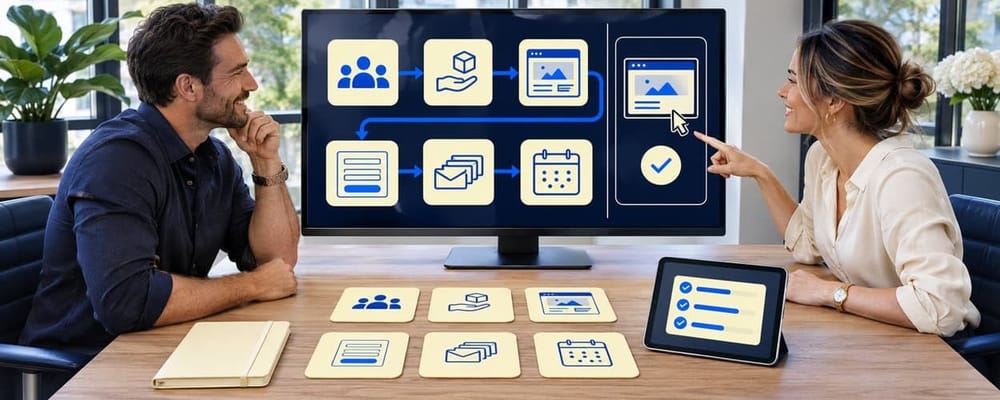
Here's a practical framework to create automated sales funnels from scratch:
1. Define goals and metrics Set clear targets: monthly qualified leads, webinar registrations, booked calls, revenue. Identify your cost per lead, conversion rate benchmarks, and customer lifetime value. Outcome: a one-page dashboard outline.
2. Map your funnel stages and customer journey Sketch each stage from initial awareness to post-purchase. Define what content, offers, and messaging your target audience needs at each point. Outcome: a visual funnel map with notes per stage.
3. Choose your tech stack Select a sales funnel builder for pages, an email marketing platform for sequences, a CRM for lead scoring and pipelines, a booking calendar, and a payment processor. Look for native integrations or use connectors to keep the entire process seamless. Automation saves time by handling repetitive tasks like email follow-ups.
4. Create offers and lead magnets Build your lead magnet (free PDF, quiz, mini-training), tripwire ($27–$47 offer), and main offer. Align each with a specific lead acquisition strategy and funnel stage. Outcome: finalized offer copy and assets.
5. Build pages and automations Create your landing pages, thank-you pages, sales page, and upsell pages. Set up your marketing automation workflow: welcome emails, behavior-based follow-ups, tagging, and lead segmentation in your CRM. Outcome: a connected funnel with live automations.
6. Launch traffic Start driving visitors via paid ads (Meta, Google), content marketing, or SEO for lead generation. Set up retargeting for website visitors who didn't convert on the first visit. Outcome: consistent flow of potential leads entering the funnel.
7. Analyze, iterate, and scale Track drop-off between funnel stages. Run b testing on headlines, lead magnet titles, email subject lines, and call to action buttons. Use analytics tools and funnel reports to identify bottlenecks. Outcome: improving funnel performance with each cycle.
8. Retention and upsell Automate post-purchase onboarding, upsell sequences, and referral programs. Collect testimonials and feedback requests. Outcome: increased customer lifetime value and loyal customers who refer others.
Email Marketing & Nurture Sequences Inside an Automated Funnel
Email marketing is the engine that moves leads between funnel stages. Personalized email drip campaigns improve lead engagement and conversion by delivering the right message based on where someone is in the customer journey.
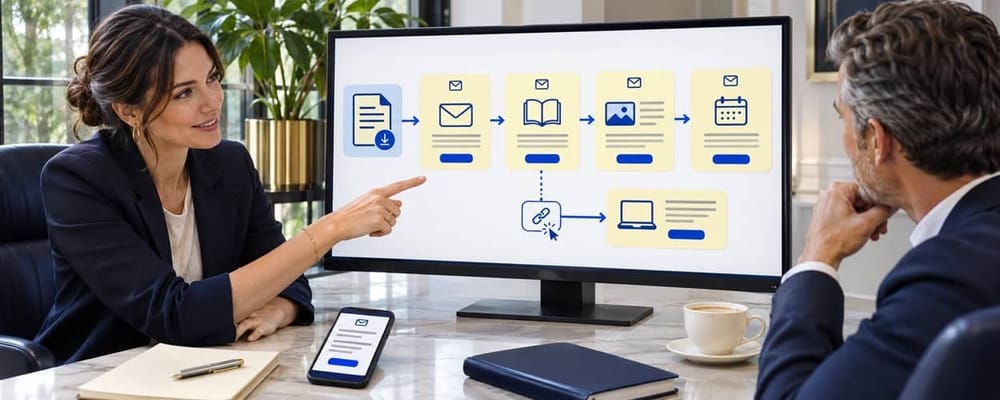
Here are the essential sequences:
- Welcome series (3–5 emails): Deliver the lead magnet, share your story, set expectations, provide quick-win value. Personalized email drip campaigns keep leads engaged with consistent value from day one.
- Consideration-stage nurture: Address pain points with case studies, comparison guides, and testimonials. This is where you nurture leads and build trust. Segmentation improves targeting by delivering tailored messaging to different audience segments.
- Sales sequence: Invite prospects to a webinar or present your main offer directly. Use urgency, social proof, and a clear call to action. Personalized email sequences ensure each prospect receives relevant content based on their behavior
- .Post-purchase onboarding and upsell: Confirmation, getting-started guides, cross-sells, and advocacy content to engage leads beyond the first sale.
Automated lead nurturing impacts conversions depending on your sales cycle and customer type-a $47 digital product converts faster than a $5,000 consulting engagement.
For deliverability: use permission-based opt-ins, include unsubscribe links, maintain consistent sending domains, and monitor bounce rates. Without these basics, even the best sequences end up in spam.

Optimization: A/B Testing and Data-Driven Insights
A/B testing (sometimes written as A B testing) is not optional for sales funnel optimization-it's how you turn a mediocre funnel into a high-performing one.
The most impactful elements to test:
- Headlines and hero images on landing pages
- Lead magnet titles and descriptions
- Button copy and placement on your sales page
- Tripwire pricing ($27 vs. $37 vs. $47)
- Email subject lines and send times
- Webinar length and format
Sales funnel software helps track user behavior and optimize funnels by showing you exactly where leads drop off. Businesses can track key performance metrics-opt-in rates, email click-through rates, booked call rates, and sales conversion-to evaluate funnel effectiveness at every stage.
Data-driven insights from automated funnels help identify conversion rate bottlenecks. For example, if your webinar registration rate is strong but attendance drops below 30%, the problem is likely in your reminder sequence, not your ad creative. Actionable insights like these prevent wasted ad spend and guide your marketing efforts toward the highest-impact improvements.
AI-Powered Automation: Smarter Funnels, Less Manual Work
In 2026, AI powered tools go far beyond basic rule-based workflows. AI powered automation now enables businesses to run smarter funnels with less manual work:
- Lead scoring automates the identification of high-quality sales opportunities, helping your sales team focus on the most promising leads rather than chasing every contact equally. Advanced models now use hierarchical preference ranking to prioritize promising leads relative to each other.
- Predictive send times optimize when each contact receives emails based on their past user behavior, improving open rates without manual scheduling.
- Dynamic content personalization adjusts landing page copy, testimonials, and offers based on visitor behavior and location.
- AI-generated subject lines and copy variants help your marketing team test more options faster, boosting marketing performance across campaigns.
According to the Amplemarket State of Agentic Sales 2026 report, 37% of first outreach touches are now written by AI, and sequences are longer, more personalized, and multi-channel.
AI helps service businesses and coaches boost sales by surfacing data driven insights without needing a full-time analyst. At Funnel Builders Expert, we leverage AI as part of our done-for-you systems-but always with human-led strategy and messaging oversight.
Common Challenges When Automating Your Sales Funnel
Even the best sales funnel automation hits roadblocks. Here are the most common ones:
- Tech overwhelm: Too many marketing platforms, disconnected dashboards, and patchwork integrations. A UK consultant might have a great offer but no CRM, leading to lost leads and manual spreadsheet chaos.
- Unclear messaging: If your value proposition is fuzzy, no amount of automation will convert. Your marketing funnel amplifies whatever message you feed it-good or bad.
- Weak lead magnets: Low perceived value or a mismatch between the lead magnet and the main offer kills conversion before nurturing even begins.
- Poor tracking: Without proper analytics, you can't identify where potential customers are dropping off or which channels drive your best customer data.
- Inconsistent traffic: A funnel without reliable traffic is like a shop on an empty street. Dependency on a single channel is risky if costs rise.
- Under-nurtured leads: Many prospects need multiple touches before buying. If sequences stop too early, you leave revenue on the table. Your sales efforts stall when follow-ups end prematurely.
Most problems stem from misaligned funnel stages, missing follow-ups, or tools that don't integrate cleanly. This is exactly where working with a specialized funnel builder agency pays for itself.
Done-for-You Automated Funnels with Funnel Builders Expert
Funnel Builders Expert is a global network of certified funnel builders and automation specialists focused on local service businesses, coaches, and consultants across the US, UK, Canada, Australia, and New Zealand.
A typical engagement looks like this:
- Discovery and strategy - We map your customer journey, audit existing marketing efforts, and identify the right funnel type for your offer and market.
- Funnel architecture and copywriting - We design the funnel flow, write conversion-focused copy, and create all page and email assets.
- Build, integration, and tracking - We connect your funnel builder, CRM, email marketing, booking calendar, and payment processing into one seamless system. This automates repetitive tasks across your entire sales process.
- Launch and optimization - We launch traffic via Google Ads, Meta Ads, or Local SEO, then monitor funnel performance, run split tests, and iterate based on advanced analytics.
Our systems are built to attract, capture, nurture, convert, and retain clients through lifecycle automation. Whether you're a kitchen remodeler in Texas wanting more booked inspections or a coach in London looking to fill your calendar with qualified leads, we build the system so you can focus on delivery.
Next Steps: Implementing Your Own Automated Sales Funnel
Here are concrete actions you can take this week:
- Map your existing funnel on paper. Identify where leads currently enter, where they drop off, and which follow-ups are manual.
- Pick one quick-win automation. An abandoned cart email, a missed-call text follow-up, or a simple welcome sequence after opt-in. Start small.
- Choose a funnel builder to centralize your pages. Consolidate scattered landing pages, forms, and checkout pages into one system.
- Set baseline metrics. Track your current opt-in rate, cost per lead, and booked call rate so you have something to improve against.
- Decide: DIY or done-for-you. If you have the time and technical comfort, start building. If you'd rather skip the learning curve and launch faster, consult with Funnel Builders Expert to get your automated funnel mapped, built, and launched by a team that does this daily.
Start with one process. Once you see leads responding without manual effort, expanding to a full automated funnel becomes obvious.
Frequently Asked Questions
Below are common questions about automated sales funnels that weren't fully covered above.
How much does it cost to build an automated sales funnel?
DIY costs typically run $50–$300/month for a funnel builder, email marketing tool, and CRM subscriptions combined. Done-for-you agency projects start in the low four figures for simple funnels and scale up based on complexity, number of channels (Google Ads, Meta Ads, Local SEO), and required automations. Long-term ROI-measured by cost per lead, cost per booked call, and customer lifetime value-matters far more than the initial setup fee. Funnel Builders Expert tailors pricing based on scope and the marketing platforms involved. Some tools offer a free plan or free trial to get started, while paid plans unlock the advanced analytics and automation capabilities most businesses need.
How long does it take to start seeing results from an automated funnel?
Simple funnels can be built and launched within 2–4 weeks, but reliable data usually requires 30–90 days of consistent traffic to evaluate. Paid ads generate faster feedback than organic traffic, allowing quicker optimization of funnel stages. Timelines vary by niche, offer price point, and how much existing audience or traffic your online business already has.
Can I automate my entire sales process, including closing sales?
Low-ticket and digital products can often be sold 100% through an automated funnel-from the awareness stage through checkout and delivery. For higher-ticket services and consulting, funnels typically automate lead qualification and scheduling while a human still handles the sales call. Automation should support and enhance human selling, not replace the relationship-building steps that close high-value deals. This is how you engage leads effectively while keeping closing personal.
What if my offer isn't validated yet-should I still build an automated funnel?
Full automation works best once an offer has at least some proven demand and paying customers. If you're still testing, start with a simpler, semi-manual approach: a basic landing page, a straightforward lead magnet, and a short follow-up email sequence to validate messaging and pricing. Layer in deeper automation afterward. Funnel Builders Expert can help refine offers and positioning as part of a strategic funnel build, but no agency can replace true market validation. Business leaders should treat validation as a prerequisite, not an afterthought.
Which metrics should I track to know if my automated funnel is working?
Focus on these key metrics across your sales pipeline: opt-in rate on lead magnet pages, cost per lead, email open and click-through rates, booked call or demo rate, sales conversion rate, and average revenue per customer. Data-driven insights from these numbers reveal where leads are dropping off and which funnel stages need attention. Set clear targets for each stage before launch so optimization decisions are objective. This is how business growth becomes measurable and repeatable, not based on gut feeling.

Website.
Ecommerce Website
Blog Website
Website Design
Web Management
WordPress Website
SEO - AIO
AI Optimization
Local SEO
On-Off Page
SEO Audits
Technical SEO
Paid Advertising
Display Ads
Meta Ads
Google Ads
Linkedin Ads
TikTok Ads
CRM Automation
CRM Setup
Email Marketing
Lead Management
Pipeline Automation
SMS Marketing
Disclaimer: This site is not affiliated with or endorsed by Google or Meta™. All content is for educational purposes only and does not guarantee results or earnings. Your success depends on your own efforts, experience, and circumstances. Financial examples are illustrative, not promises. Always seek professional advice before making business or financial decisions. By using this site, you agree we are not liable for outcomes based on this information.
2026 © Funnels Builders Expert, a Sydney Website Design Agency product - Privacy Policy - Terms & Conditions