
AI Search Optimization for Landscapers: How to Win on Google, Maps & ChatGPT in 2026
The way homeowners find and choose a landscaping company has fundamentally changed. In 2026, the search journey starts on Google, loops through Google Maps, and increasingly passes through AI tools like ChatGPT, Google AI Overviews, and Perplexity before a single phone call is made. If your landscaping business isn't visible across all of these surfaces, you're leaving jobs on the table.
This guide breaks down exactly what SEO for landscapers looks like today, how AI search optimization works, and the practical steps your landscaping company can take to show up where homeowners are actually looking.
Key Takeaways
In 2026, homeowners use both traditional search engines and AI tools to find landscaping companies. That means your online marketing strategy needs to cover Google, Google Maps, and AI-generated answers simultaneously. Here's what matters most:
- SEO for landscapers now spans two worlds. You need to rank in local search results and appear in AI-generated summaries. A focused SEO plan can increase keyword rankings by 600%, and that visibility now extends to AI answers, not just blue links.
- Local search still drives most calls, but AI shapes the shortlist. The majority of inbound leads for landscaping companies still come through Google Maps and local organic search. However, AI summaries increasingly determine which two or three companies homeowners even bother researching.
- Content clarity is your competitive advantage. Landscapers need detailed service pages, strong Google Business Profile listings, consistent business information across the web, and genuine Google reviews. AI systems pull from all of these when generating recommendations.
- SEO can generate a consistent flow of qualified leads when treated as a connected system rather than a set of isolated tactics.
- Funnel Builders Expert builds AI-aware local SEO and funnel systems specifically for service businesses like landscapers, so you get a complete client acquisition engine rather than piecemeal marketing.

Why AI Search Optimization Matters for Landscaping Companies in 2026
Between 2024 and 2026, the way homeowners discover landscaping services shifted dramatically. What used to be a simple Google search followed by a few calls has become a multi-platform loop. A homeowner might ask ChatGPT "Who's the best landscaper in Portland for modern backyard designs?", scan the Google AI Overview that appears above organic results, check the local map pack, read reviews on Yelp, and then visit your landscaping website before ever picking up the phone.
The numbers tell the story clearly. In 2026, roughly 52% of U.S. consumers used an AI tool in the past 30 days to find a local business, up from about 9% the previous year. For high-income households ($150K+), 54.5% now start their local search journey with AI tools rather than Google. AI-powered platforms see increasing search volume every year, and this trajectory isn't slowing down. But here's the critical nuance: consumers still verify via Google, Maps, and review sites after getting an AI recommendation. AI complements local search; it doesn't replace it.
For landscaping companies, AI search optimization means structuring your content, business details, and online reputation so that AI systems can confidently name your company in answers. AI optimization combines SEO fundamentals with advanced training signals like structured data, review depth, and off-site mentions. The old approach of simply ranking for "landscaping company near me" is no longer enough. You need the kind of visibility that helps a landscaping company shows up across the map pack, organic search results, and the AI summaries homeowners see before they click anything.
At Funnel Builders Expert, we approach landscaping SEO as a unified system. Local SEO, on page SEO, reviews, content, funnels, and AI-optimized visibility all work together. AI-driven search optimization combines local SEO and useful content into one engine that feeds every channel simultaneously.
How Homeowners Actually Search for Landscapers Today
Your tailored SEO strategy must map directly to how potential customers actually behave. Here's what real homeowner search patterns look like:
- "Near me" and city-based searches on mobile. Phrases like "landscaping services near me," "lawn care services in Denver," or "backyard patio design Austin" remain the most common starting point. With 64% of users searching on mobile devices for nearby landscaper services, these queries typically trigger Google Maps and the local pack first.
- Question-based and voice searches. Queries like "When should I aerate my lawn in Chicago?" or "How much does a paver patio cost?" feed both Google snippets and AI answers. Google prioritizes businesses that match user search intent, and conversational queries should be answered directly in the first paragraph of your content.
- Multi-session research for big projects. For design/build work like patios, retaining walls, or full yard renovations, homeowners search across weeks or months. They compare portfolios, read reviews, check FAQs, and visit multiple landscaping websites before requesting a quote.
- Commercial and institutional searches. HOAs, property managers, and hotels use contract-oriented language: "commercial landscape maintenance company in Phoenix," "HOA landscaping bids," "grounds maintenance contracts." These potential clients care about scheduling, reliability, and cost per square foot.
- Your content must mirror this language. Keyword research reveals what potential clients are actually searching for, and your SEO strategies should reflect those exact phrases across dedicated service pages, location pages, and blog content.

Core SEO Fundamentals Landscapers Still Need (Before Adding AI)
AI search sits on top of classic search engine optimization. Without a solid foundation, there's nothing for AI tools to draw from. Think of traditional SEO as the infrastructure and AI optimization as the layer that makes your information discoverable in new channels.
Here are the four pillars, tailored to the landscaping industry:
- Local SEO (Google Maps + local search). Your Google Business Profile, local citations, and map pack presence are still how most local clients find you. Local SEO emphasizes relevance, distance, and prominence in rankings.
- On page SEO (service pages, content structure). Create service pages for each offering: lawn care services, landscape design, hardscaping, irrigation system installation, tree trimming, garden design, low maintenance landscaping, and snow removal. Search engines value unique, useful pages over generic content.
- Technical SEO (speed, mobile optimization, security). Technical SEO improves website loading speed for better rankings and includes optimizing website code and structure. A sitemap enhances website crawlability for search engines. Structured data helps search engines interpret business information accurately.
- Off-page SEO (reviews, citations, link building). Positive reviews significantly impact local SEO rankings. Building a network of citations and quality backlinks establishes authority in the eyes of both Google and AI systems.
Getting these basics right improves both standard search engine results and the data AI tools draw from when generating recommendations.

Local SEO & Google Maps: Your Primary Discovery Engine
Local SEO is still the main driver of calls and form fills for any landscaping business, and strong local visibility helps your landscaping business stand out from nearby providers when homeowners are ready to hire. If your business appears prominently in Google Maps and the local pack, you're capturing homeowners at the moment they're ready to hire. Here's how to make that happen:
- Optimize your Google Business Profile completely. Choose accurate categories like "Landscaping company" and "Lawn care service." Write a detailed description mentioning core services (lawn care, hardscaping, irrigation), your service area, and seasonal offers. Google Business Profile boosts local search visibility more than almost any other single action.
- Upload real project photos monthly. Before/after shots of sod installation, patio builds, and drainage fixes serve double duty: they build trust with homeowners and give AI-readable context about your work. High-quality images enhance user engagement on websites and profiles alike.
- Maintain NAP consistency everywhere. Your Name, Address, and Phone number must match exactly across Google, Yelp, Angi, Houzz, Nextdoor, and local directories. NAP consistency is crucial for local SEO rankings. Maintaining accurate business information across platforms supports local SEO and prevents AI systems from getting confused about your business details.
- Understand what drives map pack rankings. Proximity, relevance, and prominence (reviews, photos, posts) determine whether you show up for "lawn care services [suburb name]." Local queries rely heavily on verified real-world profiles. A 600% increase in Page 1 rankings can result from effective, sustained SEO efforts targeting these signals.
- Post weekly on your profile. Seasonal tips like "Fall clean-up checklist for Toronto homeowners-October 2026" keep your profile active and feed AI summaries with fresh data, while active, accurate profiles also help local businesses stay visible in map and AI-driven discovery.
Design/Build vs Maintenance: Separate Service Pages for Different Intents
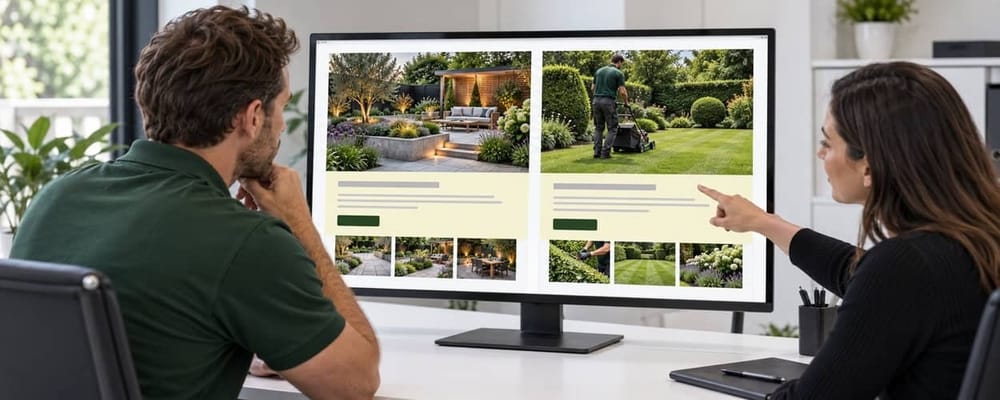
Mixing design/build and maintenance on the same page weakens targeting, confuses homeowners, and makes it harder for local search and AI systems to match queries to the right offer. Here's how to structure your service pages:
- Design/build pages. Create dedicated pages for landscape design services, hardscaping services, outdoor kitchens, and backyard renovation. Each page should feature project photos, a process overview, landscaping cost ranges, and a strong CTA like "Request a Design Consult." Similar service businesses like pool builders see dramatic results when they separate project types.
- Maintenance pages. Build pages for residential lawn care services, commercial landscape maintenance, hedge trimming services, seasonal maintenance, and seasonal clean-ups. Focus on reliability, schedules, coverage areas, and contract options for your lawn care company.
- Dedicated service pages should clearly specify the exact offerings. Creating dedicated pages for each keyword improves search engine rankings because search engines can match intent precisely. Creating service pages improves search visibility for landscapers across both Google search results and AI search results.
- Clear next steps increase conversion. Every service page needs a visible CTA-phone number, form, or booking link-so potential customers can take action immediately.

Seasonal SEO Strategy: Ranking a Season Ahead
Search engines and AI systems need weeks or months to crawl and trust new content. That means landscapers should be optimizing spring landscaping pages during winter, not waiting until April when demand peaks.
- Winter (Dec–Feb): Prepare for spring. Update service pages for sod installation, planting, and irrigation start-ups. Upload last year's before/after photos. Publish guides like "Spring lawn care checklist for Boston homeowners." Blog posts can target specific queries to attract clients before competitors even start thinking about content.
- Spring (Mar–May): Focus on summer hardscaping. Build out pages for patios, retaining walls, outdoor kitchens, and drainage. Target phrases like "patio cost estimates [city]" and "best backyard drainage solutions." Using targeted keywords in content boosts local search rankings for the season ahead.
- Summer (Jun–Aug): Plan for fall and winter services. Launch content about leaf removal, fall clean-up, snow plowing, and holiday lighting so you show up before the first frost or snowfall.
- Year-round benefit. This calendar-based approach keeps leads flowing in every season instead of only during the spring rush. Funnel Builders Expert can map out this entire calendar inside a done-for-you landscaping SEO strategy.

Building a Portfolio That Ranks (Not Just Looks Good)
Most landscaping websites treat their portfolio as a photo gallery. That's a missed opportunity. With the right structure, your project gallery becomes an SEO and AI asset that attracts targeted traffic.
- Add projects regularly. Publishing new case studies signals that your landscaping company is actively operating in 2026. Both Google and AI tools factor recency into their recommendations.
- Implement structured data. Schema markup improves how search engines display information. Use review and LocalBusiness schema so Google can highlight ratings and project details in search results and AI Overviews.
- Add client testimonials and star ratings. Short video walk-throughs on featured projects build EEAT (Experience, Expertise, Authoritativeness, Trustworthiness) signals that both Google and AI tools value. AI-generated content should reflect real projects and local expertise.
- Use descriptive image alt text. Write "paver patio with fire pit in Denver Highlands area" instead of generic "IMG1234." This helps search engines and AI models understand what's in your photos.
- Build full project pages for significant jobs. For example, "Modern backyard makeover in Dallas-June 2025" with 10–20 photos, location, property type, budget range, and a detailed narrative describing the problem and solution. AI models prefer detailed case studies over simple portfolios.

On-Page SEO & Content That AI Can Understand
On page SEO is simply the practice of making each page on your landscaping website as clear and useful as possible-for homeowners and for the algorithms that decide what to show them.
- Lead with critical information. SEO-friendly content answers client questions directly. Price ranges, timelines, and service area details should appear high on the page because AI tools favor content that provides clear answers in the first few lines. Quality content builds trust with clients and search engines alike.
- Strengthen internal links. Link from blog posts ("5 backyard design ideas for small Seattle lots") back to relevant service pages and location pages. Internal links help search engines understand your site's topical authority. For a deeper dive on how content drives leads, see SEO for lead generation.
- Add Q&A sections. Question-style headings like "How much does landscaping cost in 2026?" or "When should homeowners schedule spring clean-up?" create opportunities for featured snippets and AI answers. AI prefers content with clear specific answers to common questions.
- Place keywords naturally. Include your primary and secondary keywords in titles, the first 100 words, subheadings, and meta descriptions without keyword stuffing. For example, use "local landscaping company," "[city] lawn care," and "residential landscape maintenance company" where they fit naturally. Targeted keyword research increases visibility in local searches. Tools like Ahrefs can show what customers are searching for and where gaps exist.
- Use clear, descriptive headings. An H1 like "Lawn Care Services in Charlotte, NC" with subheadings like "Weekly Mowing Plans," "Fertilization & Weed Control," and "Aeration & Overseeding" helps both readers and systems. Using clear logical header tags helps AI engines parse content easily.

AI Search Optimization: Turning Your Website Into an AI-Ready Resource
AI search optimization for landscapers means aligning your content, structure, and business signals so that tools like Google AI Overviews, ChatGPT, and Perplexity can easily recommend you. In practice, landscapers SEO is the process of aligning content, structure, and business signals for AI tools and search engines. It's not a separate project from SEO-it's an extension of doing SEO well, with specific attention to how AI systems retrieve and present information.
AI models pull from your website, Google Business Profile, reviews, local directories, and sometimes social profiles. Research analyzing over 1,300 ChatGPT recommendations found that off-site credibility and detailed website content mattered far more than Google search rankings alone. Many businesses recommended by AI tools don't even rank in the top 50 on Google Maps. The takeaway: your off-site footprint-directory listings, review content, local press mentions-is essential.
Here's how to make your landscaping business AI-ready:
- Build pages from real client questions. "Do I need irrigation for a new sod lawn in Phoenix?" makes a better page topic than generic "irrigation services." AI search tools extract content that directly answers user questions, so structure your content accordingly.
- Use plain, specific language. Write "we install French drains to stop water pooling next to your foundation" rather than vague "water management solutions." Strong, verifiable evidence is prioritized by AI search engines over marketing fluff.
- Run regular AI visibility audits. Ask ChatGPT, Gemini, and Perplexity your three biggest customer questions and check whether your company is mentioned accurately. AI visibility audits improve answer-ready content for SEO by revealing exactly where your gaps are. AI tools assess customer inquiries and identify competitor service gaps you can fill.
- Leverage AI in your own workflow. AI tools enhance keyword research and competitor analysis efficiency, and they can uncover niche long-tail keywords for SEO that manual research might miss. AI tools also require genuine reviews to evaluate business quality, so there's no shortcut around reputation.
- AI engines look for structured data and local authority. The more consistent and detailed your business listing data, schema markup, and review profiles are, the more confidently AI systems will name you, which helps improve recommendations and search visibility.
Funnel Builders Expert designs AI-aware content strategies that overlap perfectly with traditional SEO so landscapers aren't paying twice for separate "AI packages." It's one integrated system.

Mobile Optimization & User Experience: Converting Clicks into Calls
With 64% of users searching for services on mobile devices, mobile optimization and user experience aren't optional-they're the difference between a phone call and a bounce. Google tracks user engagement signals to rank websites, so poor mobile experience directly hurts your search engine rankings.
- Speed matters enormously. 32% of users leave if site load time increases from 1 to 3 seconds. Compress your project photos, use efficient hosting, and aim for sub-three-second load times. Technical SEO directly impacts this.
- Put conversion elements above the fold. Every key page should show a phone number, "Request a Quote" button, and service area information before any scrolling is needed. Enable click-to-call and click-to-text for mobile users.
- Structure pages for scanning. Short paragraphs, bullet lists for services, simple pricing sections or "starting at" ranges, and clear CTAs. Good user experience can improve search engine rankings because visitors stay longer and engage more.
- Test your CTAs. A/B test options like "Book a Free Yard Walk-Through," "Get a 24-Hour Estimate," or "Upload Photos for a Fast Quote" to see what resonates best with homeowners in your competitive market.

Reviews, Local Citations & Link Building for Landscapers
Authority signals-reviews, citations, and backlinks-feed both Google rankings and AI trust. Without them, even the best landscaping website will struggle for online visibility.
- Build a review acquisition system. Send automated email or SMS after each job asking for a Google review, with a direct link and suggested prompts like "What project did we complete?" and "Which city are you in?" Positive reviews significantly impact local SEO performance, and detailed reviews give AI richer material to work with.
- Target descriptive reviews. Reviews that mention specific services ("sod installation," "retaining wall," "commercial snow removal") and locations ("in Naperville," "in North Vancouver") help AI tools understand exactly what you do and where. AI systems rely heavily on directories, review platforms, and listicles when generating local recommendations.
- Secure local citations. List your landscaping business on Yelp, Angi, Nextdoor, Houzz, and chamber-of-commerce directories. Make sure all business information is consistent across every platform.
- Pursue strategic link building. Backlinks from trusted websites improve your site's authority. Quality backlinks signal trustworthiness to search engines, and link building is essential for improving search engine rankings over time. Building relationships in your industry-with local nurseries, real estate agents, builders, and home improvement blogs-can generate valuable backlinks through guest guides or shared case studies. High-quality backlinks can significantly boost your SEO efforts and help you outpace local competitors.
- Automate what you can. Funnel Builders Expert integrates review requests and citation tracking directly into CRM and marketing automation workflows so the landscaper doesn't have to manage it manually.

From Click to Client: Funnels & Automation for Landscaping Leads
This is where the gap between "getting website traffic" and "booking jobs" gets closed. Driving more website traffic means nothing if visitors don't convert into satisfied clients. Here's a concrete lead flow that works:
- Simple funnel structure. Ad or organic click → service or location page → short, mobile friendly form asking for address, services needed, photos, and preferred time → automated confirmation email and SMS. For more on funnel structures for home service businesses, see how kitchen remodelers use the same approach.
- Automated follow-up sequences. SMS and email sequences that send appointment reminders, seasonal service offers (aeration, clean-ups), and review requests without manual effort. Using AI can help optimize marketing workflows and SEO processes across these touchpoints.
- Segment your contacts. Create lists like "Design/Build," "Residential Maintenance," and "Commercial Accounts" so campaigns address each group differently with relevant offers.
- Connect CRM data to SEO analytics. Tracking qualified leads is more important than tracking general traffic. When you can see which keywords, service pages, and locations produce the most profitable work, you can double down on what's actually driving business growth.
- Funnel Builders Expert as your partner. We design, build, and maintain this full client acquisition system so landscaping owners can focus on crews and clients instead of tech and marketing.

Measuring Results & Refining Your AI-Aware SEO Strategy
SEO success for landscapers isn't a one-time setup. It's data-driven iteration over 6–12 months that builds compounding local search visibility and AI presence. Tracking SEO results can improve strategy effectiveness over time, turning good results into great ones.
- Track the metrics that matter. Rankings for priority keywords ("landscaping company near me," "lawn care services [city]"), Google Maps visibility, organic traffic to service and location pages, calls, form submissions, and booked jobs. Use Google Analytics for website traffic patterns and Google Search Console for search performance. In 2026, Search Console's AI Overview reporting shows how often your pages appear in AI summaries and for which landscaping queries.
- Check AI tools manually each quarter. Search real homeowner-style questions on ChatGPT, Gemini, and Perplexity. Is your business mentioned? Is the information accurate? This reveals content gaps and misrepresentation risks.
- Refresh content quarterly. Update pricing examples for 2026, add new case studies, expand thin service pages, and add FAQs based on recent sales conversations. A 600% increase in Page 1 keyword rankings is achievable with focused, sustained SEO that's continuously refined.
- Work in 90-day sprints. At Funnel Builders Expert, we review data and adjust local SEO, content, and funnels every quarter to keep landscapers ahead of local competitors. For proven frameworks on structuring this process, explore our lead acquisition strategy guide.

FAQ: AI Search Optimization for Landscapers
Here are answers to common questions landscaping business owners ask about SEO and AI visibility in 2026.
How long does it take for a landscaping company to see results from AI-aware local SEO?
Expect early movement in your Google Business Profile and local search within 4–8 weeks. Solid rankings and steady qualified leads typically develop over 3–6 months, while consistent mention by AI tools for core queries can take 3–9 months. Your domain age, competition level in the local market, and starting point (brand-new site versus established landscaping website) all affect the timeline.
Do I need different content for Google and for AI tools like ChatGPT?
No. You don't need a separate "AI-only" website. You need one set of clear, detailed, question-focused pages that serve both Google and AI systems. The same good practices-specific service pages, local details, structured FAQs, strong reviews-improve visibility across both google search results and AI-generated answers.
Can a small landscaping company compete with big brands in AI and local search?
Absolutely. In local SEO, proximity, relevance, and reviews often matter more than brand size. A small lawn care company or best landscaping company in a suburb can outrank national franchises by publishing deep local content-neighborhood names, local soil and climate tips, community project case studies-and consistently gathering detailed reviews. This is one area where landscaping companies that do the work see a genuine competitive advantage.
What budget should a landscaping company expect for serious SEO and AI optimization?
Realistic budgets range from a few hundred to a few thousand dollars per month depending on city size, number of multiple locations, and whether funnels or ads are included. Compare cost per lead and cost per booked job against flyers, mailers, and pure PPC. Landscaping SEO services and AI optimization typically improve ROI over 6–12 months because the results compound. A landscaping SEO agency focused on your industry will deliver faster returns than a generalist.
How is Funnel Builders Expert different from generic SEO agencies for landscapers?
Funnel Builders Expert builds full client acquisition systems-local SEO, AI-aware content, conversion-focused websites, and automated follow-up-rather than isolated tactics. Our focus on service businesses and local markets means strategies are tailored to how homeowners search, compare, and hire landscapers in 2025–2026. We make sure your landscaping business stands out across Google search, Google Maps, and AI search results with one integrated system designed for relevant traffic and real business growth.

Website.
Ecommerce Website
Blog Website
Website Design
Web Management
WordPress Website
SEO - AIO
AI Optimization
Local SEO
On-Off Page
SEO Audits
Technical SEO
Paid Advertising
Display Ads
Meta Ads
Google Ads
Linkedin Ads
TikTok Ads
CRM Automation
CRM Setup
Email Marketing
Lead Management
Pipeline Automation
SMS Marketing
Disclaimer: This site is not affiliated with or endorsed by Google or Meta™. All content is for educational purposes only and does not guarantee results or earnings. Your success depends on your own efforts, experience, and circumstances. Financial examples are illustrative, not promises. Always seek professional advice before making business or financial decisions. By using this site, you agree we are not liable for outcomes based on this information.
2026 © Funnels Builders Expert, a Sydney Website Design Agency product - Privacy Policy - Terms & Conditions