AI Receptionist for Landscapers: Stop Losing Spring Calls to Voicemail
When a homeowner calls about a patio estimate and hears four rings followed by voicemail, they don't leave a message. They call the next landscaper on Google. Missed calls can cost landscaping companies $62,400 annually, and most of that damage happens during the March through May window when every phone rings with spring cleanup requests, new mowing contracts, and design-build inquiries. An AI receptionist for landscapers answers those calls on the first ring, qualifies the job, and books the site visit before the caller has a chance to dial a competitor.

Key Takeaways
- An AI receptionist for landscaping answers every inbound call on the first ring during the spring rush, qualifies leads by collecting property address, service type, and lot size, then books site visits directly into tools like Google Calendar.
- Replacing a bland AI or generic human answering service with a landscaping-calibrated AI voice agent can recover tens of thousands in seasonal revenue. One landscaping business saved $28,400 in missed jobs in a single month after deploying an AI receptionist.
- The AI handles specific use cases that matter to landscaping companies: screening out bad-fit work, triaging emergencies like a fallen tree or irrigation leak, and turning every estimate call into a ready-to-run visit sheet for crews.
- AI receptionists answer calls 24/7, capturing leads instantly, and they cost a fraction of a full-time hire whose median wage sits at $38,010 per year.
- Funnel Builders Expert designs complete lead systems around the AI receptionist, including ads, funnels, and automation, so landscapers convert more of those answered calls into booked contracts.
Why Landscapers Need an AI Receptionist in 2026
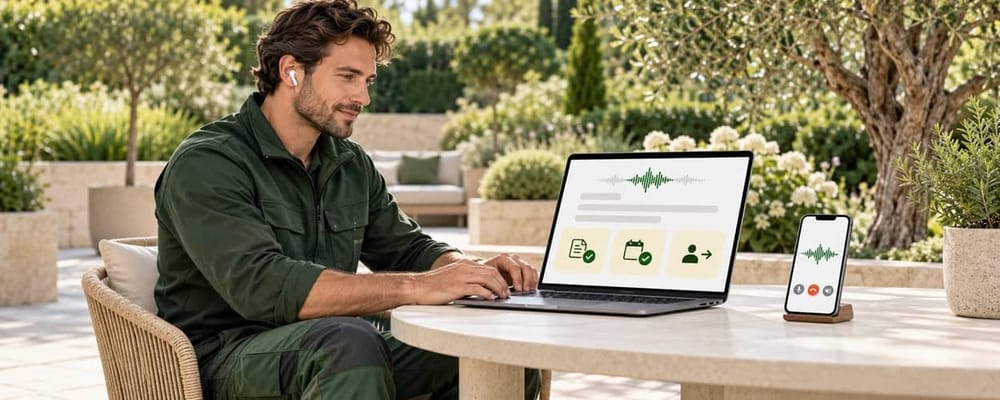
Crews running mowers, blowers, and skid steers cannot reliably answer the phone. During peak season (March through June) and after heavy storms, the noise on a job site makes it physically impossible. The U.S. has 1,299,200 grounds maintenance jobs as of 2025, and the vast majority of those workers are outdoors when the phone rings.
Traditional call handling results in lost leads during busy periods. An ai receptionist handle busy-season mowing and cleanup demand by answering calls and texts, checking service areas, gathering job details, scheduling consultations, and passing complete requests to the office for pricing. A Georgia-based landscaper tracked a 43% missed-call rate before adding an AI agent; industry data from home-services platforms places the average unanswered rate for local service businesses at roughly 27%, with landscaping firms running higher during peak week. Recovering just one missed call per week at a $300 average job value can yield $62,400 per year.
Landscaping call volume spikes in spring and fall. March through May drives the bulk of new maintenance contracts, design-build enquiries, and spring cleanup bookings. A second, smaller surge hits around fall cleanup and storm events. An AI receptionist for landscaping provides 24/7 call handling without hiring an in-house office manager or relying on a generic answering service that doesn't know turf management from interlock.
AI answering services can handle calls while crews are busy. For a seasonal business where revenue concentrates into a few intense months, having an AI receptionist that is crucial for immediate, 24/7 customer service is the difference between a packed schedule and a half-empty one.
How an AI Receptionist for Landscaping Actually Works
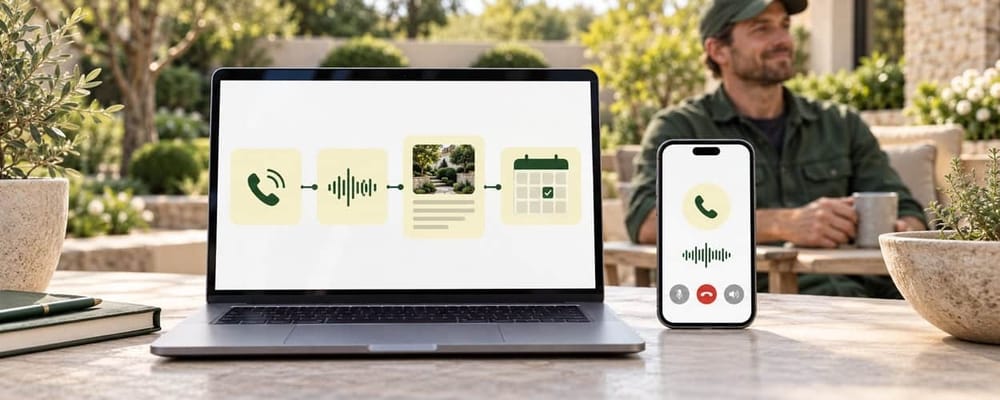
A typical workflow from ringing phone to booked appointment takes under three minutes.
- Call forwarding: The landscaper forwards their main business number or overflow ring group so the AI answers on the first ring when crews can't pick up. Most setups work with an existing number; no need to reprint yard signs or update a Google Business Profile.
- Branded greeting: The AI voice agent greets callers using the company name, service area, and tone you define. This avoids the bland AI problem where callers get a robotic, generic response that feels disconnected from the brand.
- Structured call handling: The agent confirms name, callback number, property address, service type, and urgency before deciding next steps: book a site visit, escalate to the owner, or politely decline out-of-scope work. Automated lead intake gathers client information accurately every time.
- AI receptionists filter spam and transcribe calls automatically. Call summaries plus full transcripts are pushed into the landscaper's CRM or sent via email and SMS so nothing is lost between jobs. AI receptionists can drop leads directly into your CRM, and they collect essential property details during calls for lead qualification.
The result: AI receptionists manage lead flow within existing CRM systems, and the owner reviews a clean summary instead of listening to voicemail recordings at 9 PM.

Seasonality: Spring Rush, Storm Chaos, and Winter Slowdown
The landscaping year follows a predictable pattern with sharp peaks and quiet valleys.
March through May is where most landscaping companies make or break their year. Spring calls drive new weekly mowing contracts, aeration bookings, mulch installs, and design-build consultations. One New Jersey landscaper tracked 680 inbound calls during this window; their answer rate sat at 54% before deploying an AI receptionist, then climbed to 98% afterward. The estimated revenue loss from those missed spring calls was $62,900.
Missing calls in March doesn't just lose a one off job. It often costs a full season of weekly mowing revenue plus referrals. A homeowner who signs up for lawn maintenance in April generates recurring maintenance income through October and often adds fall leaf removal or landscape lighting later.
Storm-related spikes create 24-to-48-hour windows of heavy call volume after high winds or heavy rain. Calls about drainage failures, washed-out beds, and fallen trees explode in bursts that no solo operator or small office can handle alone. Weather chaos doesn't check business hours.
AI answering services reduce missed calls during peak seasons because they handle many simultaneous calls with consistent intake. 24/7 answering services capture leads before they go cold, even at 2 AM when a homeowner discovers a flooded yard. During winter slowdown, most AI plans offer lighter tiers so costs drop alongside call volume. Scripts can shift to snow removal, winter pruning, or early-bird spring contracts.
From Call to Calendar: Booking Site Visits and Estimates
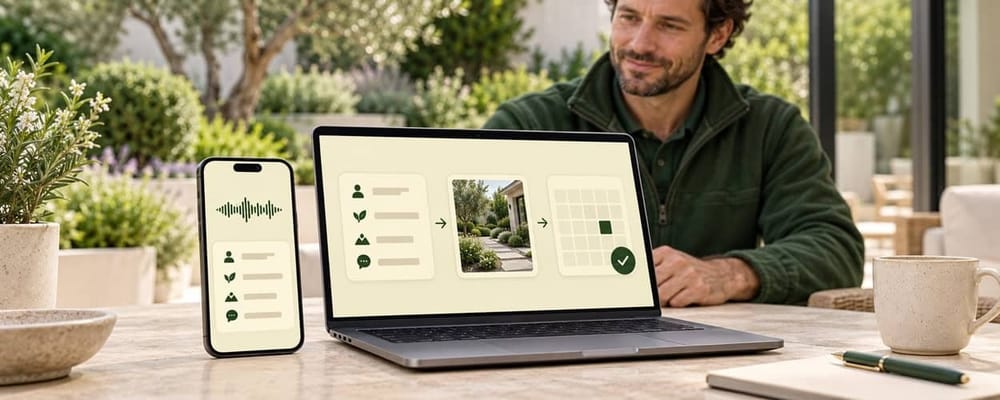
The primary goal for many landscaping calls is not an instant quote but a properly qualified site visit. Integrating AI receptionists enhances lead capture during peak business hours by converting every call into an actionable booking.
An AI receptionist can handle the following intake for landscaping:
- Full property address and property type (residential, commercial, HOA)
- Property size or rough frontage
- Whether the work is recurring maintenance or project-based
- Preferred timeline ("before June 15," "ASAP," "sometime this fall")
- Access notes: gates, pets, slope, machinery access
For design-build, interlock, or drainage calls, the AI receptionist books an on-site consultation instead of guessing prices, then syncs that visit into Google Calendar or scheduling software tied to the field crew's calendar. AI receptionists answer calls on the first ring, day or night, so no lead waits until morning for a callback.
The visit sheet arriving in the owner's inbox or CRM includes customer expectations, budget hints, timeline, and access details. Funnel Builders Expert maps this data into automated follow-up sequences so every booked visit is paired with reminder texts and post-visit nurture emails.

Qualifying Maintenance vs. Projects on the First Call
Separating recurring maintenance from one-time or project-based work on the first call determines which pipeline a lead enters and how fast it moves.
The AI receptionist quickly identifies whether the caller wants weekly mowing, seasonal cleanups, mulching, or bigger work like patios, retaining walls, or outdoor kitchens. A simple scripted question works: "Is this a recurring service like lawn care, or a one-time project?"
Maintenance leads are evaluated on route fit: day of week, neighborhood, minimum yard size, and whether the property falls inside the defined service area. Qualified leads improve when out-of-service-area callers are filtered before site visits consume estimator time. Project leads are screened for budget range, scope, and timeline.
This early split determines which internal workflow triggers:
- Maintenance pipeline: route-day check, minimum property size, recurring maintenance contract template
- Project pipeline: design-build estimation process, portfolio materials, in-person consultation scheduling
Tagging calls as "maintenance," "project," or "emergency" keeps reporting and follow-up clean. AI receptionists filter spam and qualify leads so the owner's dashboard shows real opportunities, not noise.
Interlock, Hardscape, and High-Ticket Design-Build Calls
Hardscape and design-build calls often represent $8,000 to $35,000+ jobs. These should never hit voicemail.
The AI voice agent should ask specific questions for interlock and hardscape work:
- Type of project: patio, driveway, steps, retaining wall, walkway
- Approximate dimensions or square footage
- Existing surface material (if replacing)
- Access for machinery (tight backyard, slope, narrow gate)
- Timeline and any hard deadlines
Detailed intake allows the estimator to arrive with the right catalog, samples, and expectations. A New Jersey landscaper case study reported that hardscaping leads averaged $8,200 per project when the AI captured full job details on the first call. AI receptionists help businesses respond faster to customer inquiries, which increases conversions because the estimator shows up prepared rather than starting from scratch.
Funnel Builders Expert can build a dedicated hardscape AI funnel that pairs the AI receptionist's intake with Facebook Ads or Google Ads targeting homeowners searching for "paver patio cost" or "retaining wall contractor near me." The AI receptionist answers, qualifies, and books; the funnel nurtures.

Handling Emergencies: Irrigation Leaks and Fallen Trees
Not all landscaping calls are routine. Some are urgent property-protection issues that need fast escalation.
An AI answering service is configured to recognize high-priority keywords: "flooding," "burst pipe," "sprinkler leak," "tree on the house," or "blocked driveway." AI can differentiate between routine queries and emergencies for proper call routing, ensuring the right calls reach the right person at the right speed.
When emergency triggers appear, the AI receptionist can immediately send priority SMS alerts to the on-call crew lead or supervisor, not just drop a message in email. For safety-sensitive issues, the script offers basic guidance (e.g., "You can shut off the irrigation main valve at the meter box") while explicitly avoiding liability-prone advice.
This triage reduces response time on emergency jobs that typically command premium rates. One case study from GreenScape Landscaping reported that faster follow-ups after implementing an AI agent increased their close rate from 40% to 65% on time-sensitive work.
Screening Out Bad-Fit Work and Price Shoppers
One of the biggest gains from AI call handling is politely avoiding non-revenue work that clogs calendars.
- The AI receptionist declines services the business doesn't offer (tree removal, pool installation, grading-only jobs, out-of-area requests) using friendly but firm language.
- Minimum job values, service area zip codes, and property size thresholds prevent crews from driving 40 minutes for a $75 one off job.
- Callers focused solely on the cheapest price are nudged toward online resources or a callback form instead of tying up the owner in phone tag.
- Declined calls are logged separately so the owner sees exactly how much unprofitable call volume the AI absorbed in a given month.
Using AI creates a smoother customer journey with fewer communication gaps. Callers who do fit the profile get a focused, professional experience. Callers who don't get a polite redirect. Both outcomes protect the landscaper's time and margins.

Replacing Human Answering Services and Bland AI
Most landscaping companies that have tried a human answering service know the pattern: the service takes a name and number, promises "someone will call you back," and the lead goes cold. Generic answering services know nothing about seasonal contracts, route density, service packages, or equipment access. They take messages instead of qualifying and booking.
A well-configured AI answering service runs from a custom knowledge base about the landscaping business: services offered, starting prices, policies, and routing logic. It answers routine calls with the same accuracy every time. Consistent communication improves customer satisfaction and professional perception because the caller gets real answers, not a hold message.
Modern AI voice agents avoid the bland AI effect by using natural phrasing, pauses, and local vocabulary ("pavers," "mulch," "interlock"). AI systems also provide multilingual support, accommodating diverse customer bases in markets where crews and customers speak both English and Spanish.
AI does not replace human judgment on edge cases. It pushes genuinely complex or high-risk decisions (waiving a fee for a loyal client, scheduling a landscape architect consultation) to the owner or office team. Everything else, it handles.
Integrating AI Receptionist With Calendars and Field Software
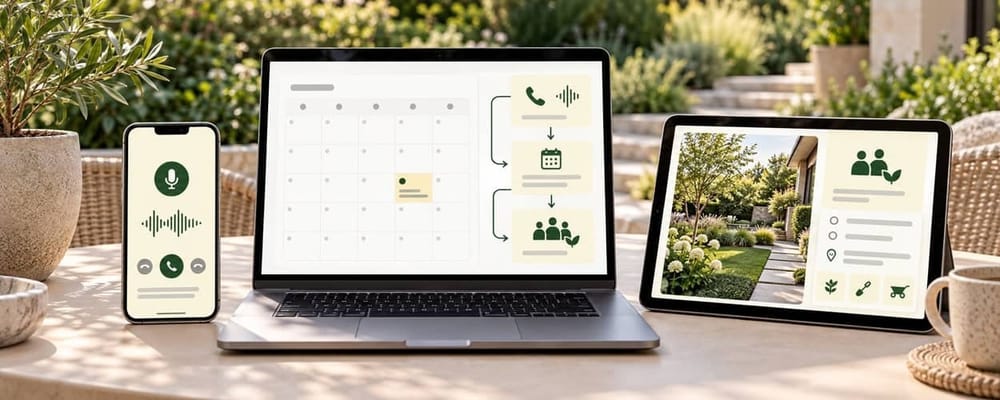
Landscapers already live in tools like Google Calendar, Jobber, or other route planners. The AI receptionist must fit into that stack, not create a parallel system.
At a high level, the AI books estimates and maintenance visits into Google Calendar directly, respecting blocked time and travel buffers. More advanced setups sync with a field service CRM or job management tool so service areas, crew routes, and time slots are enforced automatically. AI receptionists allow staff to focus on core work by handling the scheduling layer that otherwise eats into productive hours on the job site.
Two-way communication matters: changes in the calendar update AI availability rules, and new bookings from the AI show instantly on mobile devices. A Florida landscaping company integrated AI scheduling with their receptionist so new maintenance leads were proposed on days matching existing routes. Crew productivity jumped from 58% to 82%, and the company added productive capacity equivalent to three crews without hiring.
Example: a Friday afternoon design consult is automatically clustered with two other jobs in the same subdivision, cutting windshield time and keeping route optimization tight.

Lead Capture, Funnels, and Automation Around Your AI Receptionist
Answering the phone is step one. Turning those calls into predictable revenue is the objective. AI can automate follow-ups, reducing administrative tasks for human staff and keeping every lead warm.
Here is how AI answering data flows into a lead capture funnel:
- Calls become contacts with tags like "Spring cleanup 2026" or "Retaining wall enquiry," triggering automated SMS and email follow-ups.
- Design-build leads receive a photo-upload link and portfolio. Lawn care leads receive a seasonal tips guide and upsell to fertilization or turf management.
- After jobs marked as complete, automation requests Google reviews, closing the loop between AI-powered calls and long-term reputation growth. One NJ landscaper's review count went from 2 to 47 in 90 days, moving their local search ranking from page 3 to the top 3.
Integrating AI receptionists reduces missed calls and lost leads across the entire funnel. Funnel Builders Expert combines Local SEO, Google Ads, Meta Ads, and sales funnels so that once the AI receptionist answers, there is a full pipeline in place to nurture and close.

Costs, Pricing Models, and ROI for AI Answering
Landscapers shopping for an AI receptionist solution encounter two main pricing structures:
- Usage-based: Per-minute or credit-based billing. Works well for low-volume months but can spike during peak season if your busiest week sends 80+ calls.
- Flat monthly plans: A set fee with a plan's included calls or minutes. Seasonal landscaping operations often prefer this model because costs stay predictable even when April call volume doubles.
AI receptionists cost from $29.99 per month for landscaping businesses on entry-level plans. Compare that to a human receptionist's median wage of $38,010 per year, plus benefits, sick days, and limited coverage hours. AI receptionists answer calls 24/7, unlike human receptionists who clock out at 5 PM.
Worked example: 40 inbound calls per month, $300 average job value, 35% close rate. That's $4,200 in monthly revenue from calls answered. If you're currently missing even 10 of those calls, recapturing them at the same close rate adds $1,050 per month; more than enough to cover any AI plan several times over. A landscaping company acquisition case study documented $28,400 in saved missed jobs in the first month alone, against a setup cost of roughly $247.
Configuring Your AI Receptionist Before Going Live
Smart configuration is what makes an AI receptionist feel like part of the team rather than a bolted-on gadget.
Define these items before launch:
- Services offered and excluded: List every service (weekly mowing, fall cleanup, landscape redesign, landscape lighting, snow removal) and what you will not do (tree removal, pool installs). The AI script must have both.
- Service area boundaries: Set zip codes or neighborhoods. Managing crews across a wide territory means the AI needs to know where you will and won't drive.
- Minimum job sizes: Property size floors, minimum recurring contract values, or minimum one off job fees.
- Price floors and ranges: Approved starting prices for standard services like lawn maintenance. For variable work, the AI defers to a site visit.
- Emergency vs. routine rules: Define who gets notified, via what channel (SMS, email, app push), and during which hours. A crew lead handling a fallen tree emergency at 6 AM needs a different alert path than a Tuesday morning mowing inquiry.
- Tone of voice: Casual for small lawn care companies; more formal for commercial grounds contractors. Decide whether the AI introduces itself by name or simply as "the office."
QuoteIQ's Virtual Call Team is one example of a platform that answers calls 24/7 for landscapers and captures and qualifies leads automatically. Whichever platform you choose, Funnel Builders Expert can run a structured onboarding workshop to translate the owner's "in their head" rules into precise AI scripts and automations.
Testing, Tuning, and Trusting Your AI Voice Agent
Pressure-test the system before the phones start ringing in March.
- Have owners and office staff do a test call on their own phone, pretending to be different caller types: price shopper, out-of-area caller, HOA manager, emergency storm damage victim.
- Deliberately ask odd questions ("Do you do rooftop gardens?" "Can you pave my boat dock?") to see how the AI handles unknowns and whether it escalates gracefully.
- Track caller sentiment. One landscaping business reported sentiment rising from 64% positive in the first six months to 98% positive after tuning scripts based on transcript reviews.
Set a monthly review rhythm: scan transcripts for misclassifications, missed upsell opportunities, or awkward phrasing. Check whether the AI correctly distinguished between a routine lawn care inquiry and a drainage emergency. Funnel Builders Expert monitors analytics on call volume, conversion to appointments, and revenue per booked call to continuously optimize scripts and funnels.

Scaling From One Crew to Multi-Route Operations
A typical growth path runs from one truck and a trailer in 2024 to two or three crews by 2026 and multiple routes across several suburbs by 2028.
An AI answering service scales with that growth. It handles separate calendars per crew, tags landscaping leads by route, and enforces different minimums for distant suburbs. Dispatch rules can be embedded in the AI receptionist logic so new residential maintenance leads are automatically proposed on days that match existing neighborhood routes, keeping route optimization tight.
As operations grow, the AI becomes the single consistent intake layer, even if office staff changes or expands over time. Solo operators get the same professional phone presence as a lawncare business running five crews. Funnel Builders Expert plans funnels and automation with this scale in mind, avoiding rework when the landscaper adds crews or new territories.

How Funnel Builders Expert Builds Systems Around Your AI Receptionist
Funnel Builders Expert is not an AI vendor. We are a marketing systems partner that makes the most of whichever AI receptionist platform the landscaper chooses.
The agency designs and implements full client acquisition systems: Local SEO so your Google Business Profile ranks for "landscaper near me," Google Ads targeting spring cleanup and hardscape keywords, Meta Ads for seasonal promotions, and conversion-focused landing pages that funnel traffic into calls and form fills.
Those campaigns are integrated with the AI receptionist so every form fill, click-to-call, or chat is answered and routed without leaks. Automation workflows in the CRM turn AI-captured call data into pipelines, task lists, and follow-ups, freeing owners from chasing every detail manually.
Book a strategy session before the next spring rush to ensure everything is live ahead of peak call volume. The landscapers filling their schedules in 2027 are the ones planning their systems now.

Common Pitfalls and Honest Limits of AI Receptionists
AI answering services are powerful, but they have boundaries landscapers should understand.
- No binding quotes sight unseen. The AI should share published starting prices or approved ranges for simple services like weekly mowing or fall leaf removal. For complex design-build work, it should book a site visit, not guess.
- Nuanced judgment still belongs with a human. Whether to waive a call-out fee for a long-time customer, approve a discount for a landscape architect referral, or schedule around a crew's personal day; these decisions need a person. The AI captures job details and tees up the decision.
- Poor configuration creates more work. Wrong service area boundaries, no minimum job sizes, or unclear emergency rules can flood the owner with unprofitable leads or let good ones slip. That is why setup and testing matter before peak season.
- Scripts need regular updates. Revisit AI scripts at least twice a year (pre-spring and pre-fall) to reflect new service packages, pricing changes, review requests, or lessons from the previous season. A script written for 2025 pricing will underbid every call in 2026 if nobody updates it.

Frequently Asked Questions
Will customers realize they are talking to an AI receptionist?
Modern AI voice agents use the landscaping company's name, follow local conversational norms, and include natural pauses. Most callers experience it as "the office." Alterra Landscape Design deployed an AI receptionist named "Daisy" and found that callers described the experience as "professional" and "friendly"; none refused to continue the call. Landscapers can choose whether the agent introduces itself as AI or as a virtual assistant. In practice, callers care more about fast answers and a booked site visit than whether the receptionist is human.
Can an AI receptionist give prices over the phone for mowing or projects?
For simple, standardized services like weekly mowing or recurring lawn maintenance, the AI can share starting prices or tiered brackets you approve in advance. One NJ landscaper initially had the AI defer all pricing; after configuring it to quote small mulch jobs directly, mulch bookings doubled. For anything needing a site visit (patios, retaining walls, drainage fixes), the AI books a consultation instead of guessing. This keeps pricing consistent and protects margins.
Do I need to change my existing business phone number?
In most setups you keep your existing number. You simply set up call forwarding or conditional forwarding so unanswered or all business calls route to the AI receptionist. Yard signs, truck wraps, Google Business Profile listings, and existing customers remain untouched while call handling upgrades behind the scenes. Advise checking with the current carrier for the exact forwarding code (often *71 or similar in North America).
What happens during winter when call volume drops?
Many AI answering service plans offer flexible tiers, so landscapers can move to a lighter plan or use fewer minutes when calls slow down. Scripts can be adjusted to focus on snow removal, winter pruning, or early-bird seasonal contracts. The off-season is an ideal time to refine scripts, funnels, and automation with Funnel Builders Expert so everything is tuned for the next March spike. If you offer snow removal, the AI picks up storm-night calls that most landscaping companies miss entirely.
How long does it take to get an AI receptionist and funnel system live?
Basic AI receptionist setup (call forwarding, service list, simple script) can often be completed in under an hour with most modern platforms. A full Funnel Builders Expert implementation, including integrated funnels, Local SEO adjustments, call-routing logic, and automation, typically rolls out over several weeks ahead of peak season. Landscapers aiming at March 2027 should begin planning and implementation in January or February 2027 so there is time to run a test call with every scenario, tune scripts, and verify calendar syncs before the spring rush hits.

Website.
Ecommerce Website
Blog Website
Website Design
Web Management
WordPress Website
SEO - AIO
AI Optimization
Local SEO
On-Off Page
SEO Audits
Technical SEO
Paid Advertising
Display Ads
Meta Ads
Google Ads
Linkedin Ads
TikTok Ads
CRM Automation
CRM Setup
Email Marketing
Lead Management
Pipeline Automation
SMS Marketing
Disclaimer: This site is not affiliated with or endorsed by Google or Meta™. All content is for educational purposes only and does not guarantee results or earnings. Your success depends on your own efforts, experience, and circumstances. Financial examples are illustrative, not promises. Always seek professional advice before making business or financial decisions. By using this site, you agree we are not liable for outcomes based on this information.
2026 © Funnels Builders Expert, a Sydney Website Design Agency product - Privacy Policy - Terms & Conditions