AI Optimization & Generative Engine Optimization: How Funnel Builders Expert Uses Artificial Intelligence to Maximize Performance
Funnel Builders Expert builds complete sales funnels, marketing funnels, and automation systems for service-based businesses that want more qualified leads, more booked calls, and more paying customers without getting buried in technical setup.

AI Optimization & Generative Engine Optimization: How Funnel Builders Expert Uses Artificial Intelligence to Maximize Performance
Artificial intelligence optimization is no longer optional for coaches, consultants, and local service businesses that want to stay visible online. Since Google rolled out AI Overviews in mid-2024 - now used by over a billion people globally - the way prospects discover, evaluate, and choose service providers has fundamentally changed. At the same time, generative engines like ChatGPT, Gemini, and Perplexity are becoming primary research tools for buyers making real purchasing decisions.
This article walks you through how to use AI optimization, generative engine optimization, and SEO together to maximize performance across content, ads, and sales funnels. Written from Funnel Builders Expert's perspective as a B2B funnel and marketing systems agency, it covers systems that turn AI-driven traffic into booked calls and revenue - no fluff, just process.
What you'll walk away with:
- Clear definitions of the three acronyms reshaping search: AIO, GEO, and SEO
- A practical workflow for keyword research, content optimization, and funnel design in an AI-first landscape
- Concrete techniques for turning AI visibility into client acquisition and measurable growth

AI Optimization, GEO & SEO: Core Definitions for Modern Search
The best funnel builder isn't the one with the prettiest templates or the longest feature list. It's the one that supports a complete, measurable client acquisition system-connecting traffic, landing pages, lead capture, automation, and CRM into a machine that reliably generates more leads and turns them into customers.
AIO
GEO
SEO
Target system
AI models, LLMs, AI Overviews
Generative engines (ChatGPT, Gemini, Perplexity)
Traditional search engines (Google, Bing)
Main goal
Be understood and used by AI systems
Be cited and recommended in AI-generated answers
Rank on page 1 for relevant keywords
Primary tactic
Entity clarity, schema, structured data
Authoritative mentions, citations, prompt-aware content
On-page SEO, backlinks, technical performance
Key metrics
AI-referral traffic, brand-citation share
Share-of-voice in AI answers, citation frequency
Rankings, organic traffic, CTR
Typical tools
Schema validators, AI audit platforms
Prompt monitoring, brand mention trackers
Ahrefs, SEMrush, Google Search Console
For Funnel Builders Expert clients, none of these replace each other. GEO and AIO layer on top of solid SEO foundations, and together they form a complete visibility system.

How Generative Engines Are Changing Google Search Behavior
User journeys no longer follow the old "type query → scan 10 blue links → click" pattern. Today, a prospect searching for a business growth coach in Austin might see a Google AI Overview summarizing top options, then ask ChatGPT a follow-up like "what should I look for in a business coach," then click directly into a booking funnel - all within minutes.
Google AI Overviews pull content from existing indexed pages and present it in summary form, often pushing classic organic links further down the page. Google's own data shows that users who do click through from AI Overviews stay longer on the page because the context match is stronger.
What this means for your business:
- Content quality, specificity, and niche focus matter more than raw search volume
- Being accurately represented in AI summaries requires clear entity signals - who you serve, where, and what outcomes you deliver
- Local SEO elements (Google Business Profile, location-specific case studies, precise schema) feed both traditional search and AI-generated answers
- Users ask longer, multi-part queries and expect comparison-ready content
The optimization process isn't about gaming AI systems. It's about making your brand's narrative so clear and credible that generative engines trust and cite it.
Building Semantic Authority for AI: Brand Context, Citations & Mentions
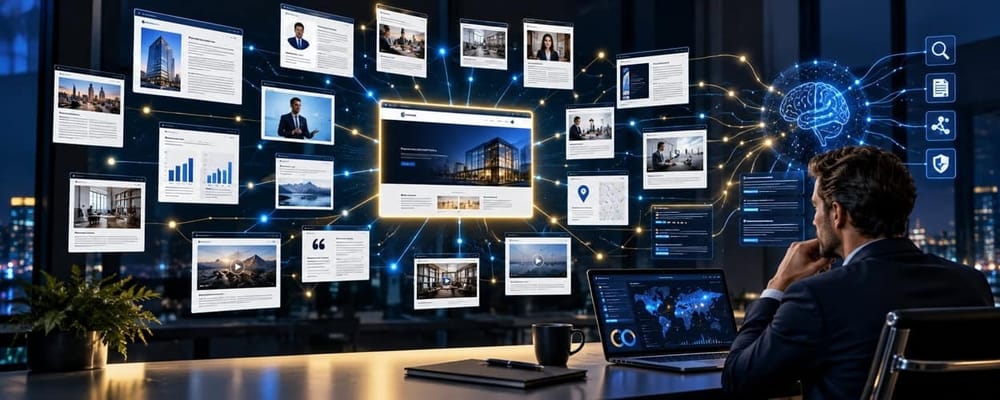
AI models learn about brands through repeated, consistent, contextual signals across the web. A "general digital marketer" site that says "we help businesses grow online" will struggle to build entity authority. But a site positioned as a "funnel and automation expert for high-ticket online coaches in the UK" - with case studies, testimonials, bios, and content all reinforcing that positioning - gives artificial intelligence models clear semantic context to work with.
Funnel Builders Expert helps clients build this semantic footprint across their websites, funnels, Google Business Profiles, and ad copy. Here's how:
- Get cited and mentioned on niche sites, podcasts, and local directories relevant to your industry
- Publish case studies that tie your brand name to concrete outcomes (e.g., "UK leadership coach scaled from £8k to £25k/month in Q2 2025")
- Align all social profiles and bios with the same positioning language - offer, niche, geography
- Use schema markup (LocalBusiness, Service, Author) so AI technologies can parse your entity data accurately
- Build content pillars around your core positioning - not generic marketing topics but specific problems you solve for specific audiences
- Ensure your brand is discoverable in the same context as industry terms users search and prompt for
This kind of positioning work is no longer optional - it's the foundation that determines whether AI agents include your brand or skip it entirely.

Keyword Research in the Age of AI Overviews & Generative Engines
Keyword research is still crucial, but now you must also account for what users ask inside AI tools. The technique is straightforward: combine traditional search engines data with prompt-based exploration.
For example, researching "sales funnel for fitness coaches" starts with classic tools for volume, difficulty, and CPC. Then you feed an example prompt into ChatGPT: "What questions would someone ask about building a funnel for fitness clients?" You'll discover semantic clusters around pricing, funnel stages, tools, templates, and case studies - queries that AI Overviews topics also surface.
Our 5-step workflow:
- Gather seed keywords using Google Keyword Planner, Ahrefs, or SEMrush
- Generate prompt-based questions via ChatGPT or Gemini to find related user prompts and follow-up questions AI tends to suggest
- Cluster keywords and prompts into topical groups mapped to awareness, consideration, and decision stages
- Map content assets (funnel pages, lead magnets, blog posts) to each cluster
- Monitor which queries trigger AI Overviews and adjust content to satisfy those prompts directly
Good keyword strategy now means optimizing content both to rank in Google and to be quoted inside generative answers. The data you gather from prompt-based research reveals what traditional search tools miss.

Optimizing Content for Both SEO and Generative Engine Optimization
Once you know what people search and ask AI about, you need to optimize content so both Google and generative engines can use it effectively. AI marketing optimization focuses on improving digital content visibility and making sure your pages are structured for extraction.
Core on-page elements that matter:
- Clear headings and subheadings using question-based framing
- Concise, well-structured paragraphs with a short direct answer before elaboration
- Schema markup for services, local businesses, and FAQs
- Internal linking that clarifies topic relationships across your site
Improving prompt and context boosts performance in AI systems and language models, which means your content should mirror the way users actually phrase questions. Here's a mini example of an AI-optimized FAQ block for a page targeting "coaching funnel agency in Toronto":
Q: What results can I expect from a coaching funnel in Toronto? A: Our Toronto-based coaching client increased booked calls from 15 to 50 per month within 90 days after funnel optimization, with a 35% improvement in show-up rate.
That kind of specific, quantified block is exactly what AI Overviews extract and what generative engines cite. When generating content, use AI writing tools for outlining, idea expansion, and content gap analysis - but never for publishing unedited, generic output. Add domain-specific insights, local details, and real numbers from your audience's context.

AI Optimization Inside Marketing Funnels: From Click to Client
This is the conversion layer - where AI is used not just for visibility but to maximize performance of funnels, ads, and automation workflows. AI optimization streamlines business workflows to enhance operational efficiency at every stage from click to client.
Funnel Builders Expert uses artificial intelligence optimization across the funnel:
- Predicting best audiences and offers for Meta Ads and Google Ads using AI-driven testing
- Dynamic ad creative testing for headlines, hooks, and offers through AI-driven subject line and ad copy testing
- Routing and scoring leads in CRMs based on behavioral data - tagging leads as hot, warm, or cold and triggering automated sequences accordingly
- Personalized follow-up based on user actions (watched 25% vs 75% of a webinar replay)
Scenario: An online course creator doing €20,000+/month wants to scale to €50,000+/month using one-to-many webinars. AI optimization improves show-up rates through intelligent email timing, automates repetitive tasks like follow-up sequences, and scores leads in real time so the sales team focuses only on high-intent prospects - driving customer satisfaction and pipeline value simultaneously.
The applications extend well beyond marketing funnels. AI optimization enhances retail experiences through personalized recommendations and inventory management. AI-driven optimization boosts product visibility for sports apparel brands. AI process optimization reduces customer support workload in hotels. Even platforms like Netflix use AI optimization to improve recommendation systems. The underlying principle is the same: let AI handle pattern recognition and decision making so humans focus on high-value interactions.

Technical AI Optimization: Speed, Infrastructure & Tooling
Behind the scenes, AI systems themselves undergo an optimization process that directly impacts user experience and conversion. AI model optimization is crucial for reducing latency and enhancing deployment efficiency - if your landing page chatbot takes 8 seconds to respond, visitors leave.
Key technical concepts, explained simply:
- Quantization can achieve 2-4x speedup in AI models by reducing numerical precision, and AI optimization employs techniques like quantization and pruning to reduce model size and improve efficiency overall
- Knowledge distillation transfers learning from a larger model to a smaller model to retain performance while running faster
- Continuous batching keeps GPU utilization at 90-100% during processing, which means more queries handled per second
- AI optimization can improve throughput by 3 to 5 times when these techniques are combined
- AI optimization systematically alters model components for better performance - from optimization models and model weights to training data preprocessing
- Gradient Descent minimizes loss function by updating model parameters iteratively
- Hyperparameter tuning improves model performance through optimal settings, while early stopping prevents overfitting by halting training early
- Data preprocessing cleans raw data to improve AI model performance, and effective data strategies significantly boost model performance more than model complexity alone
These techniques power industries far beyond marketing. Financial institutions use AI optimization for real-time fraud detection. AI optimization enhances trading algorithms in financial services. Energy providers use AI optimization for smart grid management and renewable energy forecasting. Manufacturing sectors apply AI optimization for predictive maintenance and quality control. Healthcare applications of AI optimization include diagnostic imaging and patient scheduling, and AI models optimize healthcare diagnostics by analyzing patient data at scale.
For most Funnel Builders Expert clients, you don't need to build custom infrastructure. Using the right SaaS tools, APIs from providers like OpenAI or Google, and CRM platforms is completely fine. But ask your tech partners these questions:
- How are you monitoring AI performance and uptime?"
- "What happens if the AI service fails mid-funnel?"
- "How do we ensure data privacy for leads and clients?"
Retrieval augmented generation and reinforcement learning are advancing rapidly, but your focus should be on choosing partners who understand these trade-offs - not becoming an engineer yourself.

Measurement, Reporting & Continuous Improvement with AI
AI optimization includes prediction methods to minimize operational costs and maximize efficiency - but only if you measure consistently. Continuous optimization is the feedback loop that separates one-time projects from compounding growth systems. AI optimization reduces operational costs by 60% to 80% when measurement drives iterative improvement.
Visibility metrics:
- Impressions and clicks from Google Search and AI Overviews (Google's Search Generative AI performance report, launched June 2026, now tracks this)
- Share of queries where your brand appears in AI-generated summaries
- Branded vs non-branded search growth in Google Search Console
Funnel and revenue metrics:
- Cost per lead from Google Ads and Meta Ads
- Booking rate from funnel opt-ins to sales calls
- Show-up rate and close rate on calls or webinars
- Lifetime value and payback period
AI can assist with reporting through automated weekly summaries, anomaly detection (sudden drop in AI Overview appearances or spike in CPL), and recommendations for split-tests based on historical data. Real case studies back this up: one fintech company achieved a 315% surge in AI Overview appearances after implementing GEO strategies, while an apparel brand saw AI search sessions grow from 12,000 to 42,000 per quarter with conversion rates jumping from 1.9% to 3.4%.
AI optimization enhances performance and efficiency in many forms - from funnel operations to content visibility - but only when treated as an ongoing operating system.

Putting It All Together: An AI-Optimized Growth System for Coaches & Local Services
AI optimization is crucial for maximizing AI's transformative power across your entire business - from how prospects discover you to how they become paying clients. AI optimization enhances performance for digital marketing campaigns at every stage, and the businesses that build these systems now will own their niches as generative engines become the default search interface.
Your 90-day roadmap:
- Clarify your niche positioning so AI technologies can access and categorize your brand accurately
- Run AI-augmented keyword research using both traditional tools and prompt-based exploration
- Rebuild 1–2 core web pages for AI Overviews and generative engines with structured, extractable content
- Audit and strengthen your semantic footprint - mentions, citations, schema, videos, and consistent bios across platforms and websites
- Launch or refine one flagship funnel with AI-optimized ads and automation to generate leads efficiently
- Set up measurement dashboards and AI-assisted reporting to track visibility, funnel performance, and revenue impact
- Review and iterate monthly - test new tactics, update content, and expand to additional pages
You don't need to master every technical detail. Partnering with specialists like Funnel Builders Expert means you can deploy a complete, AI-optimized client acquisition system faster - one that's no longer optional but essential for any brand serious about growth.
Ready to see where your funnels and AI visibility stand today? Book a strategy session with Funnel Builders Expert to audit your current systems and map out a plan built for 2025–2026 and beyond. The brands that start now will be the ones generative engines recommend first.
Website
Ecommerce Website
Blog Website
Website Design
Web Management
WordPress Website
SEO - AIO
AI Optimization
Local SEO
On-Off Page
SEO Audits
Technical SEO
Paid Advertising
Display Ads
Meta Ads
Google Ads
Linkedin Ads
TikTok Ads
CRM Automation
CRM Setup
Email Marketing
Lead Management
Pipeline Automation
SMS Marketing
Disclaimer: This site is not affiliated with or endorsed by Google or Meta™. All content is for educational purposes only and does not guarantee results or earnings. Your success depends on your own efforts, experience, and circumstances. Financial examples are illustrative, not promises. Always seek professional advice before making business or financial decisions. By using this site, you agree we are not liable for outcomes based on this information.
2026 © Funnels Builders Expert, a Sydney Website Design Agency product - Privacy Policy - Terms & Conditions